Birthday Gift Is A Constant Reminder Of Impending AARP Membership

birthday_countdown_timer

Sometimes milestone birthdays can be a bit depressing. 30 is rough, and 40 tougher – but 50…that’s a big one!

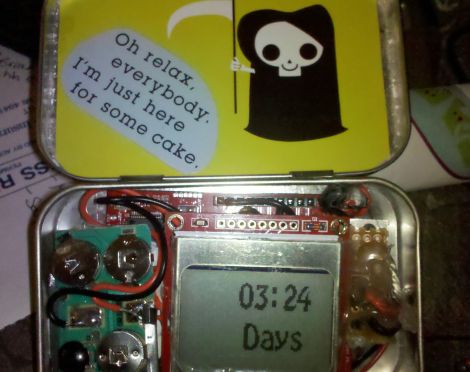
[Ryan’s] uncle is going to be turning 50 shortly, and in the interest of good-natured fun, he has constructed a handy birthday countdown timer for his uncle, lest he forget (or tries to avoid) the big day.

The device displays the amount of time left before his uncle’s birthday, playing an audio clip of “Don’t fear the Reaper” when the clock strikes 00:00. This is accomplished by using the MSP430’s internal clock to keep time, while also interfacing with a Nokia 3310 LCD panel to display the countdown timer. The music is provided by the circuit board from a greeting card he gutted for the project, which was wired to the LaunchPad in order to be triggered at the right moment. Everything was crammed inside an Altoids tin, as you can see in the picture above.

Though not overly complicated, it’s a fun little project, and we’re hoping his uncle gets a big kick out of it. Once his birthday has come and gone, [Ryan] plans on converting the piece into a permanent desktop clock for his uncle.

Keypad Input Scanning By A 555 Timer

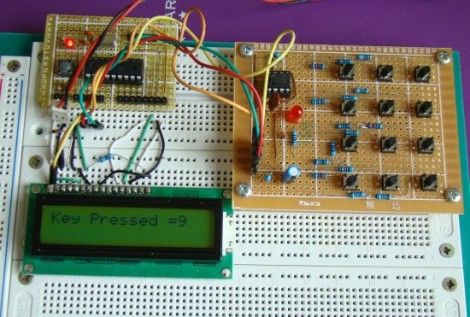
[R-B] designed a 555 timer circuit to scan a keypad. Keypads are common interfaces for small projects and require row and column scanning by a microcontroller. [R-B’s] setup allows you to reduce the number of pins used on the microcontroller to just two. One is an interrupt that is triggered when any of the buttons are pushed, the other reads the frequency from the 555 chip. Each button has its own resistance which alters the frequency of the 555. The microcontroller reads the frequency for 100ms using a timer. The number of timer overflows that occur during that period directly correspond to the button press (five overflows for the numeral 5, zero overflows for the numeral zero).

We usually debounce our button presses for 40 ms, this is more than twice that amount of time but still not a staggering difference. It does make us wonder if you will miss quick button presses? The only really way to know is to try this out yourself. Check out the video after the break and don’t forget to leave a comment with your own experiences in working with the circuit.

Continue reading “Keypad Input Scanning By A 555 Timer”

Electronic Watering Can

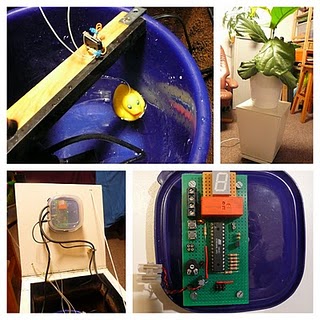
When [Deddies lab] was looking to keep their (rather large) Ficus Lyrata appropriately watered, they followed their motto, stuck a micro controller on it and whipped up an Electronic Watering Can .

The whole thing starts off with power that is switched on once a day for 15 minutes by a traditional mechanical lamp timer, and that is connected to a atmega8 micro controller running @ 1MHz which increments a counter by one. When that counter hits 7 the mega switches on a pump, watering the plant with roughly half a liter of water per week out of a bucket reservoir , which according to the article’s calculations should last about 4 months.

In order to assure that the pump does not run out of water a rubber duck was attached to a string, the other end is attached to a micro switch, and when the water gets too low the string is pulled, switching one of the micro controller’s pins low.

While we agree that it could use a low water indicator, that is trivial to add, and over all the project represents a great hack done on a Sunday using parts and materials already on hand. Join us after the break for a quick video too!

Continue reading “Electronic Watering Can”

Charging Timer For R/C Batteries

arduino_controlled_socket

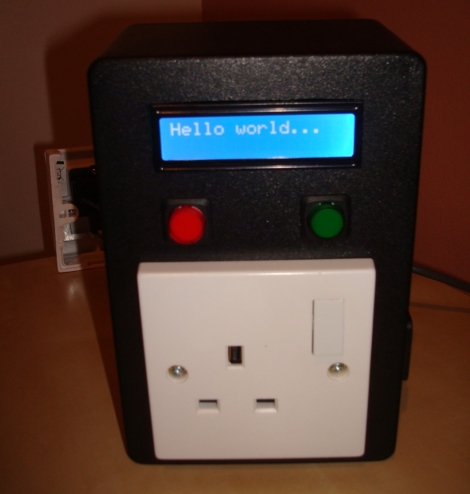
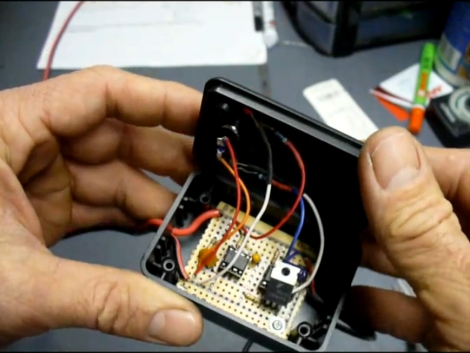
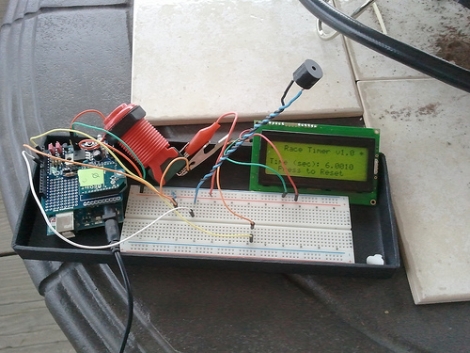
Santa brought [Quinten’s] son a shiny R/C truck for Christmas, but this new toy had one drawback – its batteries could only be connected to the charger for a maximum of 6 hours, lest he turn his house into a pile of smoldering ash.  With grave warnings from the manufacturer dancing in his head, he searched around for a timer that would allow him to cut power to the battery after charging for its allotted time.  Coming up empty, he decided to create his own timed electric socket regulated by an Arduino he had sitting around.  He grabbed a project box and wired up a nice looking socket timer, complete with an LCD status display.  To make things easy for his son, he added two buttons to the front of the controller – one for selecting the amount of charging time, and one to set the timer in motion.  As with his previous hacks, [Quinten] has provided plenty of documentation in the form of pictures, code, and even a video of the timer in action.

$20 Fuel Injector Tester

[Dino] is an auto mechanic and needed a way to test out fuel injectors. Commercially available tools start well over $100 and go up from there, but he built his own for about $20.

The injectors have a coil in them that needs to be tested. His design calls for a series of 0.008 millisecond pulses to test the coil. He started by setting up a 555 timer to output a one second pulse. This signal is fed into a second 555 chip that outputs the 0.008 pulses and in turn actuates a MOSFET to switch the coil on and off. To use it [Dino] connects to a 12V bench supply and to the injector, using a single button to start the test. See him explain the setup in the video after the break.

Continue reading “$20 Fuel Injector Tester”

Talking Poker Timer

[youtube=http://www.youtube.com/watch?v=k8iIuPnXzm8]

This interesting box of buttons is a talking poker tournament timer. Full of useful tools like a binary time display, words of wisdom, countdowns to the end of the game, and even good old “bicycle built for two” mode (around 1:20).  While we find it fairly difficult to understand, we applaud the feature list, especially the song.  He used an Arduino with a voice shield, so there’s not much to the electronics side, but you can download his source code from his site.

[via Makezine]

Biosphere Lighting

Sometimes, sitting in a windowless office can drive you crazy. Adding a little bit of life and color can really help. [Gripen40k] did this by building a biosphere. He didn’t have any windows though, so he made an LED light on a PIC based timer. What is interesting is what he did with a thermistor. The Cree LED bulb that he salvaged was going to be submerged in the water, so he had to do some workarounds to keep from over heating the biosphere. Read the project log for more details.