Snapshot of topology analysis

Designing PLA To Hold Over A Metric Ton

There’s never been such a thing as being “too competitive” when it comes to competition. This is something that [Tom Stanton] from “Tim Station”, [Tom]’s 2nd channel, took to heart for Polymaker’s 3D design challenge. The goal was simple: a single 3D printed part to hold as much weight as possible.

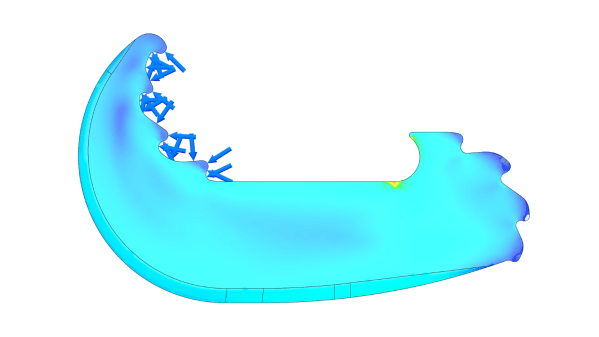
While seemingly simple, when considering the requirements, including a single print in addition to being able to open up for the mounts, the challenge gets exponentially more complicated. While the simplest and strongest joint would be a simple oval for uniform stress, this isn’t possible when considering the opening requirements. This creates a need for slightly more creativity.

[Tom] starts out with two flat C-shaped geometries to test his design. The design includes teeth specially placed to allow the forces to increase their own strength as force is applied. Flat features have the unfortunate quality of being able to slide across each other rather easily, which was the case during testing; however, the actual structures held up rather well. Moving onto the final design, including a hollow cavity and a much thicker depth, showed good promise early on in the competition, leading up to the finals. In fact, the design won out over anything else, getting over double the max strength of the runner up. Over an entire metric ton, the piece of plastic proved its abilities far past anything us here at Hackaday would expect from a small piece of PLA.

Design can be an absolute rabbit hole when it comes to even the simplest of things, as shown with this competition. [Tom] clearly showed some personal passion for this project; however, if you haven’t had the chance to dive this deep into CADing, keep sure to try out something like TinkerCAD to get your feet wet. TinkerCAD started out simple as can be but has exploded into quite the formidable suite!

Continue reading “Designing PLA To Hold Over A Metric Ton”

Stretching The Flight Time On A Compressed Air Plane

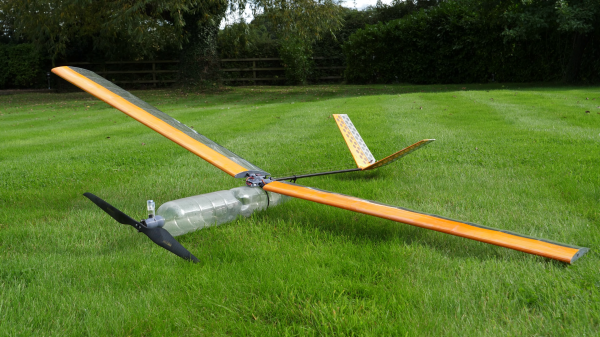
[Tom Stanton] has been experimenting with compressed air motors on model aircraft for a good few years, but keeping them aloft (and intact) for more than a few seconds has proven a tough nut to crack. His latest design represents a breakthrough — pulling off an impressive 1 minute and 26 seconds flight on 4 liters of compressed air.

The model incorporates an enhanced engine design featuring an expanding seal on the piston, a concept inspired by the old Air Hogs toy plane. For the airframe, he constructed lightweight wings using 3D printed ABS ribs on a carbon spar and reinforcing rods, all of which were wrapped in heat shrink film. Additionally, [Tom] incorporated a thin balsa former along the leading edge of the wing to help maintain its shape. The fuselage is also composed of a carbon fiber tube, and is outfitted with printed fittings to install the wings, V-tail, RC electronics, and soda/air bottles. A hollow nylon bolt holds the two bottles together end-to-end while allowing the motor to be screwed directly onto the front bottle. To conserve weight, each of the two V-tail control surfaces are actuated by single cables linked to servos, with piano wire torsion springs in the hinges to maintain tension

Despite successful flights, [Tom]’s trials were not without challenges. One crash threatened severe damage to his airframe, but thanks to a central 3D printed bracket that absorbed most of the impact, total destruction was avoided. Similarly, a printed shaft saved his expensive carbon fiber propeller from being damaged during multiple landings, an outcome that led [Tom] to devise a readily replaceable consumable connector.

A second video after the break offers a behind-the-scenes insights into this project including some fascinating technical details. For more on this project’s history, take a look at the initial diaphragm engines and his attempts to make them fly.

Continue reading “Stretching The Flight Time On A Compressed Air Plane”

A Guide To 3D Printing Model Aircraft Wings

The exact airfoil shape of a wing has a massive effect on the performance and efficiency of an aircraft and will be selected based on the intended flight envelope. If you’re moving beyond foam board wings, 3D printing is an excellent way to create an accurate airfoil, and [Tom Stanton] provides us with an excellent guide to modeling wing sections for easy printing.

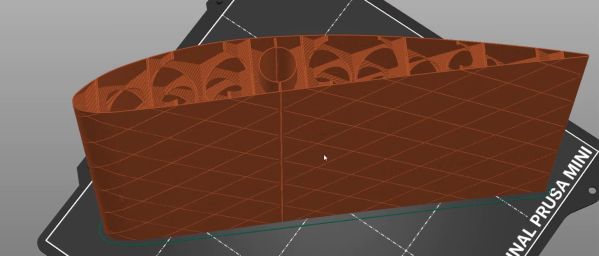
[Tom] used the process demonstrated in the video after the break to create the wing for his latest VTOL RC aircraft. It was printed with lightweight PLA, which can ooze badly when it stops extruding. To get around this, he designed the wings and their internal ribs to be printed in one continuously extruded line.

He wanted a wing that would allow a smooth transition from hover to forward flight, and used the Airfoil Tools website to find and download the appropriate airfoil profile. After importing the profile into Fusion 360, he created internal ribs in a diagonal grid pattern, with lightening holes running along the length of the wing. A cylinder runs along the core of the wing to fit a carbon fiber wing spar. The ribs are first treated as a separate body in CAD and split into four quadrants. When these quadrants combine with the outer shell, it allows the slicer to treat the entire print as a continuous external perimeter line using “vase mode“.

These steps might seem simple, but it took about 3 weeks of experimentation to find a process that works. It’s primarily intended for straight wings with a continuous profile, but it should be adaptable to tapered/swept wings too. A well-designed airframe is essential when pushing aircraft to the edge of efficiency, like solar-powered plane to fly overnight.

Continue reading “A Guide To 3D Printing Model Aircraft Wings”

Optimising An RC Tilt-Rotor VTOL

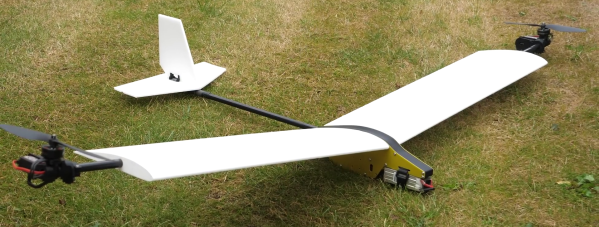
There are a variety of possible motor configurations to choose from when building a fixed-wing VTOL drone, but few take the twin-motor tilt-rotor approach used by the V-22 Osprey. However, it remains a popular DIY drone for fans of the military aircraft, like [Tom Stanton]. He recently built his 5th tilt-rotor VTOL and gave an excellent look at the development process. Video after the break.

The key components of any small-scale tilt-rotor are the tilt mechanism and the flight controller. [Tom]’s tilt mechanism uses a high-speed, high-torque servo that rotates the motor mount via 3D printed gear mechanism. This means the servo doesn’t need to bear the full load of the motor, and the gearing can be optimized for torque and speed. [Tom] also used the tilting motors for yaw and roll control during forward flight, which allows him to eliminate all the other conventional control surfaces except for the elevator.
Continue reading “Optimising An RC Tilt-Rotor VTOL”

Supercapacitor E-Bike With DIY Motor

Supercapacitor technology often looks like a revolutionary energy storage technology on the surface, but the actual performance numbers can be rather uninspiring. However, for rapid and repeated charge and discharge cycles, supercaps are hard to beat. [Tom Stanton] wanted to see if supercaps have any practical use on e-bikes, and built a DIY electric motor in the process.

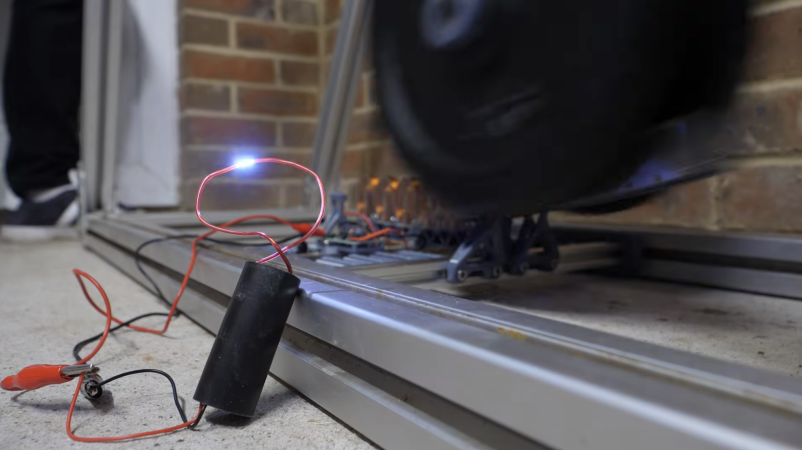
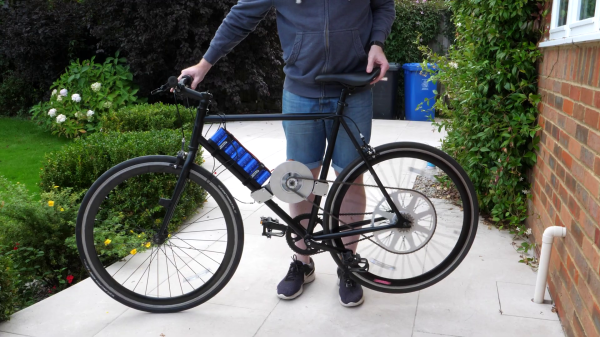
One of the problems with supercaps is the rapid voltage drop during discharge compared to batteries, which can limit the amount of usable energy. In an attempt to get around the voltage limitation, [Tom] built his own axial flux motor for the bike, using 3D printed formers for the coils and an aluminum rotor with embedded magnets. He expected torque to be severely limited, so he also machined a large sprocket for the rear wheel. He built a capacitor bank using six 2.7V 400F supercaps, only equivalent to the capacity of a single AA cell. Although it worked, the total range was only around 100 m at low speed. When he hooked the motor up to a conventional battery, he did find that it was quite usable, if a bit underpowered.

The controller for the DIY motor was not capable of doing regenerative braking, so he fitted the capacitors to another e-bike that does have regenerative braking. Using this feature, he was able to reclaim some power while slowing down or going downhill. Since this type of charging cycling is what supercaps are suited for, it worked, but not nearly to the level of being practical.

[Tom]’s projects are a popular feature here on Hackaday, and he has also experimented with supercaps in RC “rockets” and a flywheel for energy storage on the same bike.

Continue reading “Supercapacitor E-Bike With DIY Motor”

Pelton Turbine Development For An Air Powered Model Helicopter

[Tom Stanton] has been messing around with compressed air power for a few years now, and most of his work focused on piston engines. He likes using 2-liter soda bottles as lightweight tanks but their capacity is limited, so the nozzle can be a maximum of 1 mm in diameter if he wants to produce thrust for 30 seconds or longer using a turbine. Pelton turbines have been in use for a long time, especially for hydroelectric systems, and they use small diameter nozzles, so he decided to experiment with a pneumatic Pelton turbine. (Video, embedded below.)

Pelton wheels are water wheels with specially designed buckets to efficiently extract energy from a high-velocity jet of water. [Tom] 3D printed several geared Pelton turbines and started doing bench tests with a propeller and a load cell to gather empirical data. With the help of high-speed video of the tests, he quickly realized that the turbine efficiency is highly dependent on the load. If the load is too small or too large, the moving air will not come to a complete standstill, and energy will be wasted. [Tom] also suspected that some moving air was escaping from the bucket, so he created a version that enclosed the buckets with a ring on the outer perimeter, which increased the peak thrust output by 65%. Compared to his diaphragm air engine design, the peak thrust is higher, but the overall efficiency is less. [Tom] believes there is still room for improvement, so he plans to continue working on the Pelton turbine concept, with the hopes of building an air-powered model helicopter that can lift off. Continue reading “Pelton Turbine Development For An Air Powered Model Helicopter”

Diaphragm Air Engine

One of the tricky parts of engineering in the physical world is making machines work with the available resources and manufacturing technologies. [Tom Stanton] has designed and made a couple of air-powered 3D printed engines but always struggled with the problem of air leaking past the 3D-printed pistons. Instead of trying to make an air-tight piston, he added a rubber membrane and a clever valve system to create a diaphragm air engine.

This GIF is worth 115 words

A round rubber diaphragm with a hole in the center creates a seal with the piston at the top of its stroke. A brass sleeve and pin protrude through the diaphragm, and the sleeve seals create a plug with an o-ring, while the pin pushes open a ball which acts as the inlet valve to pressurize an intermediate chamber. As the piston retracts, the ball closes the inlet valve, the outlet valve of the intermediate chamber is opened, forcing the diaphragm to push against the piston. The seal between the piston and diaphragm holds until the piston reaches its bottom position, where the pressurized air is vented past the piston and out through the gearbox. For full details see the video after the break.

It took a few iterations to get the engine to run. The volume of the intermediate chamber had to increase and [Tom] had to try a few different combinations of the sleeve and pin lengths to get the inlet timing right. Since he wanted to use the motor on a plane, he compared the thrust of the latest design with that of the previous version. The latest design improved efficiency by 366%. We look forward to seeing it fly! Continue reading “Diaphragm Air Engine”