Those USB TV Tuners Used For SDR Can Also Grab GPS Data

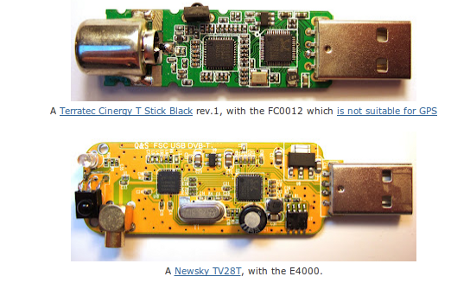
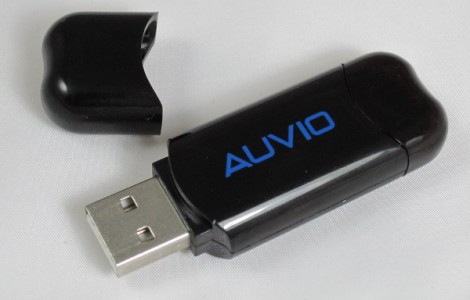
Talk about versatile hardware. These inexpensive TV tuner dongles can also grab GPS data. You may remember seeing this same hardware used as a $20 option for software defined radio. But [Michele Bavaro] decided to see what other tricks they could pull off.

Would it surprise you that he can get location data accurate to about 20 centimeters? That figure doesn’t tell the whole story, as readings were taken while the dongle was stationary for three hours, then averaged to achieve that type of accuracy. But depending on what you need the data for this might not be a problem. And [Michele] does plan to implement real-time GPS data in his next iteration of the project. He plans to use an SDR acquisition algorithm to measure doppler shift in accounting for the slow clock speed of the dongles compared to standard GPS receivers. We can understand how that would work, but we’re glad he has the skills to actually make it happen because we’re at a loss on how the concept could be implemented.

[via Reddit]

Automated Turntable Photography

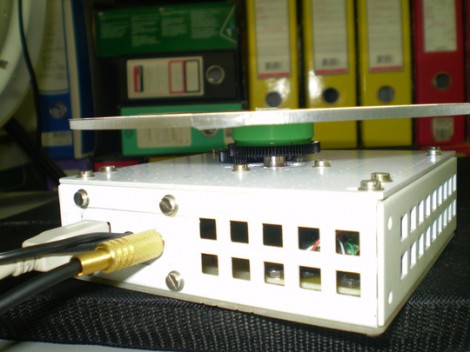
[Muris] has a friend who is selling items on the internet. This friend wanted a simple way to make rotating images of the products and asked him to help. The result of his labors is this base unit that drives the turn table and controls the camera.

The first iteration of the turntable was powered by the stepper motor from a floppy drive. A disc was mounted directly on the motor spindle, but the results were a bit poor. This is because the motor had a fairly low resolution of 200 steps per rotation. That doesn’t allow for smooth animation, and there was a lot of vibration in the system. An upgrade to the geared system you see above included swapping out that motor for one from an old scanner. Now it achieves 1200 steps per rotation and the vibration is gone.

The connectors seen in the base are USB, incoming power, and shutter control. [Muris] wrote a program to control the PIC 16F628A inside the base. The program sends commands via USB and has parameters for number of frames per rotation, direction of rotation, and the like. Set it up as desired, place the product on the turntable, and hit start. Unfortunately there’s no video of this in action because [Muris] gave it to his friend as soon as it was finished. We guess the fact that he didn’t get it back means it’s working great.

If you don’t mind some rough edges and exposed wiring you can throw a system of your own together pretty quickly.

PS3 IR Dongle Tamed For Use With A Linux Box

So a man walks into a Radio Shack and the clerk says “Why the long face?”. No, that’s not it. [Ms3fgx] walks into a Radio Shack and says “holy crap, that PS3 IR dongle is only two bucks”. He’s been looking for an IR remote receiver to use with a Linux machine and decided to bend this PS3 dongle to his will. It’s a lot less expensive that the parts to build the simplest IR receivers like this FTDI cable version, or a microcontroller based receiver.

He plugged it in and was delighted to find that it enumerates. The kernel has PlayStation 3 controller support built-in and has no problem picking up this device. When he uses ‘cat’ to display the incoming data all he gets is repetitive garbage. This is because the dongle only supports Sony remote control codes. But after a bit of universal remote setup, he’s got unique commands for each button. The last piece of the puzzle is to map the controller commands to keyboard keys. This is done with the QJoyPad package, but there are a myriad of ways to remap these buttons so go with what you know.

Coin Cell Battery Charger

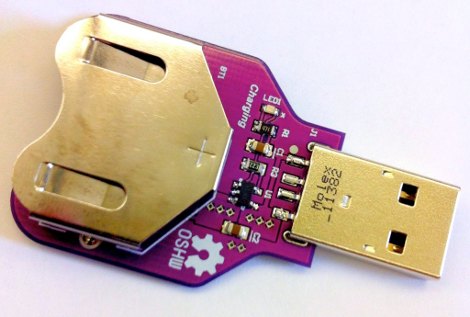
[Jay Kickliter] built his own coin cell battery recharger. This won’t work on the vast majority of coin cells as they are manufactured as disposable parts. But there are rechargeable options out there with model numbers that start with LR instead of CR. In this case he tailored the charging circuit around MCP73832 IC and chose components best suited for charging his 110 mAh LR2450. But we believe all of the LR options out there are rated for 3.6V so altering his design for use with different models should be a breeze.

We’ve been unhappy with the use of disposable coin cell batteries for some time. Sure, in a real-time clock where the cell might last 6-8 years this is not very wasteful. But in an Apple TV remote that gets a lot of use, we hate the choice of a disposable battery. All of our less-hip remotes which use AA or AAA have NiMH rechargeables in them and have used the same pair for year and years. So we’re happy to see this charger project come along.

Now the bad news. We looked around and indeed you can find LR2032; a rechargeable replacement for the CR2032. But the capacity rating falls way flat. The model we looked at boasts only 50 mAh while the disposable CR2032 offers something along the lines of 240 mAh. Hopefully this will change as battery tech evolves.

Software Defined Radio From A USB TV Capture Card

With a simple digital TV USB capture card, you can build your own software defined radio or spectrum analyzer. While it may not be as cool as [Jeri Ellsworth]’s SDR, it’s still very useful and only requires $20 in hardware.

The only piece of hardware required for this build is a USB FM/DTV capture device with the Realtek RTL2832U chipset. So far, two USB sticks have been tested and the unit with the largest frequency range (64 – 1700 MHz) is available direct from China for $20.

Turning these cheap capture cards into software defined radios and spectrum analyzers was discovered by [Antti Palosaari] after sniffing the device. These cards demodulate the frequency and send all the data to the computer and is decoded via software. If you have one of these capture cards lying around, you can grab the software and load it up on your *nix box. Right now, the software only writes directly to a file, and may drop a few samples if writing to a hard disk instead of ram. Small problems, but we’re sure this project will pick up steam in the very near future.

via reddit

From Reference Design To USB Sound Card

[Entropia] decided to try his hand at rolling is own sound card. He picked out a DAC chip, started his prototyping by studying the reference design from the datasheet, then went through several iterations to arrive at this working model.

He chose to base the board around the PCM2706. It’s a digital to analog converter that has built-in USB support; perfect for his needs. It’s got a headphone amplifier, but is also capable of putting out S/PDIF signals for a digital amplifier to pick up and use. Not bad for a part that can be had for right around eight bucks.

The first PCB he designed had a few electrical and footprint errors. But he was able to get it to run by adding some point-to-point jumpers, and bending the legs of his capacitors to fit the board area. With those issued accounted for he ordered a second batch of boards. These went together nicely, but the headphone output was incredibly loud. Turns out the filtering circuit had the wrong resistor and capacitor values. Changing them around, and swapping the audio output so that the correct channels were patched to the audio jack brings it to the first release version seen above.

Build Your Own USB To Serial Dongle

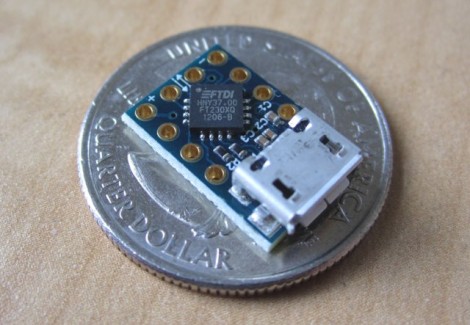
[Johan von Konow] found that he was using an FTDI USB-to-Serial chip in a lot of his projects and wanted to have an easy prototyping component on hand to facilitate this. What he came up with is the extremely small USB to serial dongle seen above. The copper fingers are designed to plug into your USB port. And if you’ve got an unused thumb drive (we’ve got a 128mb version that’s been collecting dust for years) it would make a perfect enclosure for the device.

He’s using an FT232BL chip in a LQFP-32 package. That’s got 0.8mm pitch so make sure you’ve got a steady hand, a fine tipped soldering iron, and some solder wick on hand. The 0603 passives might also give you a bit of a run-around during soldering, but all-in-all we think everyone will be able to successfully assemble this with a little bit of practice. The chip is the most expensive component at just under $6. But the good news is that the board is single sided and only needs one jumper wire making for very little drilling and easy home fabrication.

If you’re putting in a parts order, we’d recommend getting doubling the amount of resistors and capacitors. Chances are you’ll drop a few and nary will they be seen again. We also highly recommend looking into [Gerrit’s] surface mount component clamp.