Living The Dream: New PCB For A Dirt-Cheap Calculator Watch

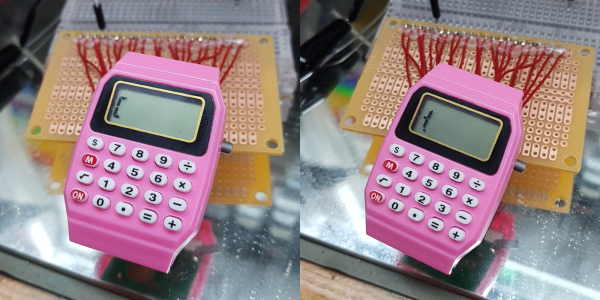
Well, this hack has us tickled pink. We love the idea of buying some really cheap piece of technology and doing something amazing with it, and this is a textbook example of that. [davedarko] found the cutest little calculator watch on Ali Express and is working on making a new PCB for it. The plan is to use an ARM processor and Arduino and add a few extras like 24-hour mode and a pink (or potentially RGB) backlight. The new brain will be an ATSAML22G18A, which has an on-board LCD controller and exactly one I/O pin to spare without charlieplexing the buttons.

One of [davedarko]’s primary goals is to keep the LCD and figure out how to talk to it. The first order of business was reverse engineering the watch’s LCD controller by sussing out the secrets from beneath the black blob of epoxy. This was an eye-opening experience as [davedarko] had never worked directly with LCDs before. A strange reading made him bust out the oscilloscope. Long-ish and informative story short, [davedarko] found out that it uses a bias of 1/2 for generating the wave necessary to multiplex the segments and keep the signal alternating. This is definitely one to watch!

We love timepieces around here and have seen all kinds of hacks, especially on Casio watches. Want dark mode? Done. Enable the hidden countdown timer? We’ve got that, too. And have you ever wondered just how water-resistant the F91W is?

Modding A Casio W800-H With A Countdown Timer

Stock, the Casio W800-H wristwatch ships with dual time modes, multiple alarms, and a stopwatch – useful features for some. However, more is possible if you just know where to look. [Ian] decided to dive under the hood and enable a countdown timer feature hidden from the factory.

The hack involves popping open the case of the watch and exposing the back of the main PCB. There, a series of jumpers control various features. [Ian]’s theory is that this allows Casio to save on manufacturing costs by sharing one basic PCB between a variety of watches and enabling features via the jumper selection. With a little solder wick, a jumper pad can be disconnected, enabling the hidden countdown feature. Other features, such as the multiple alarms, can be disabled in the same way with other jumpers, suggesting lower-feature models use this same board too.

It’s a useful trick that means [Ian] now always has a countdown timer on his wrist when he needs it. Excuses for over-boiling the eggs will now be much harder to come by, but we’re sure he can deal. Of course, watch hacks don’t have to be electronic – as this custom transparent case for an Apple Watch demonstrates. Video after the break.

Continue reading “Modding A Casio W800-H With A Countdown Timer”

The IEEE Builds A Smart Watch

It used to be that building your own watch was either a big project or it meant that you didn’t really care about how something looked on your wrist. But now with modern parts and construction techniques, a good-looking smart watch isn’t out of reach of the home shop. But if you don’t want to totally do it yourself, you can turn to a kit and that’s what [Stephen Cass] did. Writing in IEEE Spectrum, he took a kit called a Watchy and put it through its paces for you.

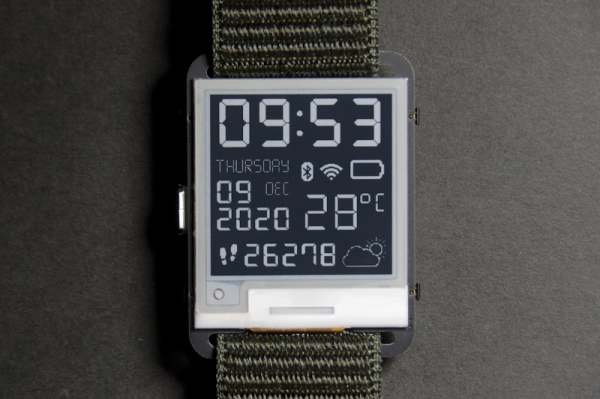
Watchy is an open source product that uses an ESP32, an E-ink display, and costs about $50. The display is 1.5 inches — good enough for a watch — and it has a real time clock, a vibration motor, an accelerometer, and four buttons. The whole thing runs on a 200 mAh lithium polymer battery. The charger is microUSB and you can also upload software to it using the usual Arduino tools.

However, [Stephen] found that none of the examples he tried would work at first. He found problems with the Mac software, but he also had problems under Windows. The answer? Switching to a Raspberry Pi seemed to work and once the watch was wiped clean, the Mac tools would work, too. It sounds like this isn’t a common problem, but he has to erase the watch with the Pi before each programming cycle.

Unlike a normal Arduino program, all the work in a typical Watchy program happens in setup() so the watch can mostly sleep and it updates the 200×200 typically just once a minute. As an example, [Stephan] wrote a watch face that uses an old Irish alphabet to tell time. He plans to add code to grab online data, too, and the phone has support for connecting wirelessly and parsing JSON to make tasks like that easier.

We always thought the EZ430-Chronos was a good-looking watch, but its screen is dated now. You can also pick up a lot of cheap import watches that can be hacked.

Apple Watch Gets Custom Transparent Case

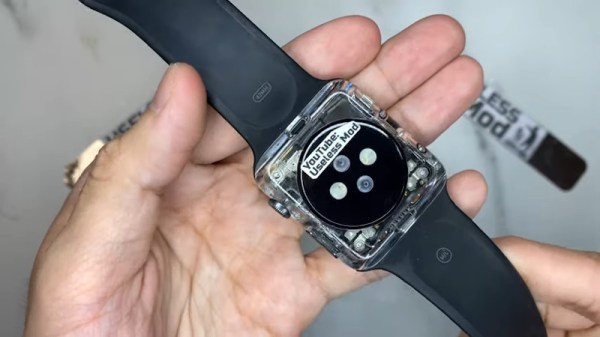
The Apple Watch was the tech company’s attempt to bring wrist computers into the mainstream. It’s naturally available in a variety of fits and finishes, but if you want something properly original, you’ve got to go custom. [Useless Mod] does just that with a clear case for the popular smartwatch.

The mod starts with a patient, careful disassembly of the watch – necessary given the delicate components inside. It’s achieved in the end with only having to drill out 1 screw and an unfortunately snapping of the crown wheel axle. However, [Useless Mod] presses on, and silicone casts the original Apple enclosure. The video goes over all the finer points, from degassing to using strips of acrylic plastic to act as runners. Once done, the silicone mold is used to produce a replica case in transparent epoxy, and the watch is reassembled.

The final result is impressive, with the case optically clear and showing off the watch’s internals. The look is improved by removing some of the original insulation tape to better reveal the PCBs inside. Unfortunately, the design of the watch, which is largely covered by a screen and heartbeat sensor, means it’s not the greatest choice for a clear case mod, but it works nonetheless. We’ve seen similar work before from [Useless Mod] too – like this transparent drone case for the Mavic Mini. Video after the break.

Continue reading “Apple Watch Gets Custom Transparent Case”

Rolex Becomes World’s Most Expensive ESD Strap

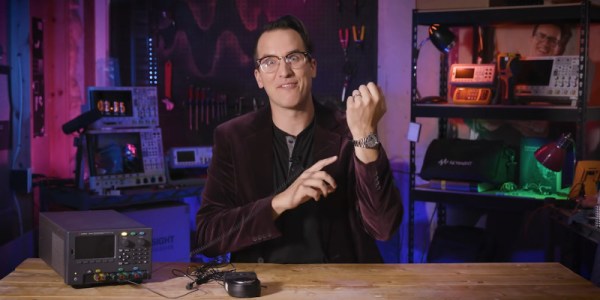
Anti-static ESD straps are de rigueur in lab settings for those working with sensitive electronics. They’re a simple protective device, and one that generally doesn’t warrant a second thought. However, [Daniel Bogdanoff] figured they could stand to be a little more fashionable, and set to work on a fancier design.

The first step was to take a look at a regular ESD strap. Typically, they consist of a band that fastens around the wearer’s wrist, with a metal stud for connecting to the earthing lead. The earthing lead contains a high resistance to limit the discharge current to avoid ugly high-energy shorts when wearing the strap.

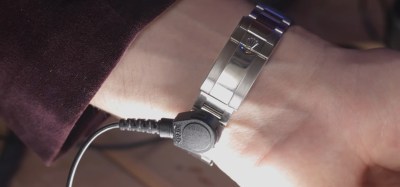
The metal stud is attached to a replacement link on the ROLEX’s strap, making the modification neat, tidy, and reversible.

With a good understanding of the basics, [Daniel] set about modifying a CASIO calculator watch for practice. After soldering a metal stud to the watch case failed, a second attempt with conductive epoxy worked great. The watch could be connected to the earthing strap, and an ESD tester confirmed the device was doing its job.

But unfortunately, permanently modifying the borrowed ROLEX wasn’t an option. Instead, [Daniel] limited his work to a single replacement link which could be inserted into the watch band. Hooked up to an earthing strap, the luxury watch also passed a basic ESD test successfully.

[Daniel] notes that while this is a fun experiment, using properly rated safety equipment is best. Additionally, he points out that the ROLEX is likely to do worse than the CASIO for the simple fact that a metal-banded watch is more likely to cause shorts when working on electronics. Of course, if a watch isn’t your thing, consider a ring instead. Video after the break.

Continue reading “Rolex Becomes World’s Most Expensive ESD Strap”

Watch Winder Keeps Your Timepieces Ticking

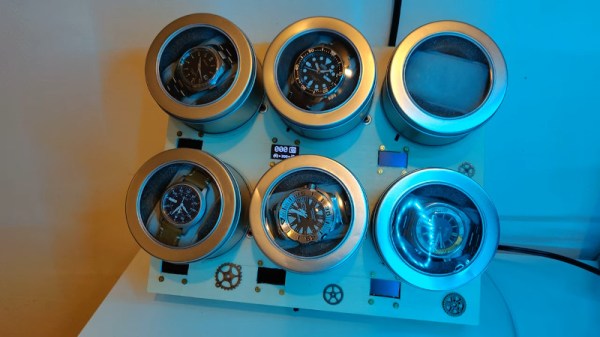
Mechanical watches are triumphs of engineering on a tiny scale. Capable of keeping time by capturing the energy of the user’s own movements, they never need batteries changed. Unfortunately, they quickly lose time when not worn for a few days. To solve that problem, [sblantipodi] built a smart watch winder.

The overall build consists of six individual winder units. Each one has an ESP8266EX D1 Mini microcontroller, hooked up to a 28BYJ48 stepper motor with a ULN2003 motor driver. There’s also an OLED screen for status information. When commanded, the stepper motor turns, rotating a watch case to wind the timepieces. Control is via voice command, thanks to a Google Home Mini and a Raspberry Pi running Home Assistant. Watches can be wound individually, or all together, depending on the command given.

It’s a device that would serve any collector well, and could come in handy for watchmakers to wind customer watches waiting for pickup. Other similar builds have used special silent drives to ensure the device doesn’t disturb sleep when used on a bedside table. Video after the break.

Continue reading “Watch Winder Keeps Your Timepieces Ticking”

An Off-The-Grid Instant Messaging Plattform

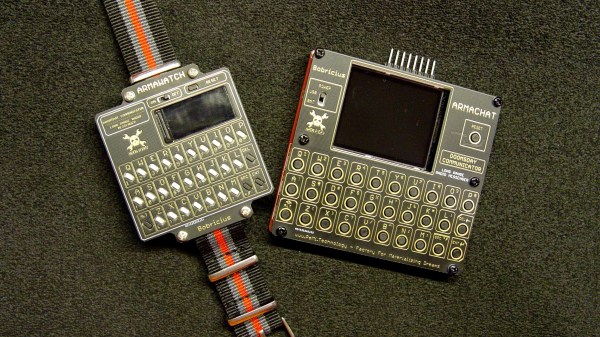
Having an open-source communication device that is independent of any network and works without fees sounds like a hacker’s dream come true. Well, this is exactly what [bobricius]’ is aiming at with his Armawatch and Armachat devices.

Recently, [bobricius] built a LoRa based instant messaging device named Armachat. The gadget is controlled by a SAMD21 MCU with native USB and includes a QWERTY keyboard and an LCD display. Communication is based on an RFM95 LoRa transceiver which can reach a range of up to 2 km under ideal conditions. [bobricius] is a wiz when it comes to PCB design and one thing that makes his projects look so good is how he often uses PCBs as enclosures.

Armachat came in two form factors a large desktop and a smaller pocket version. The new Armawatch is another downsized version that perfectly fits on your arm by using a smaller display and keyboard. [bobricius] also did a lot of work on the firmware which now features a message delivery confirmation and the possibility to automatically resend undelivered messages. Future improvements will include message encryption, a store-and-forward function, and GPS position parsing. [bobricius] is also working on completing his portfolio of communicators with a credit-card-sized version.

LoRa is the go-to technology for off-the-grid communication devices and there are already other ongoing projects for using it to construct a mesh network.