posted Dec 8th 2010 4:00pm by
Joseph Thibodeau
filed under:
home hacks,
misc hacks

There are already a lot of different ways to brew up a decent coffee at home, from the humble saucepan to the elegant vacuum flask. In an office environment the choice of coffee-making technique can have a major impact on workplace harmony—how can people be expected to work happily when the kitchen is filthy with grounds and the coffee is always stale? “Someone have mercy,” [Christian Finger] lamented, “and boil a pot of fresh.”
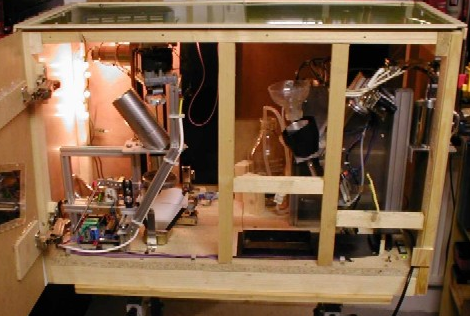
In the end he took extreme measures, building a machine that grinds whole beans, measures out a dose, brews a cup and self-cleans. He used all sorts of odds and ends to put the thing together, detailed in his long and hilarious build log (english translation—and check out the dude’s sweet ride). Refer to his shockwave animation for a summary of the intended operation.
The end result is an extremely impressive Goldbergian contraption—download the video from the build log. It is pretty noisy and probably energy- and water-hungry, but that wouldn’t stop us from using it every day, if given the chance. Hell, this here could form a major part of your next breakfast machine.
We’re sure that there is further potential in this, because to get the really freshest possible cup of coffee you’d want to roast the coffee beans just before grinding them. Then you’d be well on your way towards something else entirely: a delicious breakfast machine.
posted Dec 3rd 2010 8:30am by
Joseph Thibodeau
filed under:
chemistry hacks,
green hacks,
wearable hacks

We know that you can transform the mechanical motions of your body into electrical energy, like when you turn the crank or shake a mechanically-powered flashlight. These types of mechanical motions are quite large compared to many of the day-to-day (and minute-to-minute) actions you perform–for example walking, breathing, and thumb wrestling.
What if we could harvest energy from these tiny movements? Researchers at the Korea Advanced Institute of Science and Technology are seeking the answer to this question with piezoelectric barium titanate. The electrical output of their devices is very small (in the nanoAmps) but over a long period and over many repetitions it would be possible to run a small electric device–even a biologically-embedded one. An alternative to blood power?
There is clearly a lot of potential in this technology, and we’ll be interested to see if and when we can start messing around with this stuff. Heck, it’s already been used to power a small LED and you all know just how much everyone would jump at the chance to cover themselves in self-powered LEDs…
posted Dec 3rd 2010 7:28am by
Joseph Thibodeau
filed under:
robots hacks

Oberon is a wheeled remotely operated vehicle that [LucidScience] built based on an electric wheelchair. The detailed and helpful build log is valuable enough even before considering the vast potential of Oberon’s intended use: strutting around town, scaring the neighbours.
We’ve seen other ROVs before, of course, but none with the same kind of War of the Worlds “real-life invasion” kitch. Running down hapless pedestrians or raining hell upon your enemies are great and all, but once you’ve destroyed the surrounding population you’re out of laughs. Not so with Oberon, with which you can convince Mr. Nutcase down the road to go on wild quests for the glory of the new robot empire. The fun doesn’t stop there–enjoy the Hubbard side of life by starting a cult to worship the great Oberon and enjoy decades of financial payoff and moral depravity…all from the comfort of your own living room!
It would be wicked rad if we could move forward with this idea by combining the abilities of specialized ROVs like this camera-bot and this termite-killer-bot. Face it, who wouldn’t want a smooth-talking camera-snapping chemical-spraying avatar for christmas?
posted Nov 28th 2010 2:00pm by
Joseph Thibodeau
filed under:
classic hacks,
robots hacks

Tentacles have inspired fear and respect in humans long before anime came into the scene. Sailors shivered in their timbers at the thought of the great Kraken, or that octopus from 20,000 Leagues Under the Sea. It’s no surprise to know that humans have been trying to harness this fear and respect in technological form since the mid-20th century at least.
The fascinating world of tentacle robots has come a long way. It used to be that every breakthrough in tentaclebot technology had to be justified with either a military or misogynistic application, as demonstrated in this remarkable MIT project from 1968.
Thankfully our society has moved on since those misguided times, and while there is still the ever-present military-industrial complex to push for tentacled combat-omatons, forward-thinking people on the domestic front like [festo] demonstrate that at least some of us want to use tentacle robots for peace, love and food handling.
Catch the video after the break.
Read the rest of this entry »
posted Nov 25th 2010 2:00pm by
Joseph Thibodeau
filed under:
misc hacks,
security hacks

In the cold and mysterious wilderness of Norway, it pays to be ready for anything–especially heavy-walking trolls. The team at [nullohm] decided to prepare thoroughly for their trek into the woods to witness the Leonids meteor shower by putting together an Arduino-based “troll detector”.
The device is based on the superstition of hammering a steel spike into a tree to keep trolls away from camp. This goes one step further by including an accelerometer and LED indicators so that you can tell exactly what type of troll is just about to feast upon your tender human flesh.
When the detector is installed into a nearby tree, it takes an average seismic measurement and then looks for telltale footfalls. Even if you’re not concerned with perpetuating superstitions, you might find a use for the source code for simple seismic activity monitoring at home to supplement your miniature seismic reflector.
posted Nov 25th 2010 12:00pm by
Joseph Thibodeau
filed under:
robots hacks

It’s always nice to show our appreciation for our elders. Today’s young robots may be whippier, snappier, and go-gettier than their forbears but you have to admit that few of them have the moxie to dust themselves off after 45 years and have a walk around town (although it still wouldn’t qualify for a senior’s discount). George, a British humanoid robot made out of a WWII bomber, was resurrected by his inventor after decades in the garage–and all it took was a little bit of oil and some new batteries. Respect.
George is very impressive, but he’s not the oldest robot by any means. Ever-popular Buddha inspired a Japanese robot some 80 years ago that has recently been updated (pics here)–do robots meditate in solid state?
In a similar aesthetic vein to George, Chinese farmer Wu Yulu made a robotic rickshaw driver, one of his many eccentric projects since the 80s.
Here on hackaday we see a lot of modern robotics, but what about a return to the old school? Next time you have a scrap airplane on hand why not weld together a classic robot, and while you’re at it give your regards to old George.
posted Nov 24th 2010 2:00pm by
Joseph Thibodeau
filed under:
hardware,
tool hacks

[tinhead] has opened up a Tekway DST1102B oscilloscope and doubled its bandwidth to 200MHz, sharing his work in the eevblog forum. This is great news to anyone who is looking for a faster sampling rate but can’t afford the high-end models. Mind you, for a lot of us even these Hanteks and Tekways are hard to afford but there are more appropriate options for the ramen-dependent hacker.
In the hacking guide [tinhead] includes comprehensive information on the different scopes he originally considered (a Rigol, Atten and UniTrend) before settling on the Tekway, as well as links to regional distributors for the hackable scope. Good quality benchtop units are invaluable for development and troubleshooting, and it pays off to understand their inner workings. It’s heartwarming to know that even the tools of hacking can be hacked.
posted Nov 18th 2010 1:00pm by
Joseph Thibodeau
filed under:
contests,
Hackerspaces,
robots hacks

If you’re a member of a hackerspace and you’ve been hoping and wishing for an evalbot to tear apart with your bare hands, you’re in luck! [Dave Bullock] is giving out five evalbots to five lucky hackers chosen at random. We thought that the $125.00 deal we saw the other day was good but this is right outta town!
The draw is on Black Friday, so you’ve got a few days to submit your details. We’ve only had a few posts about the evalbot to-date covering the initial examination of the hardware and a USB power modification. We’re interested in seeing where people take this, and we’d love to follow how each of these free ‘bots turns out. For those already working on an evalbot, keep it up and take lots of pictures!
[Photo credit: Dave Bullock from eecue]