posted Jul 15th 2011 2:13pm by
Mike Nathan
filed under:
arduino hacks,
led hacks,
transportation hacks

Last year, when [Alex] was asked by his friend [Martin] to help him out with building some LED POV modules for a race car, his response was a enthusiastic “YES!”
[Martin’s] goal was to involve fans more deeply in the race, so he decided that the POV modules would carry messages from fans on-board, printing them in the night as the race cars screamed around the track. The pair started prototyping and testing a design, wrapping things up shortly before this year’s 24 hours of Nürburgring.
The modules consist of an Arduino-compatible AVR, a GPS module, a 16-LED light bar, and the circuitry for driving the LEDs. While most of the components are pretty standard fare, the we don’t often see a GPS sensor built into a POV display. [Alex] says that the sensor is used to calculate the speed of the cars, ensuring a uniform font size.
They took their LED displays to the 24 hours of Nürburgring, where they were invited by Audi to install the modules on a pair of R8 Le Mans race cars. As you can see by the pictures on his blog and Flickr set, the POV units worked out nicely without having to stretch the camera exposure times too far.
If you’ re interested to hear a bit more about how the displays were built, check out this entry in[Alex’s] blog, where he goes through some additional details.
Update:[Alex] pointed us to the videos!
posted Jul 10th 2011 7:01am by
Mike Nathan
filed under:
clock hacks

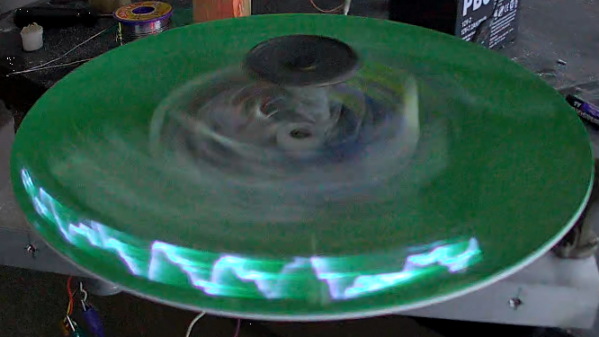
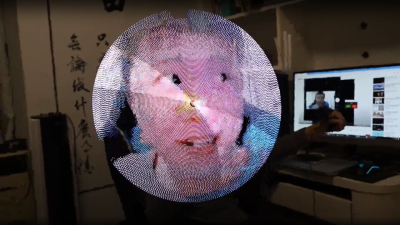
Hackaday reader [svofski] sent in a fantastic looking hard drive-based POV clock (Google Translation) created by a maker in the Sichuan province of China. The clock, like the one [svofski] built, relies on LEDs placed behind the spinning platter to create the POV effect.
Quite a few carefully placed cuts have been made to the platter, which make up the segments required to display both numbers and letters of the alphabet. This isn’t a simple 16-segment POV display however. The font uses a lot of sharp edges and odd segment lengths, so we’re guessing that quite a bit of care was taken in the production of this clock.
You can see a demonstration of the clock in the video embedded below, which shows off its ability to display numbers, text, as well as a handful of simple patterns. It looks like there are some details available on the designer’s site, however it is all in Chinese, and Google’s translation is questionable at best. If only we knew someone that could give us a hand with deciphering the inner-workings of this clock…
Read the rest of this entry »
posted Jun 14th 2011 5:05am by
Mike Nathan
filed under:
arduino hacks

We see lots of persistence of vision projects around here, but we can’t recall any that involve a POV display facilitated by a living, breathing animal (humans aside, if you want to picky). [Michael] has a Miniature Pinscher that just loves to run and run…and run…in circles. Since she generally runs very fast and in large curves, he thought she would make a great POV device.
He has a small fleece “jacket” for his dog, and on it, he mounted a Lilypad Arduino, the associated power supply, and five bright white LEDs. Naturally, conductive thread was used to wire up the circuit, and after a bit of trial and error, things came together nicely.
With the vest complete, [Michael] unleashed his dog at the park, letting her run to her heart’s content. All the while, her vest was writing out [Cory Doctorow’s] “Makers” while he snapped some pictures.
We can’t think of a more appropriate text to write with LEDs in the night, but in the spirit of the book, we were hoping to see a circuit diagram or the project’s code posted. If he shares it, perhaps we could convince [Cory Doctorow] to run about the park in a vest, writing out [Michael’s] code in bright white LEDs!
posted Apr 26th 2011 10:01am by
Mike Szczys
filed under:
led hacks

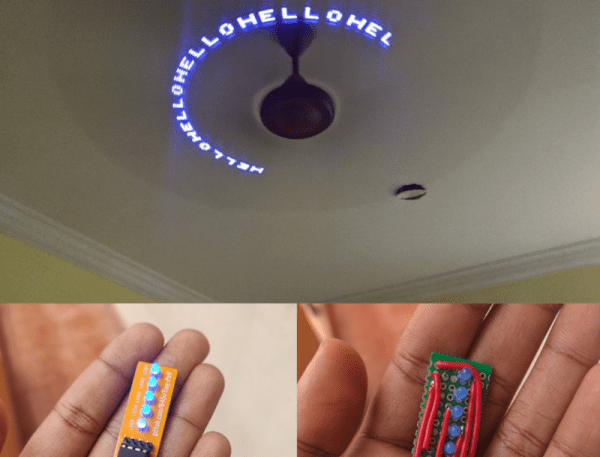
We’ve already added the components needed to build [Rucalgary's] tiny POV device to our next parts order. The little device sets a new standard for tiny persistence of vision boards. Instead of relying on the user to find the best speed and timing for swinging the board around, [Rucalgary] used an accelerometer. This is the point at which we’d usually groan because of the cost of accelerometers. We’re still groaning but this time it’s for a different reason.
The accelerometer used here is a Freescale MMA7660. It’s an i2c device at a super low cost of less than $1.50. The reason we’re still groaning is that it comes in a DFN-10 package that is a bit harder to solder than SOIC, but if you’ve got patience and a good iron it can be done. An ATmega48 drives the device, with 8 LEDs and one button for input. On the back of the board there’s a holder for a CR2032 coin cell battery and a female SIL pin header for programming the device.
Check out the video demonstration embedded after the break. We love it that the message spells and aligns correct no matter which way the little board is waved.
Read the rest of this entry »
posted Apr 19th 2011 5:02am by
Mike Szczys
filed under:
led hacks

We love spinning POV displays but have yet to build one to call our very own. This project might be the one that we end up building. It’s looks good and it’s the only persistence of vision display that comes to mind which can be built in twelve hours.
The spinning is taken care of by a PC fan. This actually helps with some of the calculations as this fan spins at a know RPM. That information, along with a bit of geometry, can be used to calculate the timer interrupts for syncing the display. A reference point for this device is provided by an IR receiver/emitter pair which is easy to wire up since you already need a voltage source for the fan itself. The rest of the hardware is pretty common: a battery holder is centered on the axis for proper weight distribution and protoboard houses the components such as a PIC 18F252, 74LS373 data latches, and the LEDs themselves. The circuit is wire-wrapped, and works like a charm as evidenced in the clip after the break.
Read the rest of this entry »
posted Feb 16th 2011 5:05am by
Mike Szczys
filed under:
led hacks

[Powder4u] wanted to make a persistence of vision display for his bicycle but with 50 cm of snow on the ground it’s hard to get out and ride right now. Instead he made this persistence of vision ski-pole accessory. We asked him to share some details and he obliged. It’s made using an Arduino compatible ATmega168, LEDs with resistors, and installed on some protoboard. The enclosure is a clear pencil case, which isn’t water tight but he’s tried to bolster that with some creative scotch tape placement. There’s no sensor to detect which direction the board is moving in so displaying alpha-numeric messages will have some issues, but as you can see he managed to display image data without issue.
We’re used to night skiing with floodlights along the slopes. This would be a fun little thing to have along with you on those dark lift rides.
posted Nov 28th 2010 8:00am by
Mike Szczys
filed under:
Hackaday links
The Clock Clock

This digital display is made from several analog clocks with thick hands. Together they make something of a 7-segment display, which can be used to display the time. It reminds us of the “Shared Time” installation we covered previously. [Thanks Drum365 via Anonimiss Files]
Quickly desolder lots of parts

[Rhys Goodwin] is grabbing parts from junk PCBs but he’s not using a rework station. Instead it’s a hot-air gun and a brisk tap on the bench to send the parts flying. Well, at least he’s not using a blow-torch like [Ben Heck] does.
Binary Hero

This bank of 8 toggle switches is the controller for Binary Hero, a geeky take on Guitar Hero. When you see a decimal number come down the screen set your toggle to the binary equivalent in time or the game will be over before you know it. [Thanks Fabien]
Quick fan POV

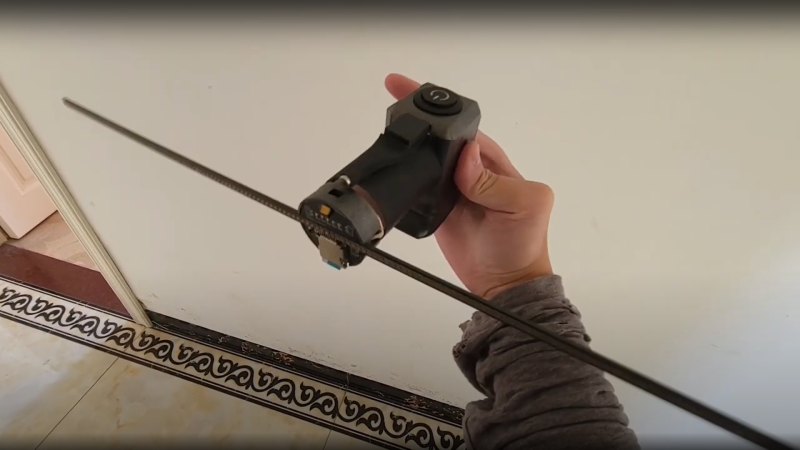
[GMG] took a small persistence of vision board and slapped onto an oscillating fan blade. Along with a couple of magnets on the safety cage this display is a persistence of vision hack you can pull off in an hour or two.
Speed up laser etching

[James] figured out a way to cut down on the time it takes to etch multiple copies of one item with a laser cutter. It doesn’t run the laser faster, but orients the pieces in a way that means less movement of the head while the laser is not on. Read through his article and see if this method can help you out when doing some CNC work.
posted Nov 13th 2010 11:00am by
Mike Szczys
filed under:
led hacks

[Retrobrad's] spinning POV display has long been our favorite. When it popped up on our radar again this morning we were surprise to see we never ran a feature on it! But now there’s so much more to share. Hit the projects icon at the top of his page and you’ll not only get the 8×85 RGB display’s build instructions, but he’s also built a 32×64 pixel spinning display.
Even if you’re not going to make one of these, he explains some pixel-graphics techniques that are useful in other instances. Check out his video on using spreadsheets for creating the hex arrays necessary for each frame the 8×85 display. It’s embedded after the break along with demos of the two displays.
Read the rest of this entry »