Alarm clock forces you to play Tetris to prove you are awake

tetris_alarm_clock

Oversleeping sucks, but we’ve all been there. Whether its a matter of hitting the snooze button a dozen times too many, or turning off the alarm and drifting back to sleep – sooner or later, you are going to wake up late.

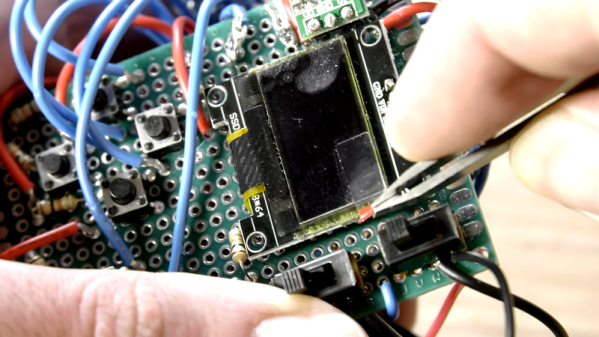
Instructables user [nolte919] has overslept a time or two in his life, and he set out to design a clock that would make it nearly impossible to wake up late. His clock is Arduino-based and shares many features with off the shelf models including multiple alarms, a backup battery, and snooze features. His alarm however goes one step further and ensures you are fully awake each morning.

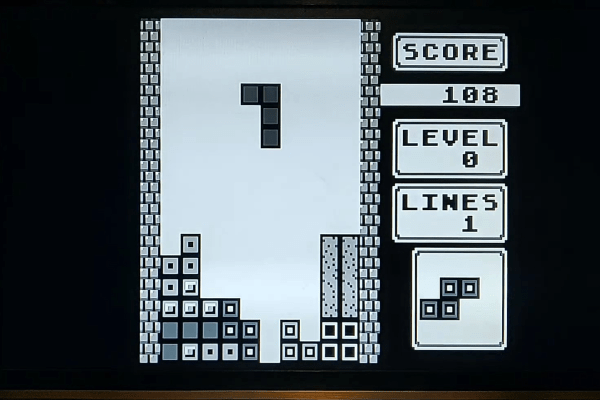
If you hit the user-defined snooze limit, the alarm sounds and will not turn off until you have cleared 4 lines in Tetris. That’s right, you have to prove to the clock that you are awake and coherent before it will shut off. Technically you can silence the alarm for a 30 second period so you can focus on Tetris, but that’s all the break you get.

It really is a novel way of ensuring you are awake in the morning, and heck, how bad can the day be when you start off by playing video games for a few minutes?

Stick around to see a quick video of his Tetris alarm clock in action.

[Read more...]

Kodak ZX3 teardown and Tetris

[Sprite_TM] was given a Kodak ZX3 to play with by a forum he moderates.  The Kodak ZX3 is a waterproof HD camcorder in a cell phone / mp3 player form factor. After opening up the camcorder, he did some poking around with a scope and was able to locate a serial port on the board. It quickly became apparent that the system uses a proprietary kernel called PrKernelV4 rather than an open source alternative. Not letting the proprietary kernel get him down, he exploited the system by simply modifying a file called “autoexec.ash” on the sd card. He now has a Tetris clone easily launched from a previously unused menu icon. See it in action after the break.

[Read more...]

AVR controlled RGB LED matrix plays Tetris

[Stan] built this LED matrix using a 16×16 grid of RGB LEDs. He built the hardware and wrote some subroutines to randomize the colors. He’s not using PWM because frame buffering is not feasible for the 1k SRAM limit of the ATmega168 he used. Instead, shift registers drive the lights which can be mixed to achieve eight different colors (including off for black) reducing the framebuffer size to just 96 bytes. After he got done with the build he realized this is sized well for a game of Tetris. We’ve seen AVR tetris, PIC Tetris, and Tetris using composite video but it’s always a pleasure to see a new display build.

After the break we’ve embedded [Stan's] demo video, several pictures, and a schematic. He’s using many of the same principles outlined in our How to Design an LED matrix tutorial.

[Read more...]

IM-ME plays music in preparation for gaming

[Emmanuel Roussel] is coding a version of Tetris for the IM-ME. Before you get too excited, he hasn’t actually written the game yet, but instead started with the familiar theme music. The IM-ME has a piezo speak on board so it’s just a question of frequency and duration. [Emmanuel] developed an Open Office spread sheet that calculates each note’s frequency and the timer value needed to produce it. He then created a data type that stores a note and its duration and used an array of those structures to store the song. If you’ve ever wondered how to cleanly code music this is a wonderful example to learn from because right now the code doesn’t have anything other than that code to get in the way.

The ground work for this was established in the other hacks we’ve seen. Now we’re left wondering who will finish coding their game first. Will it be [Emmanuel's] Tetris or [Travis'] Zombie Gotcha?

Multi-layer display uses water instead of screen

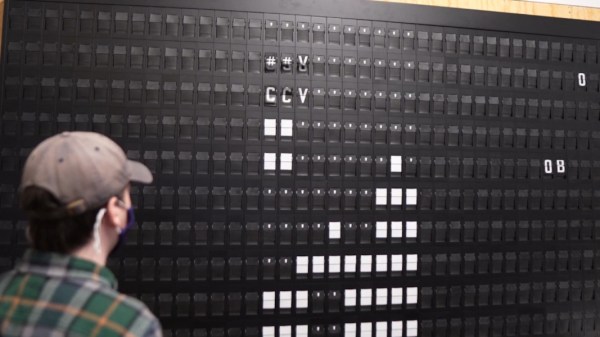
This multi-layer display uses droplets of water as a projection medium. This way, several different projected areas can be seen for a not-quite-3D layering effect. The trick is in syncing up all aspects of the apparatus. There are three manifolds, each with 50 stainless steel needles for water drop production. A solenoid valve actuates the drops, a camera images them mid-air, and a computer syncs the images of the dots with a projector. In the video after the break you can see the SIGGRAPH 2010 presentation that includes a description of the process as well as action shots including a 3-layer version of Tetris.

[Read more...]

Links expanded: Snake on LED matrix

[Yosh] came through with a link to the Snake playing LED matrix that he read about in our links post from yesterday. It seems that [Arty Fart] actually built three of these in green, yellow, and red. You can see him throw one together (an 8-10 hour job) in the video after the break. In addition to playing Snake the PIC 16F877A can also scroll messages, play a mean game of Tetris, and show a Pong screen saver on the 144 LED display. We love the clean build and the urge to make another LED matrix is becoming irresistible.

Now off to eBay for a good deal on a bulk LED order. [Read more...]

Tetris code theory explained

[Graham] designed this PIC based Tetris game on a single board. The hardware is quite nice but we enjoyed his explanation of the graphics algorithm that he used. Having coded Tetris from the ground up ourselves we understand how difficult it is to explain how the program works. Tracking pieces already on the board as well as moving pieces, making sure that rotation won’t cause a collision with another piece or go out-of-bounds, and looking for completed lines all add up to one bid headache.

[Graham's] method for handling rotation involves choosing a point around which to rotate, measuring how this affects each pixel in the piece, and then checking those pixels for overlaps. It may take a couple of readings, but he’s done a brilliant job of making it understandable. There’s a demo after the break and the link at the top takes you to his treatise on Tetris. [Read more...]