
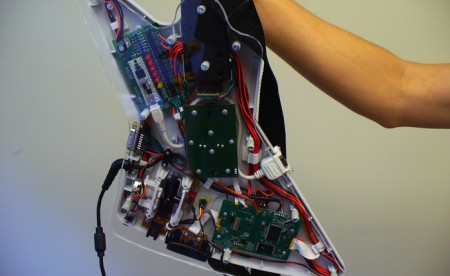
A team of five high school seniors have released some videos of their new Guitar Hero bot named DeepNote. This bot uses a group of custom photodiode modules with an 8 nanosecond latency placed on the screen to sense the notes. The Parallax Propeller system takes this input and controls solid state relays hooked into the guitar’s circuitry. After we looked at a few videos of the early prototype system, we could really see how it has evolved. They have custom PCBs and a really nice frame for the photodiode sensors. You can find more info on their How It Works page and view a demo video embedded below.
Month: July 2008
DIY Joystick Glove

[Elf] sent in this interesting DIY joystick glove. There aren’t many details on the actual glove switch design, but from the schematic on the site, it seems to mostly consist of micro-switches with some pot adjusted transistors to calibrate the X-Y signals.
Related: Data glove USB interface and Clove 2 one handed input
DeWalt-16, How Rambo Would Remodel

[David Wiggins] has sent some info on this DeWALT M-16 gun mod to Toolmonger. Inspired by a picture of an earlier version back in 2003, he decided to go a step further. He already had the M-16 and only lives a few miles from a DeWalt factory service location so he was able to get original stickers and battery casings. After some careful dremmeling and a layer of Krylon, he had the DeWalt-16. Lets be clear, this thing still shoots bullets, not nails.
If modding your M-16 to be a DeWalt power tool is just too manly, you could always go with the Hello Kitty AR-15.
Modifying A Servo For Continuous Rotation
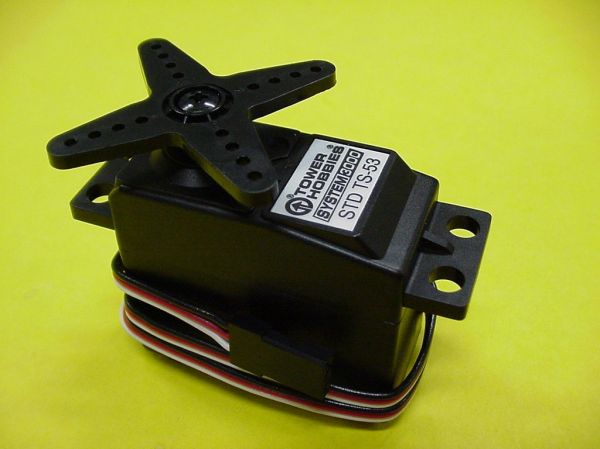
[robomaniac] shows us how to modify a standard servo to allow continuous rotation. This is a classic robotics hack and has been around for a while, but we really like the way he put this together. Although you may need some soldering and desoldering tools to open the servo up, the hack is a physical one. All you really need to do is cut off a plastic tab on one of the gears. If you want to see an example of a bot you can build with one of these CR servos, he just posted this one motor walker.
Victorian Nixie Tube Clock
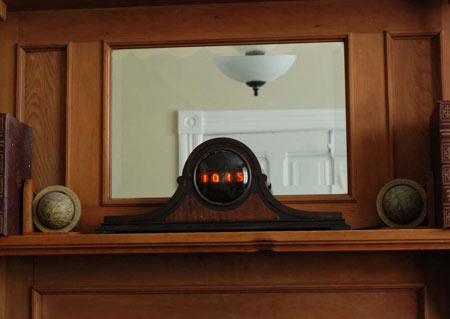
[John Clarke Mills] has pieced together this tastefully done Victorian style Nixie tube clock. He picked up a kit from nixietube.com and an old clock off of eBay. A little bit of elbow grease and solder later, he has this very nice mantle piece. Well done.
For those unfamiliar, a Nixie tube is used for displaying numbers or letters. They are a glass tube, filled with a gas (usually neon). There are metal structures inside that glow when electricity is applied. First widely used in the early sixties, Nixies were pretty much replaced when LED technology got cheap.
We noticed that nixietube.com was down, so you might also check TubeClock.com and neonixie.com for kits.
If you’re looking for more inspiration, read about the Nixie counter clock, Russian vfd, and the 6502 driven Nixie clock all previously on Hack a Day.
[via Retro Thing]
Mister Jalopy On NPR

[Mister Jalopy] is an outspoken recycler. He believes it is wrong that we live in a “throw away culture” and we here at Hackaday tend to agree. There is so much potential left in products, long after they may have given up their original purpose. He has been pushing to get companies to work with the public, to encourage re purposing and hacking. The belief is that it can only improve a company’s relationship with their customers.
[Mister Jalopy] appeared on National Public Radio today. They discussed the benefits of making your own stuff, as well as the legalities involved with modifying off the shelf products.
We covered his open house last October. Tons of fascinating stuff there.
[via Hoopty Rides]
Science Fiction, Help Or Hindrance?

[Annalee Newitz] from io9 has written a piece about how science fiction can impact the public’s perception of scientific research. She’s covered stories ranging from Frankenstein, for showing the negatives of humans “playing god”, to The Diamond Age, for showing an inspiring use of nanotechnology.
We wonder what direct impact science fiction has had on research. Depictions of a 3D metaverse have always been compelling, but is pouring effort into half measures like Second Life a waste of time compared to serious computer interaction research?
We discussed this for a little while and concluded that whether inspiring or hindering, the very act of critically thinking about technology was beneficial. What books have inspired you in the past? Was it because they showed a better world or were they a stern warning?









