A Remote Controlled RGB Light Bulb Lamp

RGB just got a lot brighter by using 3x60Watt flood lights instead of an LED. The bulbs are driven via TRIACs and the whole thing uses a remote control to change the levels of the three bulbs. It is also able to store these levels for later recall. The IR receiver was taken from a dead TV set along with its remote control, or a universal remote set to a Phillips TV can be used. The source code and schematic for this project are available.

Control Media Center With Programmable IR Receiver

This IR receiver based on ATtiny13 microcontroller is used to control a Media Center box via a remote. The circuit is powered by 20 pin ATX connector pin 9 “+5VSB” because it is the only pin that is powered when the computer is off, or in standby. The receiver is programmed to accept the codes from the remote by holding down the switch while pressing the remote button. The circuit can use “Girder” or “PC remote control” as controlling software on the Media Center.

DIY Vertical Axis Wind Turbine

This vertical axis wind turbine (VAWT) uses five 3” PVC pipes cut in half for blades rotating on three kids bicycle wheels to spin an Ametek 38 volt motor or a wind blue alternator. The whole thing spins in a frame that is a 12 feet high and 2 foot square box that is able to sit on his deck. In total it cost him about $125 plus time, a bit more if you use the wind blue alternator.

Video of the vertical turbine in action after the break.
Continue reading “DIY Vertical Axis Wind Turbine”

Upgrading The Cisco PIX 506E


[Albert] read the Cisco PIX Wiki, and discovered that the motherboard of the PIX 506E is the same as the PIX 525, which has a 600Mhz Coppermine Pentium III CPU. So he took his Cisco PIX 506E and upgraded it by swapping out the Celeron 300Mhz, with a Pentium III 600Mhz and populating the second PC100 RAM slot inside. The system only shows 448Mhz instead of 600Mhz, but it does recognize the PIII, and there are no problems.  The CPU load has dropped to 0% after the CPU swap, and RAM upgrade.

Email Notification Via An RGB LED


This project provides LED feedback when an email is received. It uses a 4d-micro-USB module from Dontronics to interface serially and provide power to a Picaxe 08M. The PIC can control color and brightness of a RGB LED. The feedback is given by seven colors of the LED. The code is python script and picaxe basic, which he’s posted.

Peltier-based Cooling/heating Backpack

[Max Weisel] recently created a Peltier-based cooling/heating system that fits into a backpack. The system uses two Peltier units, each running at 91.2 watts, with computer heat sinks mounted on one side of the unit to dissipate the excessive amounts of heat generated. While he was originally trying to build a cooling backpack, the use of the Peltier units meant that the cool side would become warm when the direction of current was switched, meaning that the backpack could become a heating backpack with the flip of a switch. In order to power the two Peltier units, he uses two 12v motorcycle batteries, weighing in at around 5 pounds each. While this backpack might be a little heavy for your back, it looks promising for anyone who needs to keep things cool (or warm) on the go.

IPhone OBD-II App

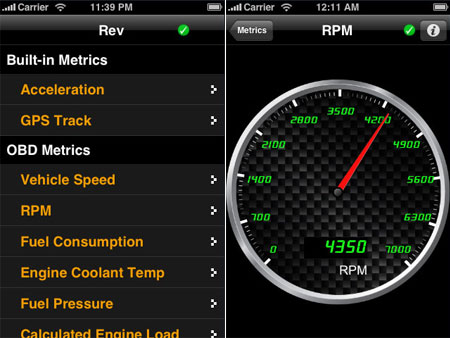
Rev by DevToaster is an application for the iPhone and iPod Touch that allows real-time monitoring of vehicle ECU data from the OBD-II port. Rev interfaces with a WiFi OBD-II dongle.

If your check engine light is on or flashing, REV is able to check the engine code, list all of the engine codes stored in the vehicle, and reset the stored codes or check engine light.

Rev is able to monitor real-time; vehicle speed, RPM, fuel consumption, engine coolant temp, fuel pressure, calculated engine load, throttle position, intake manifold pressure, air intake temp, timing advance, mass air flow, fuel level, barometric pressure, EVAP system vapor pressure, and fuel trim.

A brief video of REV in action is after the break.

Continue reading “IPhone OBD-II App”