Hackit: DTV Converter Boxes?

zenith

An anonymous Slashdot reader asked today what was the best digital television to analog converter box. He was looking for one with the best hacking potential. We actually purchased a Zenith DTT900 HD converter box this summer specifically wondering about the hacking potential. We did a teardown and you can find a full gallery on Flickr. Our conclusion was this: there’s not much there. You’re talking about a box that takes a digital RF signal and turns it into a crappier looking analog signal over composite. There isn’t much you can do outside of its designed use. Do you have any ideas what else can be done with it?

Slashdot commenter [timeOday] did mention a Tivax brand box that features a serial port. You can use it to issue remote commands to the box.

Not much has been said about the actual coupons. We’ve got a scan of them embedded below. The $40 coupons are essentially credit cards. We ran ours through a magstripe reader confirming this. Even though the card isn’t stamped with the recipient’s name, it is stored on the magstripe.

Continue reading “Hackit: DTV Converter Boxes?”

Meggy Serial Cable

meggy

We thought the Meggy had some serious potential. The open serial port is ripe for the plucking, but has thus far been fairly unused. Here’s directions on how to make your own serial cable capable of connecting two Meggies. Basically, it is just modifying an audio cable, used to connect CDROMs to the motherboard. The cool thing about this is that the resulting crossover cable should work on any Arduino that is programmed via an FTDI cable.

External Antenna On Panasonic CF-R1

ext_ant

[Steven] managed to get his hands on a Panasonic CF-R1 for pretty cheap. Though it is a decently powerful machine, it was built in 2002 and didn’t come with an internal wireless card.  It did, however have a mini-PCI slot.  [Steven] promptly installed a wireless card, but found the internal antenna lacking. The solution was to custom mount an external antenna. Mounting it was fairly easy, he removed the phone jack and epoxied the connector in its place. The reception was greatly improved. He says he went from seeing 6 access points to 31 as soon as he installed it. Similar things have been done to the Eee PC 900.

Chumby Digital Picture Frame Teardown

overview-1

At this year’s Consumer Electronics Show, Chumby unveiled their latest prototype. It’s a network connected digital picture frame that runs Flash widgets. Just like the current Chumby model, they’re publishing the software and hardware under a license designed to let you hack it. They let us borrow one of their open chassis evaluation kits to teardown and photograph. We’ve got more pictures, full specs, and the schematics below.

Continue reading “Chumby Digital Picture Frame Teardown”

Passive MIDI Foot Switch

foot

[Matt] was looking into some software that allows him to use his audio card as a means to control analog audio devices. After seeing how it worked, he got an idea to try to do the opposite.  He is sending a signal into his audio input, and piping it to a pice of MIDI software. The input he has chose is a foot switch. To create the signal, he simply needed to supply voltage while the switch was depressed. You can see above that he used a battery and a simple contact switch to send the signal. He then piped it to a virtual MIDI port using Maple Virtual MIDI Cable. Unfortunately, this isn’t suitable for knobs, but that may be next on his list.

Programmable Scientific Calculator Watch

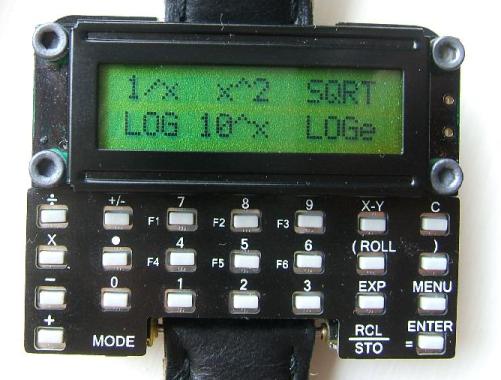
When the band support on [David]’s Casio CFX-400 Scientific Calculator Watch finally broke after 10 years of use, he found it almost impossible to find another watch with the same functionality. Like any good engineer, [David] decided to design a watch to meet his needs. The result of his endeavors was the µWatch, a programmable watch based on a PIC24 with both RPN and Algebraic calculation modes. The watch runs open source software and is expandable thanks to a serial port, an ICSP programming port, and a spot for an infrared LED on the board. On his site, [David] shows how he made the first µWatch and offers kits for anyone who wants to build their own. We’ve been told that the next batch of kits will be made available in 1-2 weeks and are expected to sell out fast.

[Thanks Tomesz]