Binary Clock Uses DS3232 RTC

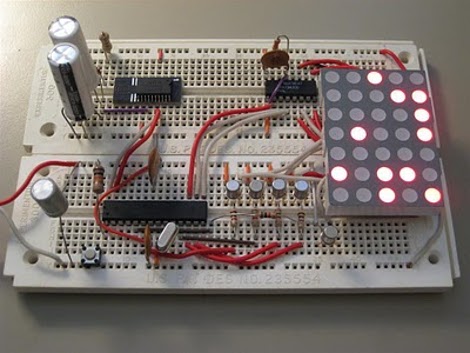
[Kenneth Finnegan] quenches our clock-a-day compulsion with his Arduino based binary timepiece. The clock uses a 5×7 LED matrix as a display and shows month, day, and time. He sourced a DS3232 real-time clock which automatically compensates for temperature to achieve very accurate time keeping. We like the super-cap circuit he added to keep the RTC running if the power is cut.

Is an Arduino overkill here? Well, the code is certainly not filling the 16k available on the ATmega168. At $4.32, the $1-2 you could save by using a lower-grade chip is not worth having to rewrite the code developed during prototyping. [Kenneth] also mentions that these projects usually only hang around for a few weeks before they’re re-purposed for the next endeavor.

Take a look at [Kenneth’s] superb hardware walk through in the video after the break.  If you’re a fan of clean breadboarding, he’s also made a time-lapse of the circuit building process.

Continue reading “Binary Clock Uses DS3232 RTC”

Repairing Your TV EDID

[Andreas] found that his home theater PC would not boot one day. Oddly, if he disconnected his HDMI cable from his TV, it would boot fine.  While most of us would have dug into the PC, he realized that it was a signal from the TV that was incorrect.  Luckily, LG had included a full schematic with the TV.  What he was able to figure out, using a home made snooper was that the EDID eeproms had somehow become corrupted. Not to worry, [Andreas] slapped together a full blown I2C interface and prepared to reprogram them with the correct data.  He noticed, however, that the eeproms were write protected.  On a whim, he decided to write to them any way and found that it was successful. He has some theories as to why they were writable, but says that he doesn’t want to pull the TV back apart to confirm.

[thanks evlapix]

Ultimate Flame Bait: Liquid Cooled Arduino

[youtube=http://www.youtube.com/watch?v=-U-cc_Qcf-w]

We do so many things around here  just because “we can”. Though this guy cites this as his reason, we somehow can’t help but wonder if he’s doing it just to troll the Arduino hating crowd. He has decided to overclock his Arduino by replacing the crystal and dropping it in some non conductive liquid coolant. Can you guess what sketch he’s running? That’s right, he’s blinking an LED.

Normally we would point out that we have no preference when it comes to Arduino. We simply post what is submitted. Though we are often accused of being Arduino lovers, it is simply just another tool to us. We sometimes delete obnoxious comments that get off topic, threatening, or vulgar because that’s just good house keeping. That being said, we know what to expect here. Go ahead, bash the Arduino. Get it out of your systems. Just keep it non offensive or it will be moderated.

[thanks jfreak09]

The Mini-Markade

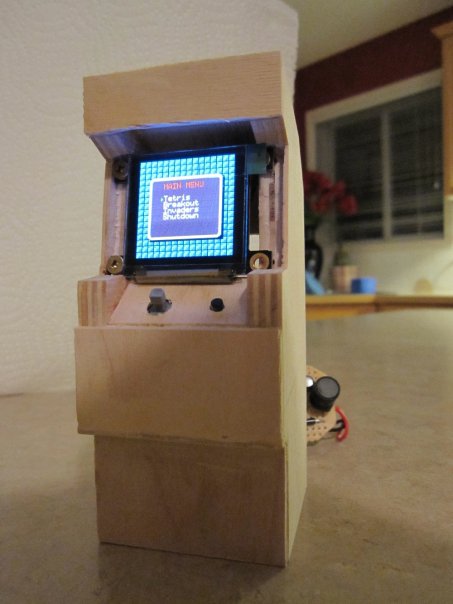
We love arcade games. Who doesn’t? We feel that the “arcade” feeling just can’t be replicated in any other form factor than an arcade cabinet. [Moslevin] must feel the same way too. He has built, what could possibly be the worlds smallest arcade cabinet. Aside from a coin mechanism, it is fully functional. It is an ATMega328p running his own custom software. The games he has available are Tetris, Invader, and Breakout, all coded by himself as well. We’ve seen small arcade cabinets before, but none this small.

Adding Words To Catch Phrase

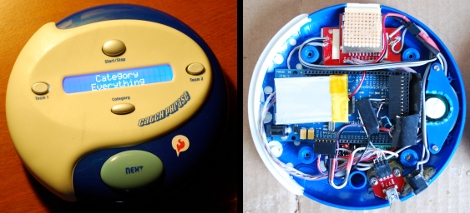
[Brandon Meyer] spared no expense in modding the Catch Phrase game to use custom word lists. The altered version of the game, normal sold for around $25, now comes in at a whopping $230! That’s because the internals were gutted and replaced with an Arduino, 20×2 LCD display, and some other interesting bits. The device now features an SD slot for storing your own lists and a USB port for programming.

At first glance we were hoping some simple EEPROM hacking had unlocked the secrets of the device but that wasn’t he case. We’d love to see some more economical versions of [Brandon’s] prototype. Perhaps reusing the original LCD, replacing the Arduino with the ATmega168 that makes up its core, and using a diy SD cradle for a card reader.

So yes, this version is a bit of overkill but still very nicely done!

[Thanks Zoidberg]

Microscope Lens Hack

Who doesn’t need to take pictures of the microscopic bits inside of an integrated circuit? [Mojobojo] made an end-run around the expensive equipment by building a microscopic lens from an old camcorder. He’s using a regular digital camera with the lens set to its largest zoom level. The camera is pointed into the salvaged camcorder lens where the fine tuning is done. His first iteration was just taped to the desk with a small hand flashlight illuminating the subject. He upgraded that setup by building a LEGO enclosure and changing to a much brighter light source. The images he’s getting are quite surprising and this will be very useful during those extreme hacks when you need to tap into an IC’s internal data rails.

[Thanks Julius]

Electronic Key Impressioning

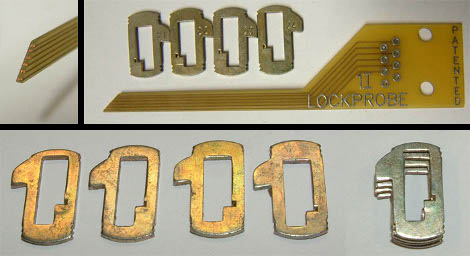
[Barry] shared his postulation on how electronic key impressioning works (google cache). You may remember his foil impressioning demo from earlier in the month, but now he’s addressing a piece of news we must have missed. Apparently, a handheld impressioning device is about to hit the market that can tell you the key codes for a lock in a matter of seconds. [Barry’s] guessing at how this is done from his experience with a similar device aimed at car locks. When the circuit board seen above is inserted into a lock, it completes a circuit between the lock housing and the wafer. The firmware monitors the conductors on the tip of the PCB to calculate how deeply the cut should be and at what point on the key.

This would be fun to try with a homemade PCB, any idea how to deal with wrapping traces around the edge of the board like that?