Reboot Life In A Heartbeat

This hoodie senses your heartbeat and uses it to control Life. Conway’s Game of Life, popular in all kinds of electronics projects, uses a grid of cells coupled with a set of rules to mimic the life and death of simple organisms. This iteration displays the game over your own heart, then taps into your heart rate, resetting the game at the beginning of each cardiac cycle. We guess you could say that Life goes on only if you do not.

The EKG circuit that detects the heartbeat is made up of an IR transmitter shining through the tip of your finger to a receiver. An ATmega168 running the Arduino bootloader controls the EKG circuit and resets an ATmega48 which is responsible for Life. [Joe] admits that this is overkill but he’s currently without an AVR programmer; he went this route to make it work. The stylishly-geeky hoodie is taken for a test run (er… test-hop?) after the break.
Continue reading “Reboot Life In A Heartbeat”

Build Your Own Hub Motor

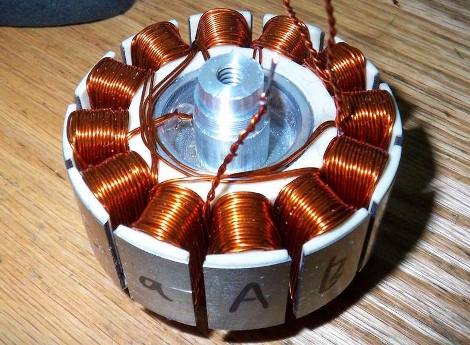
Hub motors put the power inside of the wheel. [Teamtestbot] goes deep into the hows and whys of building these motors, from parts, to windings, to the math behind the power ratios. The working example puts an electric motor inside the rear wheel of a Razor scooter. Past projects used belts to transfer the work of the motor to the wheel of the scooter. By integrating the motor and the wheel you end up with a much cleaner looking product. Check out the motor testing and the scooter test drive after the break.

For more tips on building your own electric motors take a peek at the Fly Electric page we covered back in November.

Continue reading “Build Your Own Hub Motor”

The Uber Eeepc

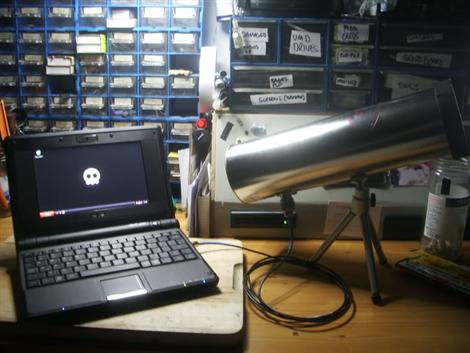
[F00] wrote in to show us his Eeepc that has been modded with almost every upgrade you can cram in one. He has an external cantenna for his wifi, an iPod hard drive, touch screen, added bluetooth with indicator lights, and an internal USB drive for booting linux. While the details are somewhat lacking on his site, you can find an article here for every piece you need to recreate his work. We’ve covered adding the touch screen, mounting external antennas, doing it all without solder, even changing the form factor. Not to mention the other Eeepc we’ve seen that was extremely well endowed.

Now You Can Record Mermaids Singing

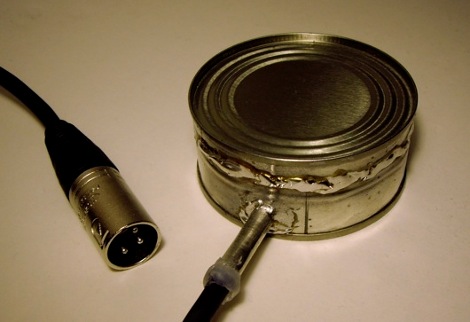
Buy stock in hot glue, this project corners the market on the stuff. [Leafcutter John] uses the hot goop as his water-proofer of choice when building an underwater microphone (also known as a hydrophone). By installing a couple of piezo elements on one lid of a tin can he is able to record some amazingly clear audio. This is aided by a pre-amp inside the metal enclosure. By cleaning off the clear coating from the inside of these steel can parts, he was able to solder the seams to keep the water out.  In the end, coins are added for ballast and any remaining space is completely filled with hot glue.

He’s got a handful of example recordings on his project page. Here’s an what a running faucet sounds like from under water:

Robo-vibe

What sounds like a sex-toy is actually the reason these musicians haven’t been practicing. Marv is the MIDI actuated robotic vibraphone built by [Tim O’Keefe], [Michael McIntyre], and [Brock Roland]. Every key has a solenoid positioned below it. The beauty here is that other than four small holes used for mounting, the vibraphone hasn’t been altered at all. The solenoids are positioned on the outside edges of the instrument but there’s also a hidden secret. A set of dampers have been installed between the two ranks of keys. These are used to stop dampen ringing keys after the note should have stopped.

These guys have exhibited some beautiful craftsmanship. Check out the videos after the break and if you have the chance, see Marv in person at BarBot 2010. If you do attend that robot extravaganza don’t miss your chance to enjoy a breast-pump actuated cocktail.

Continue reading “Robo-vibe”

Raise Your Hand If You Want To Listen To Something Else

This track is awful, someone skip it! This project does just that with a wave of your hand. A laser beam shines across a room and, when obstructed, it sends a command to an iPod. One wave pauses playback, two waves skips to the next track, and a constant obstruction jumps backward one track.

They’re using a textile-compatible electronics platform called Schemer. This is the first time we’ve run across this product which uses a modular system to connect devices via a 1-wire communications bus.

No matter what hardware you use the concept is what interests us. There’s no shortage of iPod remote projects to draw on as examples. This method seems a bit more fun than banging your head for track changes or slapping wildly at an over-sized remote. We’re just a bit concerned about the power consumption of the laser-pointer, perhaps an IR beam would be a more economical choice?

Drink Making Unit

[youtube=http://www.youtube.com/watch?v=iC9l1jO7Lyc]

3 breast pumps, a Meggy jr RGB (slightly modified) and copious amounts of alcohol. This sounds like a typical weekend at HAD headquarters, but it is in fact the parts list for the Drink Making Unit by Evil Mad Scientist Laboratories. Created for the upcoming Barbot 2010 event, this unit is a cocktail mixer. Load 3 liquids in, program the Meggy and you can push a button to dispense. We are pleased to see how much they modified off the shelf components to make this happen. Yes, there could be major improvements like mixing, more liquid reservoirs, and a better cooling system, but we think this thing is pretty slick.