Ossmann Talks About Ubertooth At Schmoocon

[Michael Ossmann’s] talk from Schmoocon about his open source Bluetooth test tool called Ubertooth is now available to watch online. The video really fills in the gaps from the first time we looked at the project, as he covers why he took on the challenge, and what has happened since. He talks about how his work with the IM-ME helped in choosing hardware along the way, and the choices he made while developing the USB dongle. His hardware considerations included parts that didn’t require a nondisclosure agreement (keeping it open source) and that were available in single quantities so that individuals could build and populate their own boards quite easily.

We’ve embedded the talk after the break. The project is coming along great, and his Kickstart funds have almost doubled the original goal.

Continue reading “Ossmann Talks About Ubertooth At Schmoocon”

Low-cost Video Chat Robot

remote_control_chat_robot

[Johnny Chung Lee], having recently moved from Seattle to Mountain View, wanted a way to keep in touch with his fiancé who would not be relocating for several more months. While most of us would likely consider purchasing a pair of web cams to keep in touch, he decided to do things his own way.  Using an iRobot Create and a netbook, both about $250 apiece, he constructed a remote-controlled video chat robot that he can steer around his former abode from 1,000 miles away. While $500 might seem expensive at first, [Johnny] reminds us that commercial versions likely run into the thousands of dollars.

The whole setup is controlled using custom software to manage the movement of the robot, which can be used in conjunction with freely available videoconferencing applications, such as Skype. He also modified the iRobot’s charging station to charge both the robot and the netbook simultaneously – a process he explains, but precedes with several disclaimers.  Like some of his previous projects we have covered, he has made the C# source used in this project available for download on his site, along with documentation for both the control software and dock modifications.

Check out video of the robot in action after the jump.

Continue reading “Low-cost Video Chat Robot”

Four-axis Camera Mount Rides On A Wire

Here’s [Badwolf’s] team posing with their college project. It’s a 4-axis gimbal mount for a camera that they designed in CAD, cut parts using a laser, then milled them down to specifications. In the picture above there is a tiny point-and-shoot camera mounted inside the suspended ring but the rig’s strong enough to support cameras of any size.

That mounting ring can rotate like the hands of a clock, but it also pivots on a horizontal axis. The bracket that holds the ring can rotate on a vertical axis, and the entire assembly moves along the wire supporting it. After the break you can see some test footage that shows the rig being operated via a handheld radio controller.

This setup let’s the camera travel as far as the cable can reach. But if you want something that lets you take photographs of very tall objects you’ll need to use a different setup. Continue reading “Four-axis Camera Mount Rides On A Wire”

Logisim: Open Source Digital Logic Simulator

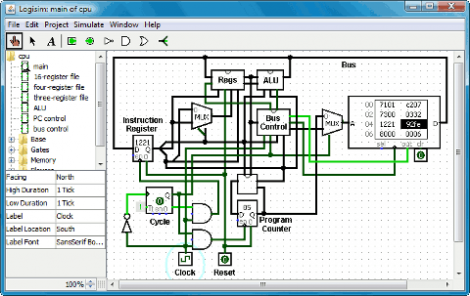
[Spi Waterwing] wrote in to make sure that we were aware of Logisim, a Java-based open source digital logic simulator. We’ve used Atanua quite a bit in the past but hadn’t heard of this program. It seems to have a pretty big educational following and right off the bat it’s got a feature we’ve always wanted, the ability to build your own ‘black box’ logic devices. That is to say you can build your own circuit out of logic gates and then package it into a part to be plopped into your next design. What it doesn’t have is the series logic chips that we’re used to with Atanua, but you can build your own with the black box feature if you really need that kind of functionality.

So grab a copy and try building that binary calculator project from last month.

Sumo Style Robot

[Jeremy] really wants to compete in some sumo bot wrestling, and in order to have robotic sumo wrestling one needs to make some robots, which is what [Jeremy’s] build log is all about.

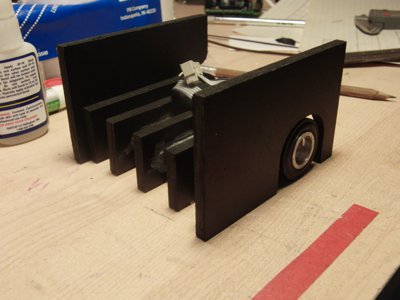
The framework is made out of 6mm thick Sintra (which is a type of closed cell pvc foam sheet) with the use of a CNC machine, using a “sliced” design style framework. Two geared motors fit snug inside of the internal frame and some wheels from solarbotics are attached to the ends. The arrangement of the drive wheels in the rear, and the large front end, seems like good design for the end application where robots doing turtle flips would be no fun.

Keeping in mind this is not a fully finished project and therefore does not have code or schematics posted, the brains of this beast are in a similar state, and should be pretty easy to figure out. The thinking is handled by an atmega328, and fed by IR sensor pair’s to detect light / dark patterns on the floor or table, and an array of proximity sensors along the front and sides to detect its opponent.

And while this project may not be completed, it at one point was dead and set aside, after some months [Jeremy] went back for a second look and found out that the only thing dead about it was the power regulator and h-bridge and quickly got it back up and working, which is a good reminder to not give up, even when it does go poof.

Update To Stairmonster

The “Stairmonster 2” is an updated verison of the hyper speed, home brew stairmaster we covered back in November. It still features most of its original version’s features including a very sturdy construction, heart rate monitor, and 320×240 touchscreen interface. What is new about the Stairmonster 2 is its handlebars. V1 used stationary bike handlebars, which would be good for pull-ups or other similar exercises, but did not do much good while on the machine.

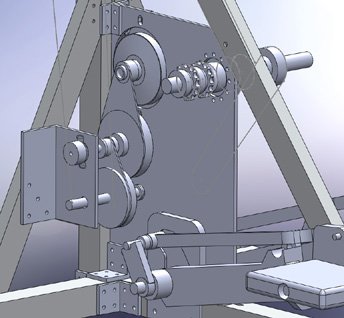
Version 2 on the other hand uses moving handles, when paired with the resistance of the machine allows the user to simulate a climbing action. The handles are also attached to rotary slip clutches so there is only resistance on the pulling cycle and not while retracting, which could be very bad at the speed this thing can run at.

Overall a good improvement to an already impressive machine, though don’t expect to see us climbing on it anytime soon.

Pong Clocks Using LED Matrix Modules

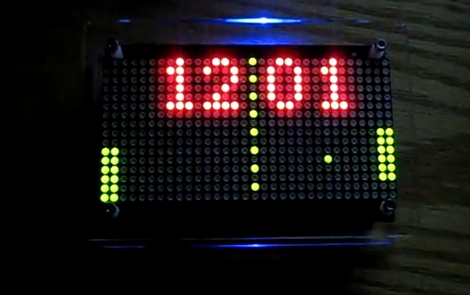
We love Pong clocks because they’re showpieces. This particular offering, called the Wise Clock, is the third hardware revision of the project. The LED display is dead simple since they’re using a 32×16 bi-color module from Sure Electronics. If you don’t want to design and build your own multiplexing display this is a somewhat inexpensive and high-performance alternative.

After the break you can see that the paddle movements look very realistic. They move like a human player might, which is quite often not the case with these clocks. If you want to see how that’s done, check out the code which was originally developed by [123led] for a different project.

Continue reading “Pong Clocks Using LED Matrix Modules”