Roomba Shares All Of Its Daily Activity On The Web

tweeting_roomba

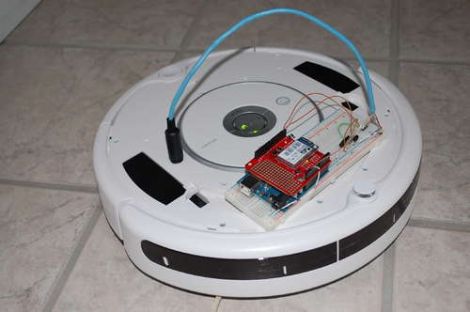
Instructables user [matchlighter] wanted to see what he could program his Roomba to do, so he decided he would make his little cleaning machine report its status on Twitter whenever something happened.

He popped open the Roomba’s case to access its serial connector, crafting a simple interface cable from some spare Cat5 he had sitting around. He added a small voltage regulator between the Roomba and his Arduino in order to protect it from the high power output present while the Roomba is charging. Once the proper bits were in place, he hooked the Roomba’s serial interface to the Arduino and attached a SparkFun WiFly shield to allow for wireless communications. After a bit of coding, the Roomba was sharing its activities with the entire world on Twitter.

Not only did he want the Roomba to tweet, but he decided that he also wanted the ability to control it from the web. He created a simple interface using a handy library he found online and was sending cleaning commands to the Roomba in short order.

While there is no video of the Roomba in action, you can check out what it is up to here, and there’s plenty of code to be had on his Instructables page.


The Passing Of Bob Pease

We are saddened by the recent passing of [Bob Pease]. You may not be familiar with the man, but his work has touched your lives in more ways than you can count. As an electronics engineer who specialized in analog components he was responsible for hardware that made some of the electronics in your life possible, and designed components that you’ve probably used if you dabble in electronic design.

EDN has a lengthy obituary celebrating his life and accomplishments. [Bob] was part of the 1961 graduating class at MIT. He started his career designing tube amplifiers before finding his way to a position at National Semiconductor about fifteen years later. Throughout his career he worked to promote education about analog electronics both through written text, and more recently as the host of Analog by Design, an online video program where a panel of experts discuss the ins and outs of electronics.

[Bob] was killed in an automobile accident on June 18th at the age of 70.

[via Make]

PLL 101

[Jeri Ellsworth] and former Commodore Computer engineer and current full time tinkerer [Bil Herd] have a little chat on skype covering the 101’s of Phase Lock Loops in this hour long video. PLL’s are handy for many applications, but their basic use is to keep clock signals in sync.

Topics covered include: Why we care, a basic explanation for the CD4046, capture ranges, and meta stability. Examples from analog tv, to clock recovery, finding falling edges and FPGA’s. This thing is jam packed full of information.

With talks of future episodes and a quick tour of [Bil’s] bench this is something to not miss. Join us after the break for the video!

Continue reading “PLL 101”

Turning Spotlights Into Soft LED Nightlights

led_spotlight_retrofit

[Bob] had a couple of bright, 12V halogen spotlights in his hallway that didn’t get much use. Rather than toss them out or leave them sitting idle, he decided to replace the bright bulbs with dimmer LEDs that he could keep lit through the night.

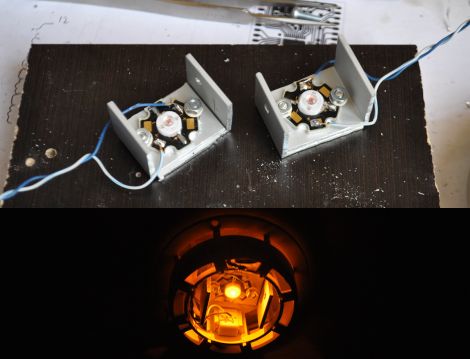
He opened up the spotlights, removing the bulbs and the built in mirrors before fitting them with 350mA LED pucks. The pucks were mounted to a pair of L-shaped aluminum scraps, which serve as both a mounting plate and heatsink. When running, the underdriven LEDs barely heat the aluminum plates, so he is pretty confident that the lights are adequately cooled.

The orange LEDs provide a nice warm glow in his hallway, and he says they are perfect for late night trips to the fridge. They currently stay lit all the time, but [Bob] is considering adding a light sensor to turn them on them automatically, as well as a PIR sensor to increase the brightness as someone passes by.

DIY Softboxes Light Your Photos On The Cheap

diy_softboxes

Softboxes are often considered a must-have piece of equipment when doing any sort of portrait or studio photography. While they are not the most expensive photography accessory, they can be built far cheaper than you would pay for an off the shelf model.

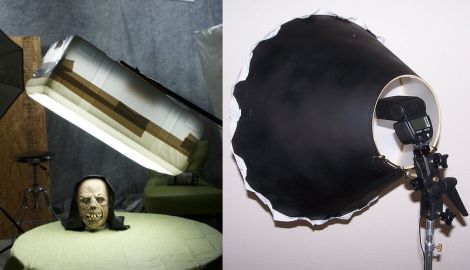
[Don] needed a softbox for his studio, and he ended up constructing a fairly nice one out of a styrofoam cooler. He mounted an outdoor light receptacle inside the cooler after laying down a reflective backing, bolting everything to a piece of plywood situated on the back of the cooler. He stretched some white cloth over the front to diffuse the light, and then mounted it on a light stand. You can see a video of the construction process below, as well as additional softbox-lit images on his site.

[Aud1073cH] had a similar need for a softbox, but went about his construction a bit differently. He grabbed a lampshade and a white dress shirt at a thrift store, stretching the shirt over the bottom opening before securing it with Velcro. He mounted the lampshade on a light stand, inserting his camera’s speed light through the smaller lampshade opening. As you can see in his photostream, the softbox does a great job at softening the shadows in his pictures.

Continue reading “DIY Softboxes Light Your Photos On The Cheap”

Salvaged Coil Magnetizes Tools On Demand

magnetizing_wand

When working in hard to reach areas, magnetized tools can mean the difference between wrapping things up quickly and spending way too much time blindly grasping for dropped screws. [Damir] wrote in to share a handy little contraption he built which allows him to magnetize and demagnetize his tools as needed.

While rubbing a magnet against the tip of a screwdriver will impart a weak and temporary magnetic field, he felt that a stronger more permanently magnetized tool was far more useful. It is pretty well known that subjecting metal to a direct current magnetic field will magnetize the item, and an alternating magnetic field will demagnetize the same object. [Damir’s] wand will perform either task with the simple flip of a switch.

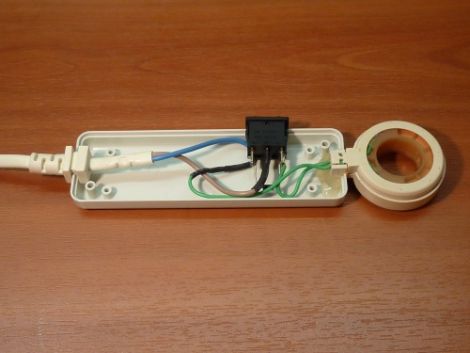
He salvaged the motor coil from a broken washing machine and mounted it in a project box, along with a single-pole changeover switch. A small diode is used to perform rectification on the AC input, providing the DC current required for magnetizing his tools.

Every once in awhile we find the need for magnetized tools, so we think this would be great to have around the workshop.

Check out a quick video demo of the magnetizing wand after the jump.

Continue reading “Salvaged Coil Magnetizes Tools On Demand”

Receipt Racer Wastes A Lot Of Paper

[Joshua Nobel] and the team at undef came up with a receipt printer game for the OFFF 2011 festival in Barcelona.

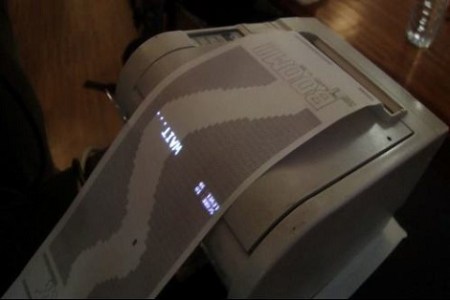
The game is a small openFrameworks app that prints a maze on a thermal printer. A ‘car’ is guided through the maze with input taken from a DualShock 3 controller. The game is limited to a maximum distance of 50 meters, the length of the roll of paper. We wondered about the waste of paper this would be until undef pointed out, “ecologically it’s pretty much a disaster, just like any real car.”

The undef team tried to use the printer for the entire visual representation of the game but that didn’t quite work out until [Joshua Noble] came up with a ‘beamer’ to project the car and score onto the paper. We’re not quite sure what the ‘beamer’ is, but everything syncs up and the resulting game is quite nice.

The game itself reminds us of a certain flash game, but that can’t be where the original idea came from. Check out the Receipt Racer gameplay video after the break.

Continue reading “Receipt Racer Wastes A Lot Of Paper”