Wireless Mouse Li-Poly Retrofit With USB Charging

wireless_mouse_lipoly_retrofit

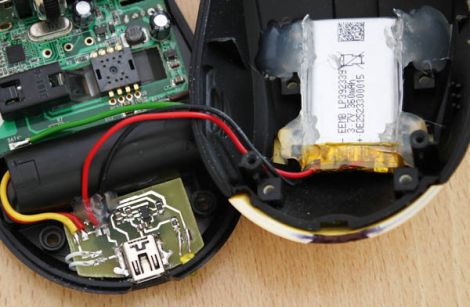
It’s no secret that wireless mice can eat through batteries pretty quickly. Rather than keep a fresh supply of AAs on hand at all times, [Phil] decided he would convert his mouse to use a rechargeable lithium polymer battery instead.

This isn’t the first time we’ve seen a cell phone battery crammed into a mouse to increase capacity, but we think this one has been done quite nicely. [Phil] managed to fit a 2.7 – 4.2v Li-Poly battery in the mouse’s palm rest, where there was a little extra empty space. The battery can be charged from any USB port via a custom-built charging module, which he constructed using a MAX1555 charge controller. Another custom-built circuit resides in the space previously occupied by the AA batteries, which uses an MC340063 DC to DC converter to drop the battery’s voltage down to the 1.25v required by the mouse.

The only part of the build that [Phil] is not pleased with is the power switch on the bottom, but since you rarely see that, we could care less. We think it is quite well done, and with a second version already in the works, we anticipate that it will get even better.

Be sure to check out [Phil’s] video tour of the hack, which you can see below.

Continue reading “Wireless Mouse Li-Poly Retrofit With USB Charging”

Open Hardware Summit 2011 Call For Submissions

The Open Hardware Summit is gearing up for their second annual conference, which is to be held on September 15th, 2011 in New York City. The summit aims to be a venue where users can present, discuss, and learn about open hardware of all kinds. Hot on the heels of the Open Hardware definition announcement, the summit is bound to be an exciting gathering of hackers, makers and hobbyists of all kinds.

The organizers are looking to you, the hacker community, to help put make the event a memorable one. They have put out an official call for submissions in several broad formats. They are interested in talks, breakout sessions, and project demos on topics such as manufacturing, diy technology, open hardware in the enterprise, and more.

If you think you have something interesting to share with the open hardware community, make your voice heard, and be sure to get your submissions in before the June 24th deadline!

[via NYC Resistor]

The Complete AVR Programmer That Fits In Your Pocket

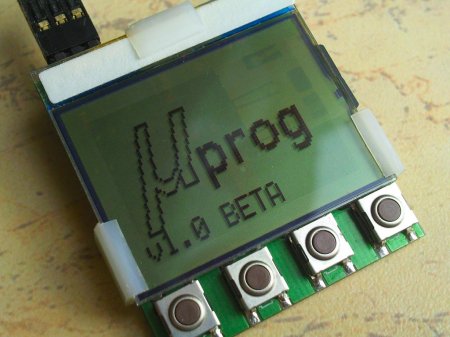
We have seen a few very nice and polished AVR based projects from [Manekinen] over the last few years. Now he has just finished his latest project, the µProg, a super tiny complete AVR programmer with a bunch of features. The µProg completely eliminates the need for a computer to program your embedded AVR chips.

The programmer fits entirely behind an LPH7779 graphics display, and accepts any FAT16/32 formatted microSD cards. Some features include, reading, writing or verifying flash, eeprom, fusebits and lockbits, it also shows amusing animations after every operation. The device is controlled with the use of 4 tactile buttons and operates on a couple of CR2032 batteries.

For an amazingly detailed write up including pictures, eagle files and firmware check out his website. The video embedded after the break has a nice demonstration of the µProg in action, showing off a few of the features and animations. You should also check out his PSU monitor and a spectrum analyser

Continue reading “The Complete AVR Programmer That Fits In Your Pocket”

Building An Electromagnetic Pendulum Clock

electromagnetic_pendulum_clock

[Stephen Hobley] has been experimenting with an electromagnetic pendulum in order to build himself a clock. Through the course of his experiments, he has learned quite a bit about how pendulums function as well as the best way to keep one moving without the need for chains and weights, which are typically associated with these sorts of clocks.

His first experiments involved driving a simple pendulum with a pulse motor. He discovered that the easiest way to keep the pendulum moving was to use a coil to detect when the it reached the equilibrium point, pushing it along by sending a small pulse to that same coil. He noticed that he could keep the pendulum moving at a pretty good tick if he triggered the magnetic coil every third pass, so he implemented an Arduino to keep count of passes and apply the appropriate force when needed.

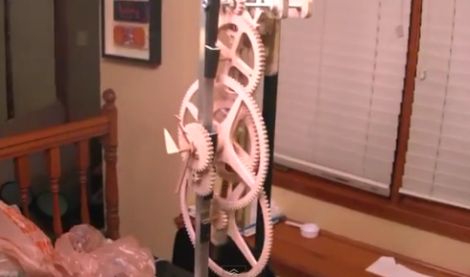
He has been making pretty decent headway since his first experiments and now has nearly all of the clock works assembled. Crafted out of wood, he uses a 15-tooth primary drive ratchet, which powers two 60-tooth gears responsible for keeping track of seconds, as well as a pair of larger gears that track the minutes and hours.

It’s looking good so far, we can’t wait to see it when finished.

Stick around to see a quick video demonstration of the clock with all of its gearing in action.

Continue reading “Building An Electromagnetic Pendulum Clock”

RFID Record Player

Like most of us at Hack a Day, [Bertrand Fan] has a huge collection of digital music that was all obtained through legal channels. Missing the physical process of choosing and playing an album, [Bertrand] built an RFID record player to get rid of the paradox of choice that arises when thousands of albums are at your fingertips.

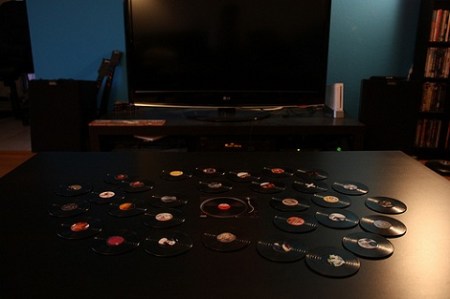
The records are repurposed Christmas ornaments with RFID disk tags pasted under the label. These records are read by a RedBee RFID reader and sent to a Popcorn Hour media server, but we’re guessing this could be easily adapted to any HTPC.

The only limitation we see is the fact that the RFID chip is hard coded to individual songs. We think it would be easier to have the RFID chip store an album’s CDDB discid, but feel free to leave a comment and say how you would catalog thousands of albums on RFID tags.

We’re a little tired of skipping though our music collection like a portable CD player from 1990, so we’re pretty impressed that [Bertrand] came up with something that would get us to sit down and listen to our Terabytes of FLAC-encoded music. Check out the video after the jump for a demo of the RFID record player.

Continue reading “RFID Record Player”

Million Volt Guitar Rocks The House…for Science!

science_brothers_tesla_hero

[Bill Porter] and his friend [Dan Flisek] work together to put on a science-related educational stage show called “Science Brothers”, in which the pair try to convince school children that their field of expertise is the cooler science. While the two are competitive on stage, the main goal of the program is to get kids interested in science, no matter what the specialty.

The pair currently finance the project out of pocket, so they are always looking for ways to make things interesting while also keeping costs in check. With that in mind [Bill] came up with an awesome way to show off the Tesla coil he built a while back. His most recent educational creation is a little something he calls “Tesla Hero”.

Since he already had a solid state Tesla coil hanging around, he dug up a PS2 Guitar Hero controller and got busy getting the two acquainted. The guitar connects to the coil via a fiber optic isolator board, playing one of five notes as he strums along. A series of Arduino-driven LED strips adorn the guitar, flashing various colors while he plays, as you can see in the video below.

It’s quite a cool project, and we’re sure that his audience will be impressed!

Stick around to see a video of  Tesla Hero in action, and if you’re interested in learning more about the Science Brothers, be sure to check them out here.

Continue reading “Million Volt Guitar Rocks The House…for Science!”

DIY Digital Bench Power Supply

[Guido Socher] built himself a great little bench power supply that’s able to put out 30 Volts at 2 Amps.

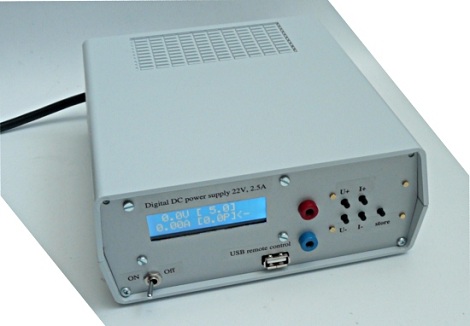
Instead of taking the easy way out by putting a few taps on an ATX power supply, this project was built around a generic 24 Volt laptop power brick. An ATmega8 generates a PWM signal that is sent though a low-pass filter, allowing everything to be very precisely controlled. This DC signal is then sent through a BD245 power transistor to bring everything up to the desired output. [Guido Socher] included a USB port for computer control of everything, and the final project is something we’d be happy to have on our bench.

We’ve seen a few computer power supplies converted into a bench power source, but we’re impressed with [Guido Socher]’s build log. It’s not often we see a hack that goes over the theory of operation, and the end product is very nice (and functional) too.