Template For Building STM32F0-Discovery Project In GCC

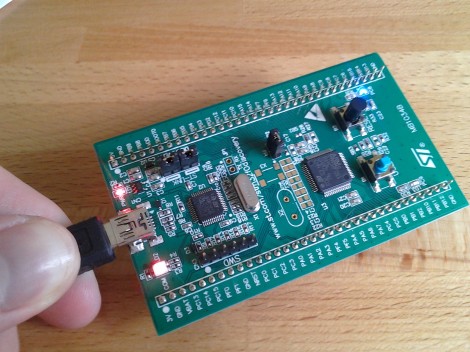
Yep, that blue light is blinking and I made it happen. I’ve been hard at work since I got my free STM32F0-Discovery board in the mail. Most recently I put together a starting template for building STM32F05x project on Linux. You’ll still need to install your own tool chain (I’m using the Code Sourcery G++: Lite Edition), but this makes it a snap to compile your projects with support for STM’s peripheral libraries.

As for programming, you may remember that I added support for writing to RAM in the stlink project. I’ve wasted spent a ton of time trying to get support for writing to Flash into that project. It’s just less of a hassle to use stlink than it is to work with OpenOCD. But I’ve really hit a wall getting the flash loader code to work. If you want to check out what I’ve done so far in that area I committed a very messy branch (see the commits for what code changes I’ve made).

In the mean time you can use OpenOCD to write images compiled with the template to your device. I included the ‘make program’ option in the Makefile to do this from command line. If you need help compiling OpenOCD check the readme in the template repository.

Finally, A 3D Printer For Burritos

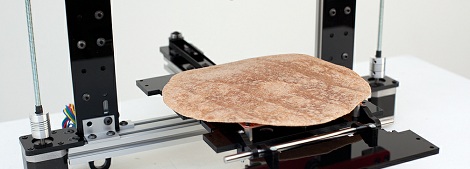
[Marko] created a robot that prints burritos. Truly, we’ve reached new heights as a species.

The Burritob0t is based on the ORD Hadron 3d printer with a pair of air compressor/syringe-based extruders based on the Makerbot Frostruder. All the ingredients – rice, meat, salsa, and molten cheese – will be printed onto the surface of a tortilla heated by a Makerbot heated build platform.

[Marko] has some pretty neat plans for his Burritob0t such as an iPhone app for ordering your burritos and some sort of social commentary thing using burritos. We’re assuming [Marko] hasn’t yet got this Burritob0t up and running for the lack of any action shots or demo videos. That said, there’s a wonderful Flickr gallery and an about page that covers the artistic statement behind the Burritob0t.

If you want to get your own Burritobot, [Marko] hopes to have a Kickstarter up sometime in July.

Recording Off A Reel-to-reel With A Credit Card Reader

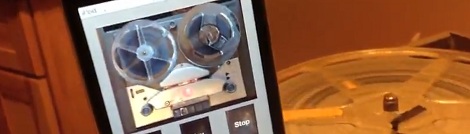
If you’ve got a few reel-to-reel recordings of 1940s radio, how do you transfer those to a digital medium? [Evan Long] and his dad used a credit card reader built for the iPhone to transfer a vintage [Art Kassel] recording from magnetic tape to the digital domain of .MP3s.

A few months ago, we saw what goes into these Square credit card readers. They’re just a magnetic tape head with a resistor an 1/8″ jack that plugs directly into the headphone jack of any iDevice. Because there’s no hardware limitation of what the Square credit card reader can do, [The Long boys] decided to back up some old reel-to-reel tapes with an iPod Touch.

[Evan] and his father needed to perform a few modifications to the credit card reader; the tape head pressed against the plastic case too tightly to allow feeding 70-year-old tape through the device. After bending a bit of metal the credit card reader was ready to record the dulcet tones of the Big Band era.

It’s a neat build, and anything that reuses proprietary hardware (however limited) is alright in our book. Nice job, guys.

Building Your Own Atari Cartridges

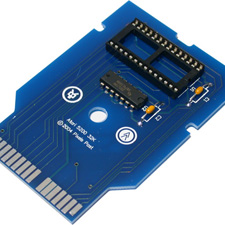
Have you ever wanted to create your own atari games from scratch? Thanks to the Grand Idea Studio, you can download the files to make your own cartridge PCBs. There isn’t a ton of information here, as this is an old project that isn’t being supported anymore. However, you can download the instructions, schematics, and gerber files for carts that work in the 3 main models of the atari 2600. As [Tyler] over at Adafruit points out, you could easily 3d print your own shell as well.

Detecting Cosmic Rays With 18 Geiger Tubes

What do you do if you have 18 Geiger tubes lying around? [Robert] had an interesting idea to build a cosmic ray detector and hodoscope to observe the path cosmic rays take while flying through his lab.

[Robert]’s cosmic ray detector works by detecting the output 9 Geiger tubes on the y-axis and 9 Geiger tubes on the x-axis with a coincidence circuit. When a cosmic ray flies through the detector, it should trigger two tubes simultaneously. By graphing which of the two tubes were triggered on an array of 81 LEDs, [Robert] not only knows when a cosmic ray is detected, but where the cosmic ray was.

The detectors do pick up a little background radiation, but thanks to [Robert]’s coincidence circuit, he can be fairly certain that what he’s recording are actually high-energy cosmic rays.

Before building the 9×9 hodoscope, [Robert] built a similar drift hodoscope that simply plots the path a cosmic ray takes through an array of Geiger tubes. You can check out videos of both these cosmic ray detectors after the break.

Continue reading “Detecting Cosmic Rays With 18 Geiger Tubes”

Two Software Defined Radio Hacks From Our Resident SDR Guru

It seem [Balint] is becoming somewhat of a SDR guru around these parts; in the past few months, he’s gotten a USB TV tuner receiver working with GNU Radio, started a software defined radio tutorial YouTube channel, and even used this project to listen in on conversations between airplanes and air traffic control. This time, [Balint] is back using this cheap USB TV tuner for radio direction finding and running HDSDR in Linux and OS X.

[Balint]’s radio direction finding presentation goes over traditional means of direction finding using the doppler effect and mechanically rotated antennas. Because [Balint] is dealing with frequencies around 150MHz (about 2 meter wavelength), building a physical direction finding setup requires spinning antennas at around 40,000 RPM; much to fast for any hardware build. [Balint]’s solution was to attach 4 antennas around the circumference of a circle and electronically switch between them many thousands of times a second. [Balint] put up a wiki page going over all the theory and implementation details of his build.

[Balint] also put wrote up a neat app to control software defined radios – including the Realtek TV dongle –  over a network. Spread over a wide enough geographic area, it could become extremely easy for anyone to play air traffic controller. The BorIP Server can also be used to run HDSDR in Linux and OS X under Wine; just connect HDSDR to the network loopback on the same machine, and you get around Wine’s distaste for accessing hardware natively.

Awesome work, and we can’t wait to see what comes out of [Balint]’s laboratory next.

Edit: instead of the dongle, [Balnt] is using a ‘real’ software radio board. A lot of people are messaging him asking if the same method of direction finding is possible with the dongle. Here’s what [Balint] has to say:

The trick, as I see it, would be to create some (more or less simple) additional hardware to take the clock signal straight off the dongle’s on-board oscillator and divide it down for use with the antenna switch, i.e. 28 MHz à tens of kHz (this is the bit that’s done in ‘software’ on the FPGA). One problem still remains however: the counter needs to remain calibrated against the known direction the antenna was pointing at the time – otherwise a stop/start of the data stream from the dongle will mean the direction will go out of sync by 90/180/270 degrees each stop/start. Perhaps someone will figure out an elegant solution for this slight hurdle!

So there you go. Up for a challenge?

ArduSat Puts Arduino Experiments In Space

CubeSats are nothing new – hundreds have been launched into Earth orbit by schools and universities over the past decade. Like anything cool, an Arduino eventually gets thrown into the mix. That’s what the folks behind ArduSat are doing: they’re launching an Arduino-laden satellite into orbit with a bunch of sensors to enable anyone to become a citizen space scientist.

On board the ArduSat is a suite of sensors including a spectrometer, Geiger counter, IR light sensor, electromagnetic wave sensor, a temperature sensor, gyroscope, accelerometer, magnetometer, GPS unit, CO2 sensor, and of course a few cameras. The rewards for this Kickstarter are fairly interesting: backers who pledge $500 are able to buy a week’s worth of time using the ArduSat sensors for your own personal experiment.

As for how this Arduino-powered satellite is getting a ride up to Low Earth Orbit, the team plans to send an application into NASA for the CubeSat Launch Initiative ride-along program. If NASA selects the ArduSat, it’ll get a ride into space along with other CubeSats on a larger commercial launch. If the ArduSat isn’t selected by NASA, the team behind this satellite has secured funding to piggyback on a commercial launch.

Tip ‘o the hat to [HackTheGibson] for sending this in.