Fashion Leads To Mind-controlled Skirt-lifting Contraption

This must be an example of when worlds collide. Who would have thought the geekery of Mindflex and Arduino could make its way into high fashion? But sure enough, this dress transforms based on the mental concentration of the model (must resist urge to crack joke here).

Details are a bit sparse, but you can get a look at the prototype in the video after the break. There’s no nudity; a larger skirt covers a more plain version. That over-skirt is connected to some type of motor system which is driven by an Arduino. When the EEG sensor in the hat detects a certain level of brain wave activity, the outer skirt is lifted and pulled to the back of the outfit, exposing the tighter version beneath.

[Lorenzo] wrote in to share the link to this garment hack. He mentions that a Lilypad and Mindflex are at work here. Looking more into the artist’s website we find this isn’t the only tech-wear produced. There’s a maternity outfit which can sense the baby’s beating heart, and harvest other data about both mother and baby, as well as a few others.

We can’t think this has much future as an everyday outfit, but more utilitarian versions are out there so we think the sky’s the limit on wearable tech.

Continue reading “Fashion Leads To Mind-controlled Skirt-lifting Contraption”

Hackday Links: March 16, 2012

Shamrock hat

[Josh] whipped up a shamrock themed hat by adding an outline of green LEDs to this bowler. Just remember, don’t drink and solder. Happy St. Patrick’s Day everyone!

Battery-powered Xmas lights can be more useful

[Karl] took a string of mostly useless battery-powered Christmas lights and found a good use for them. He replaced the stock board with a boost convert and uses the two AA batteries as a 5V power supply when mains power isn’t handy.

3D printed appliance repair

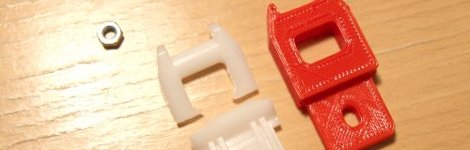
The broken plastic piece seen here keeps a dishwasher closed while running. The part couldn’t be sourced by a repairman but the best solution turned out to be printing a perfect replacement part.

Generating labels for resistor storage

[Darrell] picked up a surplus test-tube rack to use as resistor storage. It’s a great system, but his Ruby script that uses LaTeX to generate color-coded labels is a really nice touch as well.

DeLorean quadcopter build log

No, it’s not a dupe. [Alp_X] found the link to a build log for the DeLorean quadcopter that headlined our last Links post. It’s in Russian but the machine translation should help a bit.

CRT Vector Graphics Arcade Game Built From An FPGA Board

[Sprite_TM] wanted to challenge his VHDL skills, and there’s no more satisfying way of doing this than making something that will be playable when you’re done. He decided to try his hand at creating a vector-based CRT arcade. The distinction here is that vector-based games take control of the magnetic ring that guides the electron path toward the screen. This technique allows point-to-point graphic generation rather than the pixel-based scanning that CRT televisions use.

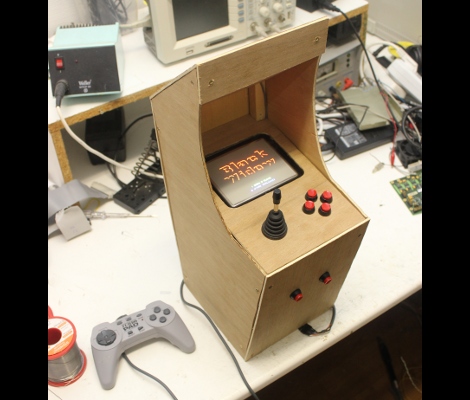
He had a small color CRT on hand and decided to grab a VHDL version of asteroids from the Internet to see if he could get it to work. But upon further inspection of the source he found that it had a chunk of code which rasterized the vectors for use with a scanning monitor. After removing that chunk, and giving it a spin he had enough confidence that he knew what he was doing to start implementing his own game. The choice of what title really came down to the hardware the original arcade cabinets used. He was not interested in implementing a soft-process for the math chips used in games like Star Wars and Tempest. In the end he got a version of Black Widow up and running, and even built a miniature cabinet for the thing. Check out some of the gameplay in the clip after the break.

Continue reading “CRT Vector Graphics Arcade Game Built From An FPGA Board”

Becoming Intelligent Designers And Saving The RepRap

While Hack a Day’s modus operandi is serving up hacks from around the Internet, sometimes we feel the need to exercise a bit of editorial freedom. A thousand words is a bit awkward for the front page, so feel free to skip the break and head straight to the full text of this article.

It’s no secret myself and my fellow writers for Hack a Day are impressed with the concept of a personal 3D printer. We’ve seen many, many, builds over the years where a 3D printer is a vital tool or the build itself.

Personally, I love the idea of having a 3D printer. I’ve built a Prusa Mendel over the past few months – Sanguinololu electronics, [Josef Prusa]’s PCB heated bed, and a very nice Budaschnozzle 1.0 from the awesome people at LulzBot. I’ve even made some really cool bits of plastic with it, including the GEB cube from the inside cover of Gödel, Escher, Bach (a very tricky object to realize in a physical form, but not a bad attempt for the third thing I’ve ever printed, including calibration cubes). Right now I’m working on the wheel design for a rocker-bogie suspension system I hope to finish by early August when the next Mars rover lands. My Prusa is a wonderful tool; it’s not a garage filled with a mill, lathe, and woodworking tools, but it’s a start. I think of it as the Shopsmith of the 21st century.

Lately I’ve become more aware of the problems the RepRap and 3D printer community will have to deal with in the very near future, and the possible solution that led me to write this little rant.

Continue reading “Becoming Intelligent Designers And Saving The RepRap”

Using The Nook As A Keyboard

[Andrew] has been pining for an Optimus Maximus – a keyboard with a small LCD screen in each key – for years. Like a lot of people, he love the idea of a completely configurable keyboard, but balked at the two thousand dollar price tag. Although it doesn’t have full color OLED screens behind each key, [Andrew]’s nook simple touch can be used as a keyboard just the same.

After rooting his new nook, [Andrew] had a very nice tablet computer, and the only Android device with an e-ink screen. Although[Andrew] never wrote an Android app before, he wanted to do a proof of concept build to see if a nook keyboard would actually work. The “keyboard app” is actually just a webpage hosted on his home server. When he presses a virtual key, JavaScript sends an ASCII value back to the server where it is decoded and sent to xte.

[Andrew] says his build works, but not very well. Opera mini doesn’t like the homebrew server he set up, and Cyrillic characters are a no go. Still, it works, and looks like an awesome application for an e-ink tablet with a proper Android app. Demo after the break.

Continue reading “Using The Nook As A Keyboard”

Storing Sketches In The Cloud

There’s a fine line between solving problems that don’t exist and solving problems that no one recognizes until a solution is found. The former shows up with housewares peddled on late-night infomercials, while the latter is summed up by [Henry Ford], “If I asked people what they wanted, they would have said faster horses.” [Dave]’s method of storing microcontroller code in the cloud definitely falls into the ‘useful’ category.

[Dave] first realized the problem when he was digging around the IDEO Toy Lab and came across an orphan project, a Barbie credit card swiper. [Dave] had no idea if the firmware for this project was saved on the server, or even if the current version was available. One solution to this problem could be burning a copy of the source onto the Flash or EEPROM on the board.

There’s a problem with this idea, though: storing the source in an Arduino’s memory takes space. Thinking laterally, [Dave] realized that editing source happens on a computer, computers are connected to the Internet, so why not keep the source “in the cloud?”

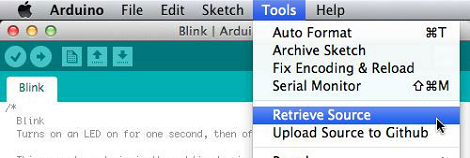
[Dave]’s solution is to host the source on GitHub, and tie every piece of code to a board’s unique USB serial number. This gives every Arduno a unique ID, allows for version control, and libraries of multiple files.

This very clever addition to the Arduino IDE is up on GitHub, ready to be added to any Arduino installation. Why the Arduino IDE doesn’t already have this feature is beyond us, but that’s what you get when you want a faster horse.

Analog Clock Display Uses A Nipkow Disk

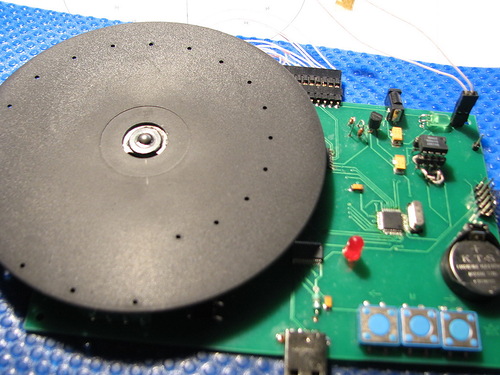
Although [Serokoy] is not thrilled with the outcome of his Nipkow disk clock (translated), but we really enjoy it. It uses the Persistence of Vision concept to create a light display from a rotating disk.

We’ve come across a lot of rotating disk clocks. Several were based off of the platters of a hard drive, using a slit, or series of slits to make up the display. This Nipkow disk uses a similar technique but in a more general way. The series of holes arranged in a spiral pattern allows a grid of concentric rings to be used as pixels when the disk is spinning. The bottom portion of the disk is used as the display area. Each pixel is illuminated at just the right time by LEDs below in order to freeze that pixel in the viewer’s eye. The demo is a bit rough, and [Serokoy] mentions that the precision of the hole layout makes all the difference. He drilled these by hand in a CD which was spray painted matte black. Even though he used a computer to lay out and print a template, it took four tries to get a suitable disk.

[Thanks Svofski]