Doing It Right With A Morse Code Keyboard

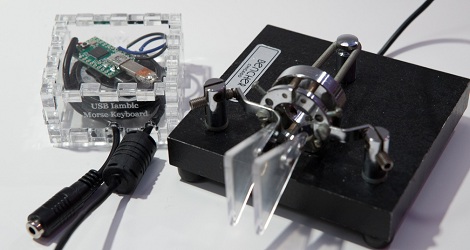
Hackaday has seen dozens of Morse code keyboards over the years, but [Hudson] at NYC Resistor finally managed to give that idea the justice it deserves. He built a USB Morse code keyboard with the same type of telegraph key the pros use.

For his project, [Hudson] got his hands on a wonderful iambic paddle that is usually hooked up to CW rigs. Unlike previous Morse keyboards we’ve seen, [Hudson] used iambic paddles, a telegraph key with one lever for dits and another for dahs. Because the dits and dahs are separate electrical connections, it’s extremely easy for the microcontroller – a Teensy – to parse the Morse code and send the correct letter to the computer.

[Hudson] also added some audio feedback for the dits and dahs, and designed a laser-cut enclosure for the Teensy and speaker. Check out the video of the iambic keyer keyboard in action after the break.
Continue reading “Doing It Right With A Morse Code Keyboard”

Electronic Bag Pipes Need No Bag And Use Only 1 Pipe

A lot of people might turn their noses up at an electronic version of bagpipes. But we see a definite need for them. After all, it’s pretty hard to take your bagpipes on a road trip, but this eChanter will have no trouble entertaining your fellow travelers.

The musical instrument is Arduino-based and the builder can decide between a headphone jack (use it with that FM transmitter when in the car!) or a speaker. The version seen above uses headphones with a piece of PVC pipe as the body, screw heads as touch sensors, and a project box to hold the electronics. But there are a lot of alternatives suggested, such as using automatic sprinkler parts. It sounds like a riser, connector, and pop-up sprinkler head body will do just as well hosting all of the components.

Want to hear what it sounds like? There’s an mp3 clip under the final steps section.

[audio http://www.echanter.com/marine-corps-hymn.mp3]

Backyard Ski Lift

If you own a cabin in the mountains of British Columbia what do you do during the warmer summer months? Well, we’d probably mix of a cocktail and string up a hammock, but [Darrin] is quite a bit more motivated. He planned for the snowy season by building his own ski lift. He shared the details in a forum post, but you’re going to have to register and wait for approval before you can view that thread. Perhaps you’ll want to look at the video after the break before making that kind of commitment. Normally we would just pass over projects that require a login to view, but this one deserves the attention.

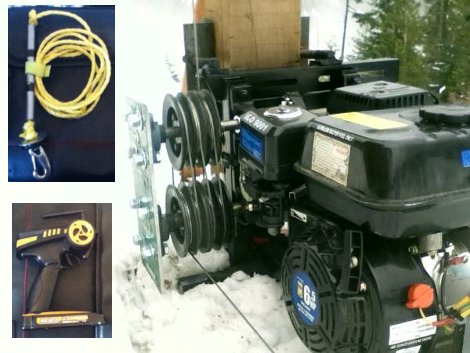
The setup is essentially a very steep tow rope. 1600 feet of 1/8″ aircraft cable covers an 800 foot span of his property. Apparently he’s got a total of 1000 feet of vertical drop but the lift doesn’t cover the whole area quite yet. That 6.5 horsepower Honda engine drives the cable loop, with the pulley system seen above used as an RPM reducer. Each skier can hook onto the cable used the nylon rope with a ski-pole spacer and a hook. The RC vehicle remote control works as a dead man’s switch, starting the lift slowly when the throttle is depressed and stopping it when released.

Normally we like to link to similar projects, but so far this is the only ski lift we’ve covered. You’ll have to settle for this ski-pole mounted POV display.

Continue reading “Backyard Ski Lift”

Automated Squinting Instead Of Glasses, Contacts, Or Lasik

[Lee] is nearsighted and has had it with contacts and glasses. When trying to figure out an alternative, he looked at the core of the problem. The eye is not shaped correctly and therefore cannot focus adequately. The solution is to change the shape of the lens. This is exactly what lasik (laser eye surgery) does, but instead of going under the incredibly bright knife [Lee] built some headgear that pulls on your face to reshape your eye.

The hardware is from an old portable CD player. The sled that moved the laser lens has been repurposed to pull a thread taped to the skin at the corner of his eye. He built a control system that lets him adjust the tension by moving his fingers. Basically when the skin is pulled tight it causes him to squint and possibly reshapes the cornea just a bit. We’re not sold on the idea, but we can’t poo-poo the experiment; who knows what discovery this could lead to? We’re just glad he didn’t use electrical impulses to hack his peepers.

You can find some test video embedded after the break.

Continue reading “Automated Squinting Instead Of Glasses, Contacts, Or Lasik”

Heatless Compressed Air Dryer

The pressurized air from a standard air compressor is fine for most uses. But some applications like plasma cutting call for low-humidity air and the hardware available to facilitate this can cost a bundle. [Roland] and his cohorts at TX/RX Labs (a Houston, Texas Hackerspace) just built this air drying system.

It works using a desiccant; a substance that sequesters moister. It’s the stuff in those little packets you find in shoe boxes and the like with a warning that you shouldn’t eat it. The image above shows two chambers which house the desiccant. Only one is used at a time, so that as it’s ability to remove moisture drops, the system can switch over to the other chamber. There’s even an automatic recharging system built in that uses a portion of the dried air to remove the humidity from the unused desiccant chamber.

There’s a functional diagram at the link above. It’s resolution is low enough that the text is almost unreadable but we’ve asked [Roland] if he can repost the image. This seems like a build in which other hackerspaces will be interested.

CNC Milled Bicycle Frame Jig

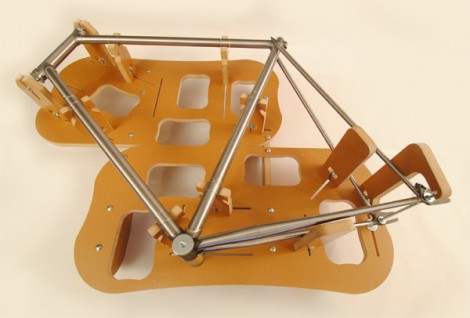
This bicycle frame jig is cut from MDF. It’s the latest in a growing trend that we love to see: the increasing availability of manufacturing techniques for the common hacker. This is a Kickstarter project, and alas it appears the designs are not available for you to cut your own. But we love the potential this shows, and maybe you can use the concept the next time you’re welding together a frame for something.

We really never look at building traditional frames at home. Mostly it’s the oddities that catch our eye. But if you’re into cycling and want to get your own custom-fit frame this has got to be the lowest-cost option available. In fact, you can get the jig and a tube set for under $600. The frame can be fit with just a few hand tools (a hack saw and a file). It uses lugs so the joints will be strong as long as you get the pipes fitting well enough for a quality welded joint.

Android 3.1 Devices Have USB Host Mode. Here’s How To Use It.

With the coming of Android 3.1 you finally have the option of using the device as a USB host. This may be through a USB OTG (On-the-Go) adaptor, but nonetheless it’s a feature which was sorely missed until now. [Manuel] put together a guide on using Android as a USB host. As you can see, his example hardware is an Arduino board but this is applicable with just about any device.

The tutorial implements a test app for the Android device where a slider will set the brightness of the Arduino’s on-board LED. The Arduino sketch is nothing special, it just reads data received on the UART. This means that it doesn’t care if it’s connected to an Android, PC, OSX, or Linux system, it goes about its business until the RX interrupt updates the data variable.

This will greatly simplify a lot of projects we’ve seen, such as this message scrolling belt buckle. That used extra hardware to make the Arduino the host, a step that is now necessary.