The GATARI “2600” Musical Instrument

gatari

So do you have an Atari 2600 laying around collecting dust? Perhaps you’d like to have a musical instrument to take up the time that you would spend playing video games if you had a modern console. Well, look no further than the GATARI 2600!

[cTrix] made this device with a custom EPROM chip plugged in as a cartridge. Although details of the build are somewhat vague, this custom chip allows music to be written for the device. Everything is controlled with a joystick that tells the GATARI to generate the desired track. From this basic track, the sound is modified using three pedals including an equalizer, a flange pedal, and a hold pedal.

Check out the video after the break for a brief explanation of how it was built. Skip to 1:05 if you’d rather just see it in action at [Blipfest] in Japan!

If you’d rather listen to music rather than playing it, why not build your own snap together boombox instead!

Continue reading “The GATARI “2600” Musical Instrument”

Watch All Of The Freshly Published Talks From 28c3

The 28th Annual Chaos Communications Congress just wrapped things up on December 31st and they’ve already published recordings of all the talks at the event. These talks were live-streamed, but if you didn’t find time in your schedule to see all that you wanted, you’ll be happy to find your way to the YouTube collection of the event.

The topics span a surprising range. We were surprised to see a panel discussion on depression and suicide among geeks (hosted by [Mitch Altman]) which joins another panel called Queer Geeks, to address some social issues rather than just hardcore security tech. But there’s plenty of that as well with topics on cryptography, security within web applications, and also a segment on electronic currencies like Bitcoins.

There really is something for everyone and they’ve been thoughtful enough to include playlists for all talks, just the lightning talks, and lightning talks categorized by the day they occurred. Get those links from their YouTube channel description, or find them after the break.

Continue reading “Watch All Of The Freshly Published Talks From 28c3”

Easy Rotary Encoding For Your Projects

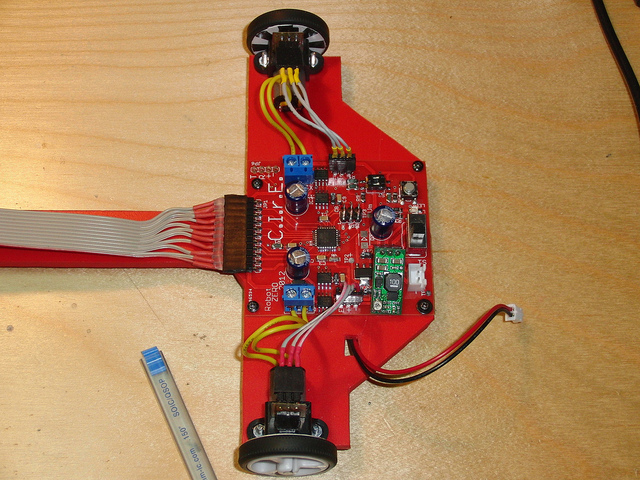
Want to monitor how much a wheel has turned in your project? Then you need a rotary encoder! Here’s a way to add rotary encoding without changing the mounting method of your wheels (translated). [Jorge] added it as a way to improve the functionality of this line-following robot. It uses a paper encoder wheel which is monitored by an optical sensor.

The paper wheel consists of alternating white and black pie pieces. You can make this with a felt-tipped marker, or use a tool like the one we featured a couple of years ago to print out a disc rendered to your own specifications. This is glued to the inside of the wheel and monitored by a CNY70 reflective sensor (the same one used in that electric keyboard retrofit).

The homemade board which holds the sensor can be seen mounted on top of each wheel’s motor. It requires three wires, voltage, ground, and data. The data line is connected to the output of the phototransistor in the CNY70 package so it can be used with a microcontroller interrupt for easy integration with the firmware driving the robot.

[Jorge] goes into some detail about how the added data helps to improve the speed performance seen in the clip after the break.

Continue reading “Easy Rotary Encoding For Your Projects”

Pep Up Your House Cat’s Boring Wintertime Life

With winter upon us, and all the windows shut, [Garfield] and [Socks] can get a little restless. But [Dino] is determined to keep his furry friends entertained through the cold dark months. He hit the junk box, and used some interesting fabrication techniques to build the Chase-a-Mouse motorized cat toy.

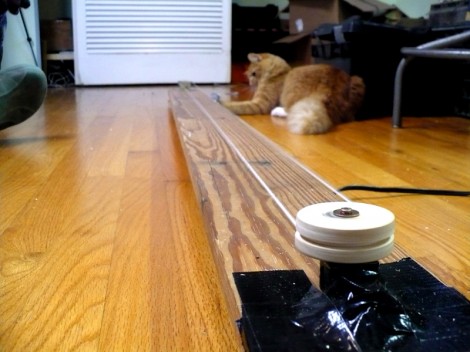
The toy is popular with the cats because it incorporates two traditionally satisfying features; something to chase, and an obstacle to chase it around. The base of the unit is a long plank which is held up from the floor by a couple of inches. The loop of rope which spans the board’s length has a mouse attached to it with about six inches of string. When the motor is flipped on it bounces and jerks its way around the circuit, darting in and out of the space below the base.

As you can see in the video after the break the motor is a bit loud. [Dino] used the sweeper motor from a Roomba for this. It might freak the kitties out at first, but curiosity will get the better of them eventually. It’s a quick build, and we love the drill-turned-lathe that is used make the wooden pulley for the system.

Continue reading “Pep Up Your House Cat’s Boring Wintertime Life”

Give Yourself A Sixth Sense On The Cheap

sixth-sense-magnetic-ring

Hackaday regular [Mikey Sklar] is no stranger to body modifications. He enjoys tweaking his body in ways that help him with day to day tasks, including a ruler tattoo on his arm and an RFID chip embedded in the web of his hand. Lately, he has been toying around with a less invasive means of getting a better feel for magnetic fields in his surroundings.

Turned on to magnetic rings by a friend, he now wears an epoxy-coated rare earth ring every day, changing the way he interacts with the world. He says that besides the obvious ability to tell when he’s near iron-heavy material, he can also feel cell phone calls, as the speaker draws the ring closer while producing sound.

He says that holding the electric cord of his tea kettle gave him the biggest start, making him feel as if he had been electrocuted, minus the actual shock.

While it’s not the most high-tech hack, [Mikey] is quite happy with the “sixth sense” this reasonably price ring has been able to provide – we just might have to try it out ourselves.

See Through Everything With A Home Made X-ray

[Grenadier] built his very own x-ray machine. He’s no stranger to high voltage – we’ve seen his Jacob’s Ladders and Marx generators. Surely he can handle himself with high voltage and dangerous equipment. With this portable x-ray machine, [Grenadier] has begun overloading Geiger counters. We’re just happy he knows what he’s doing.

The key component of [Grenadier]’s portable x-ray machine is the Coolidge tube, a simple vacuum tube that produces x-rays with the help of 75 kilovolts of power. The finished build looks awesome. Two meters display the milliamps and kilovolts going to the x-ray tube, and a trio of nixies display the exposure time.

Even though [Grenadier] doesn’t have x-ray film, he can see through things with a scintillation screen that fluoresces when exposed to ionizing radiation. There are two pictures of the x-ray in action – one showing the inside of a pen and the guts of a hard drive (as shown in the title pic).

The output of the x-ray was measured with a Geiger counter. [Grenadier] was able to get a hit every second or so at 50 yards, and very loud white noise at 1 foot. Check out the video of [Grenadier]’s Buildlounge laser cutter contest submission after the break.

via Buildlounge

Continue reading “See Through Everything With A Home Made X-ray”

led-light-wall

Hackerspace Light Wall Plays Video At 30 Fps

The folks at The Quad Cities Collaboration and Hackerspace (QC Co-Lab) were trying to find something to build for their first big project, and had to look no further than the wall for inspiration. The north end of their facility is home to a huge 15×17 glass block wall that happens to face a well-traveled roadway.

They decided that turning the wall into a huge LED display would be a great way to attract attention from passers-by, so they picked up some GE Color Effects lights and got down to business. Once they found out that the technical college next door was putting on an open house, the race was on to get the light display assembled as quickly as possible to maximize their exposure.

The team mounted the 255 LEDs in vacuum-formed reflective cones, which were attached to wooden frames before being installed behind the glass wall. An Arduino drives the entire display at a smooth 30 frames per second, a task they say tests the very limits of the board’s capabilities.

They finished the job in time for the open house, and as you can see in the video below, the display looks great.

Nice job QC-Co-Lab!

Continue reading “Hackerspace Light Wall Plays Video At 30 Fps”