There’s More To Global Positioning Than Just GPS

The Global Positioning System (GPS) was developed by the United States military in the 1970s, but it wasn’t long before civilians all over the planet started using it. By the early 2000s the technology was popping up in consumer devices such as mobile phones, and since then its become absolutely integral to our modern way of life.

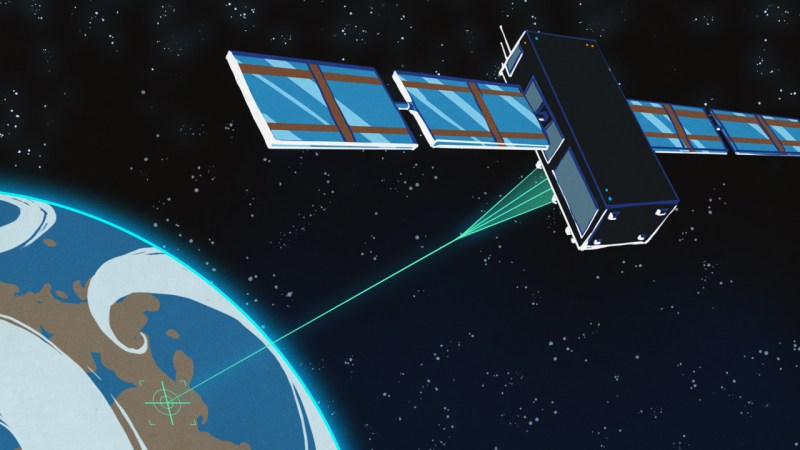
But although support for GPS in our gadgets is nearly ubiquitous, it’s not the only option when it comes to figuring out where you are on the globe. As you might imagine, not everyone was thrilled with building their infrastructure around one of Uncle Sam’s pet projects, and so today there are several homegrown regional and global satellite navigation systems in operation.

As a follow-up to our recent dive into the ongoing GPS upgrades, let’s take a look at some of the other satellite positioning systems and who operates them.

Continue reading “There’s More To Global Positioning Than Just GPS”
University Of Utah’s TRIGA Research Reactor Set To Produce Electricity

Research reactors come in many forms and sizes, with the TRIGA class being commonly found at universities. The TRIGA reactor at the University of Utah was installed in 1975, and for the past half century the thermal energy it produced was bled off into cooling systems. Now for a world’s first, the reactor will be used to generate electricity instead.

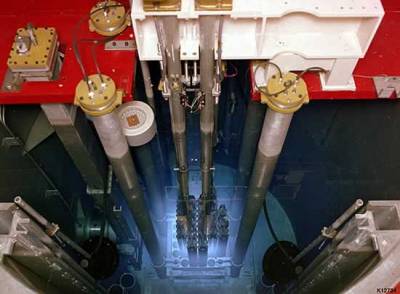
A TRIGA reactor core, with the blue glow from Cherenkov radiation. (Source: DoE, Wikimedia)

What makes the TRIGA design so practical for small research reactors is its inherent safety due to the use of uranium zirconium hydride (UZrH) fuel, which imposes a strong negative thermal coefficient on the reactivity. Along with no need for any kind of containment, these pool-type, water-cooled reactors thus allow for a pretty good look at the literal internals of the reactor core.

Their thermal power outputs range from 0.1 – 16 MWth, with the University of Utah reactor generating on the low end of the scale here, at 50 kWth. This energy will be partially used by a generator that has been developed by Elemental Nuclear, a startup company who looks to be trying to commercialize TRIGA fuel for microreactors with sodium coolant.

The installation at this TRIGA reactor should thus be seen as a proof-of-concept for Elemental Nuclear’s generator design, which uses a closed Brayton cycle with helium gas to generate an output of about 2-3 kWe from the ~13 kW generated by the turbine. This generated power will – of course – be used to power some racks with GPUs for ‘AI’ tasks. If successful, it could show the way for TRIGA-based microreactors to power datacenters.


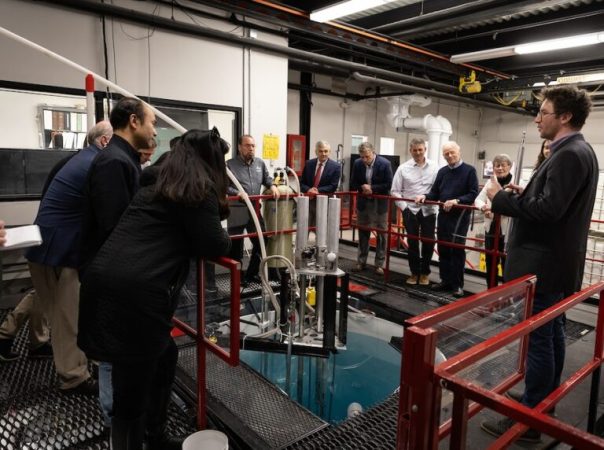
Top image: the TRIGA reactor during a tour. (Credit: University of Utah)

This Az-El Mount Is Worth Following

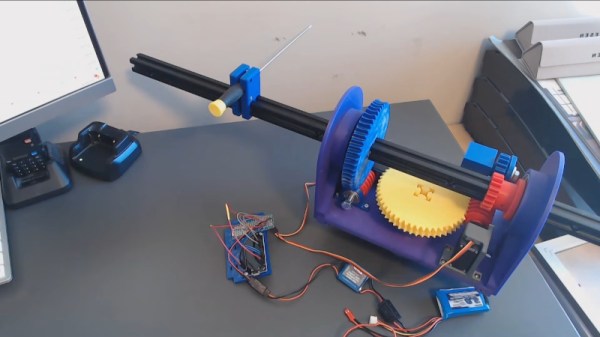
Communication with satellites often involves the use of high-gain directional antennas coupled with careful positioning to find and track the target. With a geostationary satellite the mount is either fixed or a single-axis polar mount, but when the craft is moving in a different orbit it becomes more of a challenge to stay locked on. An azimuth-elevation mount is needed to cover the whole sky, and [Ham Radio Passion] has one as a work in progress. It’s 3D printed and looks straightforward, making it a project to watch.

An az-el mount has two parts, the first being a turntable to set the azimuth, and the second being a horizontal rotating axis to set the elevation. He’s mounting the antenna to a piece of aluminium extrusion and driving it through a set of 3D printed gears driven from a 360 degree servo with a worm drive. He explains why the servo makes more sense to him here.

The result is not yet a finished project, but it shows enough promise to make it worth keeping an eye on. It’s by no means big enough for a huge antenna array, but we can imagine antennas for higher frequencies would be well within its capabilities. Meanwhile it’s certainly not the first az-el mount we’ve seen.

Continue reading “This Az-El Mount Is Worth Following”