The Teenage Angst Of 3D Printing: Solidoodle, Printrbot, And Bridges

Bridges are a part of our constructed landscape that we take for granted. And bridges by themselves aren’t especially important. What is important is that bridges let you get from one place to another. Technology is often the same. We get from point A to point B through some bridge technology that, probably, most normal people never even notice.

Years ago, point A was commercial 3D printing. Industry had stereolithography, selective laser sintering, fused deposition modeling, and other rapid-prototyping technologies. These were not toys. They were expensive industrial systems used by companies that needed prototypes badly enough to pay serious money for them.

Fast Forward to Today

Today, you can go to a big box store and buy a 3D printer for well under $1,000, and often far less. Modern machines are almost plug-and-play and tend to do all the hard parts for you. That’s point B. How we got between points is a story of hackers who had a dream, and many Hackaday readers lived through it and even played a part in that bridging.

For a long time, RepRap was synonymous with hobby-level 3D printing. The project, started by [Adrian Bowyer] at the University of Bath in 2005, was built around a powerful idea: a machine that could print many of its own parts, thereby helping make more machines. RepRap Darwin reached its early self-replicating milestones in 2008, and the movement produced a thicket of descendants, variants, and arguments about rods, belts, bearings, extruders, firmware, and what “self-replicating” really meant. Of course, the machine could only print some of the parts you needed, but it was still impressive how much of a printer you could make with one printer.

Without RepRap, the desktop 3D printer boom would have looked very different. It created a common pool of ideas: Cartesian frames, printed brackets, hobbed bolts, heated beds, RAMPS boards, Marlin firmware, and a whole common vocabulary. It also created the expectation that a 3D printer was something you could understand, modify, repair, and improve. That expectation would not survive everywhere, but it defined the early culture.

Continue reading “The Teenage Angst Of 3D Printing: Solidoodle, Printrbot, And Bridges”
HamsterOS Crams Complete Graphical Desktop Onto 1.44 MB Floppy

It’s not every day that there’s a new OS in the works for 386 and 486-era hardware, but [John Swiderski] let us know he working hard to bring HamsterOS to retrocomputing enthusiasts everywhere.

HamsterOS targets a November 2026 release.

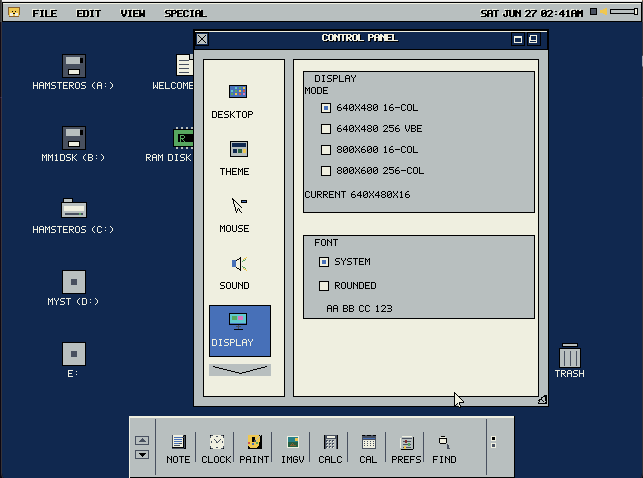
HamsterOS is a tiny but full-featured multitasking 32-bit graphical operating system that fits on a single 1.44 MB floppy disk. It’s designed as a floppy-first OS, but can easily be installed to a hard drive and includes a suite of native applications. There’s even DOS support!

The list of features is impressive, many of which are targeted at making life a little easier for those working with vintage hardware. One example we like is the CMOS crash counter, which automatically forces the system into a basic VGA safe mode after three consecutive failed boot attempts.

Speaking of making vintage computing a little easier to handle, [John] also released HamsterWeazle, a free GUI front-end for Greaseweazle, the open-source USB device that makes interfacing to old floppy drives easy. If you’re finding yourself intrigued by software like HamsterOS but wondering how you’d write to a 1.44 MB floppy without already having some old hardware up and running, Greaseweazle over USB — and HamsterWeazle to make it much more user-friendly — is one way you’d do it.

We recently featured GentleOS, a charming and streamlined graphical OS aimed at vintage hardware that makes a point of showing what’s possible when new ideas meet old hardware. If you have a retrocomputing project you want to show off, custom OS or otherwise, let us know on our tips line!

It’s Linux, On A Sega Megadrive

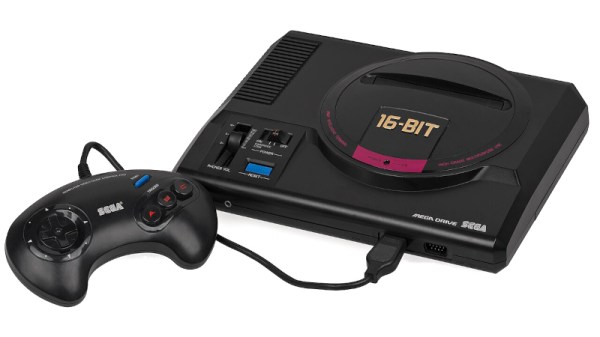
If you were in the market for a games console in 1990, the chances are that the object of your desire was either a Super Nintendo with its 16-bit 6502 derivative, or the Sega Megadrive, sold as the Genesis in North America, with its Motorola 68000. Both machines featured impressive graphics and sound for their time, but they remain firmly in the 16-bit era. Which makes it a surprise to see LinuxMD. It’s Linux, for the Sega Megadrive, with the latest mainline kernel.

The Motorola 68000 series of chips was the first porting target for Linux, and is still maintained in 2026. This build runs from an SD card  in a modern Megadrive storage peripheral, and is reported to run on the original hardware. The lowly 68000 in the Sega doesn’t have a memory management unit required for the full Linux experience, so what’s really running here is a kernel compiled with the -nommu option. That in itself is a feat, on this architecture. On it you get smolutils, a cut down coreutils, and that seems to be it.

We like this project, for pushing both console and kernel to the limit, even though we see that maybe it’s not the most practical Linux machine. Meanwhile though, this isn’t the only UNIX-like OS for this console.


Image: Evan-Amos, Public domain.