Hackaday Dictionary: Bluetooth Low Energy

Bluetooth is one of the mainstays of the mobile gadget world, allowing mobile devices to communicate easily over short distances. It’s how your wireless headset talks to your cell phone without the complexity and power requirements of WIFi. In particular, the Bluetooth Low Energy (BLE) component is interesting for those who build portable gadgets, because it requires a very small amount of power. Continue reading “Hackaday Dictionary: Bluetooth Low Energy”

Transmitting Tee Vee From A Pi

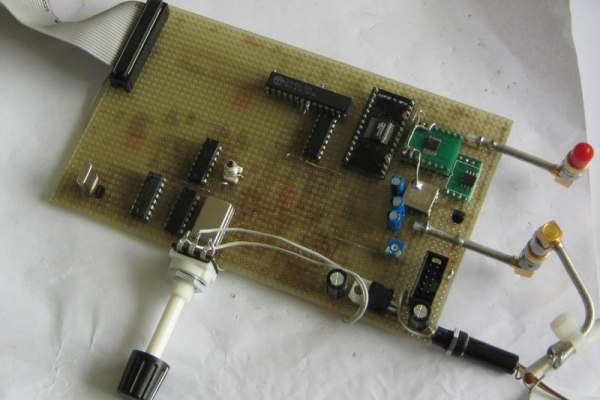
Want to set up your own television station? This hack might help: [Jan Panteltje] has worked out how to turn a Raspberry Pi into a DVB-S transmitter. DVB-S is a TV transmission standard originally created for satellite broadcasts, but Hams also use it to send video on the amateur bands. What [Jan] did was to use software on the Pi to encode the video into the transport stream, which is then fed out to the home-made transmitter that modulates the data into a DVB-S signal. [Jan] has successfully tested the system with a direct connection, feeding the output of the transmitter into a DVB-S decoder card that could read the data and decode the video signal. To create a real broadcast signal, the next step would be to feed the output of the signal into an amplifier and larger transmitter that broadcast the signal.

Continue reading “Transmitting Tee Vee From A Pi”

90,000 Lumen Flashlight Is Illuminating, Impractical And Blindingly Good

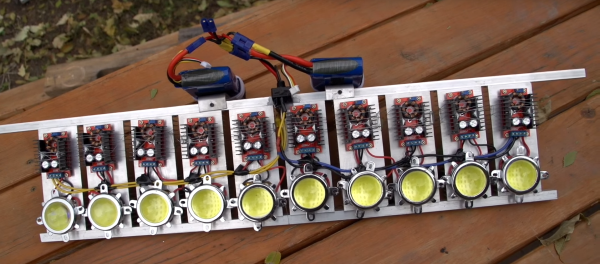
It may be better to light a single candle than to curse the darkness, but that was before [RCTestflight] came up with this: a 1000W LED flashlight that outputs about 90,000 lumens of light. That’s a lot: the best pocket LED flashlights output about 700 lumens.

[RCTestflight] built this monstrosity using ten 100-Watt LEDs, running off two RC car batteries. Each of the LEDs is connected to a sizable voltage converter and a very large heatsink that holds all of them in place. He says he gets about 8 minutes of light out of this thing, and that the heatsink gets warm after a minute or two of use. We’re not surprised: LEDs are more efficient than most other devices at converting electrical energy to light, but some always gets lost as heat.

Check out the video after the break. It’s very impressive, but this thing isn’t particularly practical as a handheld. It is big, heavy and is visible for miles. If you really want to light something up it does a great job (for a short period of time) due in part to the inclusion of a glass lens for each of the LEDs. This effectively focuses the beam on a properly distributed area. We wonder what would happen if all the beams were focused on one point? As long as you don’t cross the streams

We have covered a few more practical builds using similar LEDs, but this thing does have a certain outrageous charm, and could be useful for high-speed video, where the more light, the better.

Continue reading “90,000 Lumen Flashlight Is Illuminating, Impractical And Blindingly Good”

Bubble Catcher Watches Your Booze Burp

Making your own booze involves a lot of sitting around waiting for things to happen, like waiting for the fermentation process to finish so you can get on with bottling and drinking it. That involves watching the bubbles in the airlock: once the frequency of the bubbles falls below a certain level, your hooch is ready for the next step.

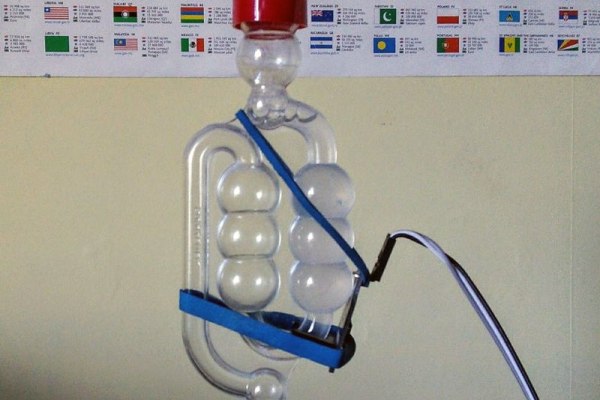
[Waldy45] decided to automate this process by building a bubble catcher that measures the frequency of bubbles passing through the airlock. He did this using an optocoupler, a combination of LED and light sensor that changes resistance when something passes between them. You can’t see it in the image, but the horseshoe-shaped optocoupler is slotted around the thin neck in the bubble tube to sense when a bubble passes through.

The optocoupler is connected to an Arduino, running a bit of code that generates an interrupt when the optocoupler is triggered. At the moment, this just outputs an average time between bubbles to the serial port, but [Waldy45] is looking to add an ESP8266 to wirelessly connect the Arduino and contact him when the bubble frequency falls, indicating that the booze is ready for bottling.

We’ve seen a couple of over the top beer breweries before (here and here), but none of them have automated the actual fermentation stage, so something like this would definitely be an addition. Cheers!

FleaFPGA + Arduino Uno = FleaFPGAUno

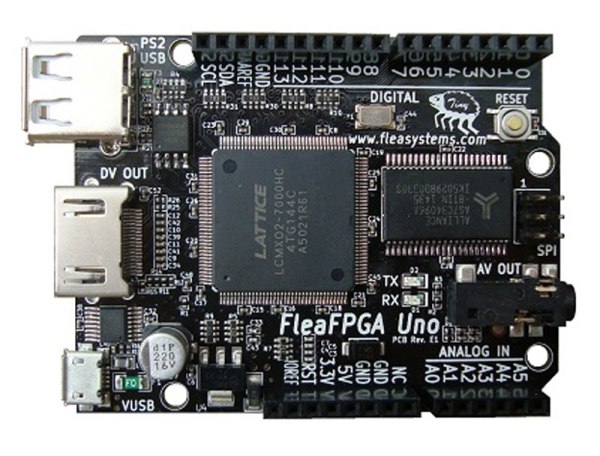
Some things are better together: me and my wife, peanut butter and jelly, and FPGAs and Arduino Unos. Veteran hacker [Valentin Angelovski] seems to agree: the FleaFPGA Uno is his latest creation that combines an FPGA (a Lattice MachX02 700HC) with an Arduino-compatible CPU.

It’s a step-up model from the origional FleaFPGA. With a few other components thrown in (such as a HDMI and composite video output and a WiFi option), you have a killer combination for experimenting with FPGAs or building an embedded system. That is because the Arduino part frees the FleaFPGA Uno from the breadboard: you can easily program, control and interface with the FPGA over a serial line or a wireless link using the Arduino IDE. There is even support for Arduino shields (albeit only 3.3V ones), making it even more expandable. This would be an awesome starting point for a retro gaming system, as many 8-bit consoles can be easily emulated in an FPGA. [Valentin] is currently selling the boards directly, and they are very reasonably priced at $50 or $60 for the WiFi version.

Continue reading “FleaFPGA + Arduino Uno = FleaFPGAUno”

Motorized Picnic Table Terrorizes Perth Streets

There is a public menace on the streets of Perth, Australia: two motorized picnic tables. Police are looking for the drivers of the, erm, vehicles, which were seen cruising down the West Coast Highway, complete with passenger casually sitting on the tables having a drink. It looks like the two picnic tables are being driven by a centrally mounted lawnmower motor and are controlled from one of the seats. The police are interested because it is illegal to drive something on the public road in Australia that isn’t properly licensed. I’ll bet that his insurance probably doesn’t cover taking it out for a spin on the highway, either. The accompanying TV news report does not identify the person responsible, but they claim have spoken to the builder, who says that the two tables can manage up to 50 miles per hour. They claim that he is even working on an upgraded model that includes a built-in barbecue, which could bring a whole new meaning to the term drive-thru.

Continue reading “Motorized Picnic Table Terrorizes Perth Streets”

Molecular Motor Drives Nano Submarine

Technology keeps making things smaller, but this is ridiculous. Scientists at Rice University in Houston have just made a tiny submarine with a molecular motor. They call it a unimolecular submersible nanomachine (USN), because it is composed of a single molecule made up of 244 atoms. The really smart bit comes from how it is driven: when the molecule absorbs a photon of light, one of the bonds that holds it together becomes more flexible, and the tail spins a quarter of a rotation to attach to another atom and reach the preferred lower energy state. This motion moves the molecule, and the process repeats. This happens millions of times a second.

I wouldn’t put down a deposit on a nanosub quite yet, though: the motion is random, as there is no way to steer the molecule at present. The researchers figured out that it behaves this way by analyzing the way that the molecule diffuses, because these molecules diffuse 25 per cent quicker with the light source than without.  Nope, not very practical, but it is a neat bit of molecular hackery.