Analyzing The Microsoft Surface Touch Keyboard Cover

The Microsoft Surface is an awesome Tablet PC, but it has one problem: there is just one USB port on it. There is an additional port, though: a connector for the Surface Touch Keyboard connector. That’s what [Edward Shin] is looking into, with the long-term intention of creating an adapter that allows him to connect a Thinkpad keyboard to this proprietary connector. His initial work identified the connector as using Microsoft’s own HID over I2C protocol, which sends the standard USB HID protocol over an I2C connection. So far so good, but it seems to get a little odd after that, with a serial connection running at nearly 1 Mbps and sending 9 bits per transfer with 1 stop bit. Presumably this is because Microsoft had planned to release other devices that used this connector, but this hasn’t panned out so far.

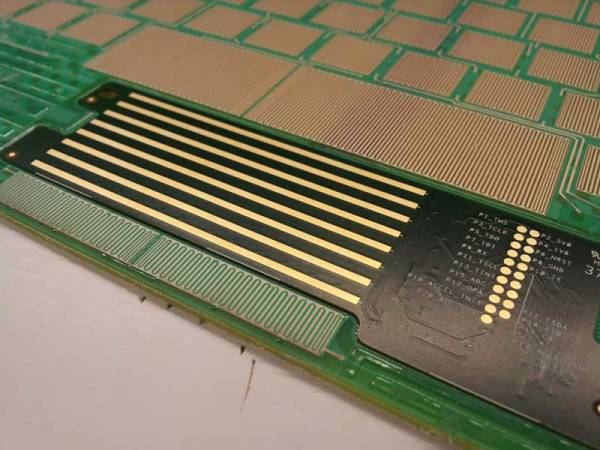
Anybody want to help him out? He has posted some captured data from the connection for analysis, and is looking for assistance. We hope he manages to build his converter: a Microsoft Surface with a decent keyboard and an open USB port would be a great portable setup. Bonus: for those teardown fans among you, he has done a great teardown of a Touch Cover keyboard that reveals some interesting stuff, including a lot of well-labelled test points.

Via [Reddit]
Dutch Student Team Aims To Launch Rocket To 50KM

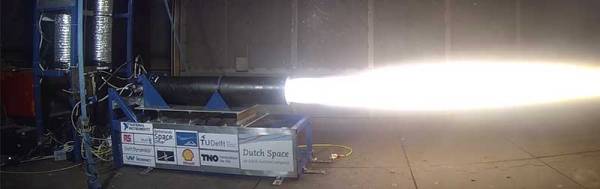
Space. The final frontier. These are the voyages of DARE, the [Delft Aerospace Rocket Engineering] team, who are looking to launch a rocket to 50 kilometers (about 31 miles) to break the European amateur rocketry record later this year.

This brave crew of students from the Delft Technical University is boldly going where no European amateur has gone before with a rocket of their own design called Stratos II, a single stage hybrid rocket which is driven by a DHX-200 Aurora engine. This self-built engine uses a combination of solid Sorbitol and candlewax fuel, with liquid Nitrous Oxide as the oxidizer. The rather unlikely sounding combination should produce an impressive 12,000 Newtons of maximum thrust, and a total of 180,000 Ns of impulse. It’s difficult to make a proper comparison, but the largest model rocket motor sold in the US without a special license (a class G) has up to 160 Ns of impulse and the largest engine ever built by amateurs had 411,145 Ns of impulse.

The team did try a launch last year, but the launch failed due to a frozen fuel valve. Like any good engineering team, they haven’t let failure get them down, and have been busy redesigning their rocket for another launch attempt in the middle of October, Their launch window begins on October 13th at a military base in southern Spain, and we will be watching their attempt closely. Godspeed, DARE!

In commercial space news, yesterday NASA tested the RS-25 engine that will be used in the Space Launch System — the rocket it’s developing to take astronauts to the moon and mars. Also, the NTSB report on the tragic crash of SpaceShipTwo was released a few weeks ago. The report found that the feather mechanism was unlocked by the copilot at the wrong time, leading to the crash. Future system improvements will be put in place to ensure this doesn’t happen again.

Update – The Stratos II is a single-stage rocket, not a two-stage, as an earlier version of this article described. 8/16/15

Continue reading “Dutch Student Team Aims To Launch Rocket To 50KM”

Amazon Dash: Hack It To Run Your Own Code

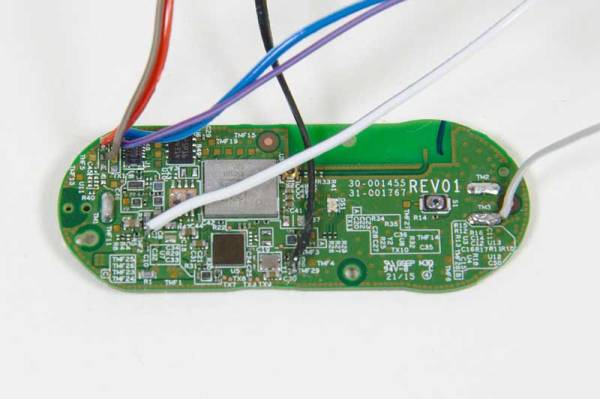
The Amazon Dash is a $5 push-to-buy-cat-litter button which has excellent potential for repurposing, but you need to know what is going on inside first. [Tony Dicola] has the details in this excellent bare metal guide to the Dash. In this, he covers how to get inside the Dash and reprogram it to do something more interesting than buying cat litter.

He first cracks the device open, connecting a programmer, then building a toolchain to compile programs to run on. This isn’t for the faint-hearted because you are programming directly for a device that wasn’t really built for it, but [Tony] has posted examples and there are few tools to hold your hand on the way. There is a safety net, [Tony] provided details on how to reset the Amazon Dash Button if you manage to brick it.

We have seen some interesting hacks that repurpose the Dash to capture your child’s bowel movements by intercepting the device connecting to WiFi, but this guide takes it a step further. It allows you to run your own code, which turns this into a really low-cost and well-engineered all-in-one WiFi device. The missing piece is proof-of-concept code to run the WiFi module inside. If you’re working on that we’d love to hear about it!

Continue reading “Amazon Dash: Hack It To Run Your Own Code”

Cheap Projector Tells Time, Invades Space

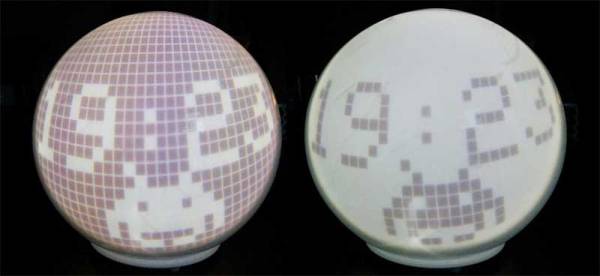
Building a video projector isn’t something that most people do casually, but [Dominic Buchstaller] isn’t most people. As part of an ongoing street art  project, he built a rather neat scrap video projector/bedside lamp/clock device he calls Great Balls of Fire. It is made from a Nokia cell phone screen and a small projector mechanism, mounted inside a frosted glass light sphere.

One of the most interesting parts of the build is the projector mechanism. Rather than build one from scratch or tear apart an expensive Pico projector, [Dominic] found another source: a cheap car logo projector from eBay. These are designed to show a car manufacturer logo on the ground when you open your car door. It came with all of the parts he needed, including an LED light source and optics. He tore that apart and replaced the car logo with the phone screen, creating a very cheap projector. It isn’t that bright, but it is bright enough that when he mounted it inside the glass sphere, it could project the time and the odd space invader. It’s a great example of how sometimes it makes sense to look for a cheap solution rather than a free one: buying the car logo projector saved him a lot of hassle in building the optics. [Dominic] was also responsible for this awesome old-school tube radio hack, where he replaced the guts of an old radio with an internet radio player.

Continue reading “Cheap Projector Tells Time, Invades Space”

Arduino Based Remote Shutter For Beme

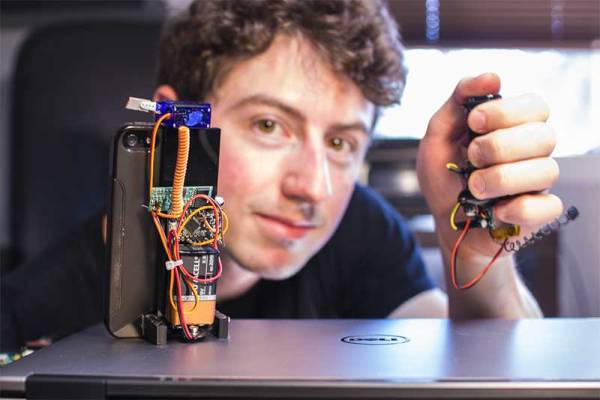
The well-dressed hacker [Sean Hodgins] has put together a neat little project: a battery powered remote shutter. He built it for use with Beme, the latest Snapchat clone that all of the cool kids are now using.

This service is designed to get away from the selfie culture by starting to record when you hold your phone against your chest, so you are looking at the thing being recorded, not your phone. [Sean] wanted a bit more control than that, so he built a remote control that starts the recording by moving the servo arm over the proximity sensor.

He built this neat little device from an Arduino Pro Mini, a battery, a small servo, a couple of power control boards and a cheap RF link from SeedStudio, all glued onto an iPhone case. It’s a bit rough around the edges (the servo makes some noise that is picked up on the recording, for one thing), but it is a great example of how to lash together a quick prototype to test a project out.

Continue reading “Arduino Based Remote Shutter For Beme”

Laser Cut Your Own Vinyl Records

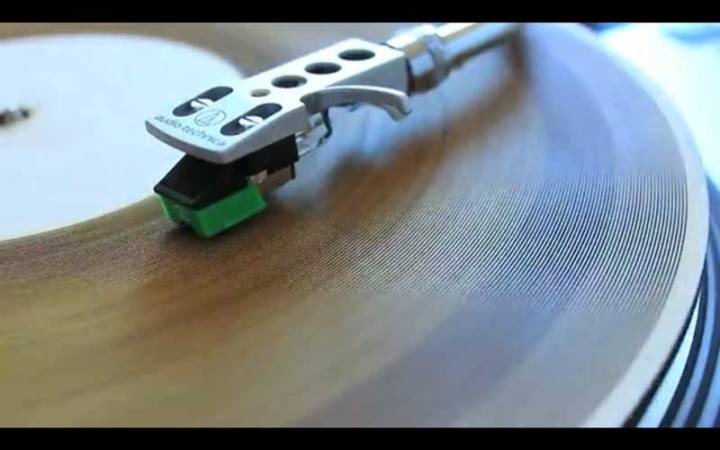
[Amanda Ghassaei] has created an awesome hack for making your own vinyl records using a laser cutter from an MP3 file. Her excellent hack uses a Processing sketch that converts a digital audio file into a vector graphics file, which is then burned onto vinyl using a laser cutter. We saw a demo of this at the FabLab11 conference, and it’s an impressive hack.

One of the best parts of her write up are the details of how she arrived at the appropriate processing settings to get the record sounding as good as possible, but still be cuttable. It’s an object lesson in how you iterate on a project, trying different approaches and settings until you find the one that works. She also decided to take it a few steps further, cutting records on paper and wood for the ultimate eco-friendly record collection.

Audiophiles should avoid this technique though. Due to limitations in the resolution of the laser cutter, [Amanda] ended up having to reduce the bandwidth of the audio signal to 4.5Khz and use a 5-bit sampling depth. That translates to a rather tinny-sounding record. Vinyl record snobs can breathe easy: this isn’t going to replace their beloved white-hot stampers. For the rest of us, there are always records etched into tortillas.

Continue reading “Laser Cut Your Own Vinyl Records”

Secrets Of The Lexus Hoverboard Revealed

Auto site [Jalopnik] got some hands-on (or rather feet-on) time with the Lexus hoverboard that was built for an advert for the luxury car brand, and their video reveals a few secrets about how this interesting device works. It is definitely real: the Jalopnik writer got to ride it himself, and described it as “Unbelievably difficult yet at the same time unbelievably cool, both because you’re levitating and because the board is filled with magnets more than 300 degrees below zero“. But a look behind the scenes reveals that it is another tease.

The device looks like it is a real hoverboard, floating several inches above the surface and even traveling over water, a feat that Marty McFly couldn’t do. But, as usual, there is a little more going on than meets the eye. The device is built around superconducting magnets cooled by liquid nitrogen, so it only works for about 10 minutes. After that, you have to refill the device with liquid nitrogen. The surface that the board is floating over also has what the Jalopnik writer describes as having “several hundred thousand dollars worth of magnets built in“. Try this on a non-magnetic surface and you’ll come to a grinding halt. If you watch the video of the hoverboard serenely gliding over the water from another angle, you can see a magnetic track just under the surface. If you run off this track, you’ll end up with wet feet.

Is it a neat hack? Yes. Is it cool? Yes. Is it the future of transportation? No: it is a cool hack put together for a car advert with a big budget. Kudos to Lexus for spending the cash to do it properly, but once again, our dreams of hoverboards are dashed in the cold, hard light of reality. Darn.