Which Microcontroller Is Best Microcontroller?

Let’s say you’re working on a project, and you need a microcontroller. Which chip do you reach for? Probably the one you’re most familiar with, or at least the one whose programmer is hiding away in a corner of your desk. Choosing a microcontroller is a matter of convenience, but it doesn’t have to be this way. There are dozens of different ARM cores alone, hundreds of 8051 clones, and weirder stuff including the Cypress PSoC and TI’s MSP430. Which one is best? Which microcontroller that costs under a dollar is best? That’s the question [Jay Carlson] tried to answer, and it’s the best microcontroller shootout we’ve ever read.

[Jay] put together a monster of a review of a dozen or so microcontrollers that cost no more than a dollar. Included in this review are, from Atmel: the ATtiny1616, ATmega168PB, and the ATSAMD10. From Cypress, the PSoC 4000S. From Freescale, the KE04 and KL03. Holtek’s HT-66, and the Infineon XMC1100. From Microchip, the PIC16, PIC24, and PIC32. From Nuvoton, the N76, and M051. The NXP LPC811, Renesas RL-78, Sanyo LC87, and Silicon Labs EFM8. ST’s STM32F0 and STM8. STCMicro’s STC8, and finally TI’s MSP430. If you’re keeping score at home, most of these are either ARM or 8051-style cores, but the AVRs and PICs bump up the numbers for ‘proprietary’ core designs.

This review begins the same as all tech reviews, with a sampling of tech specs. Everything is there, including the amount of RAM to the number of PWM channels. [Jay] is going a bit further with this review and checking out the development environments, compilers, dev tools, and even the performance of different cores in three areas: blinking bits, a biquad filter, and a DMX receiver. There’s an incredible amount of work that went into this, and right now, this is the best resource we’ve seen for a throwdown of microcontrollers.

With all this data and the experience of going through a dozen different microcontroller platforms, what’s [Jay]’s takeaway? The STM32F0 is great, the Atmel/Microchip SAM D10 has great performance but you’ll be relying on some third-party libraries. The pure Microchip parts — the PIC16, PIC24, and PIC32 — have infinite product lifetimes, a wide range of packages, and a huge community but use a clunky IDE, and expensive compilers. The Cypress PSoC was just okay, and the PSoC5 or PSoC6 would be better. Surprises from this test include the Renesas RL-78 and its high performance, low cost, and the most power-efficient 5V part in the test.

With all that said, what’s the best microcontroller? That’s a dumb question, because the best microcontroller will always be the best microcontroller for that application. Or whatever you have sitting around in the parts drawer, we were never quite clear on what the answer actually is. That said, this is a new high water mark for microcontroller reviews, and we hope [Jay] will continue his research into microcontrollers that cost more than a dollar.

Hackaday Prize Entry: A Mess Of VGA On A Breadboard

Before all our video games came over the Intertubes, before they were on CDs, and before they were on cartridges, video games were all discrete logic. Pong was the first and you can build that out of several dozen logic chips. The great [Woz] famously built Breakout out of 44 simple chips.

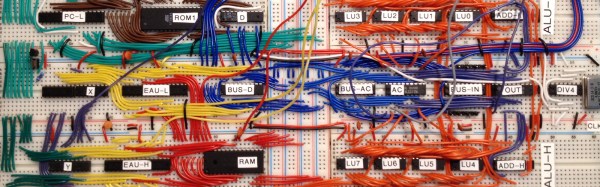
For [Marcel]’s entry to the Hackaday Prize, he’s taking the single board microprocessor-less computer to the next level. He’s building a multi-Megahertz 64-color computer on a breadboard. What’s the capacitance of a breadboard? Just ask [Marcel].

The design of this disintegrated computer has just about everything you could want in a discrete CPU. There is no microcontroller or complex chips like the 74181 ALU, there’s pipelining with sometimes two instructions per clock, decoding with diodes, and a 60 Hz, 64 color VGA output and four sound channels. There’s only about 40 TTL chips on this board.

The project logs for this Hackaday Prize entry are a treat in themsleves, ranging from topics to the implementation of NES controllers to getting rid of the breadboard and turning this computer into something like a vintage game system, but with a custom CPU and instruction set. It’s an amazing build, and an awesome project for the Hackaday Prize.

Continue reading “Hackaday Prize Entry: A Mess Of VGA On A Breadboard”

Hackaday Links Column Banner

Hackaday Links: Remember, Remember

Buckle up, buttercup because this is the last weekly Hackaday Links post you’re getting for two weeks. Why? We have a thing next weekend. The Hackaday Superconference is November 11th and 12th (and also the 10th, because there’s a pre-game party), and it’s going to be the best hardware con you’ve ever seen. Don’t have a ticket? Too bad! But we’ll have something for our Internet denizens too.

So, you’re not going to the Hackaday Supercon but you’d like to hang out with like-minded people? GOOD NEWS! Barnes & Noble is having their third annual Mini Maker Faire on November 11th and 12th. Which Barnes & Noble? A lot of them. Our reports tell us this tends to be geared more towards the younger kids, but there are some cool people doing demonstrations. Worst case scenario? You can pick up a copy of 2600.

PoC || GTFO 0x16 is out! Pastor Laphroaig Races The Runtime Relinker And Other True Tales Of Cleverness And Craft! This PDF is a Shell Script That Runs a Python Webserver That Serves a Scala-Based JavaScript Compiler With an HTML5 Hex Viewer; or, Reverse Engineer Your Own Damn Polyglot.

In, ‘Oh, wow, this is going to be stupid’ news, I received an interesting product announcement this week. It’s a USB C power bank with an integrated hand warmer. Just think: you can recharge your phone on the go, warm your hands in the dead of winter, and hope your random battery pack from China doesn’t explode in your pocket. I’m not linking to this because it’s that dumb.

You can now cross-compile ARM with GCC in Visual Studio.

The iPhone X is out, and that means two things. There are far too many YouTube videos of people waiting in line for a phone (and not the good kind), and iFixit did a teardown. This thing is glorious. There are two batteries and a crazy double-milled PCB stack with strange and weird mezzanine connectors. The main board for the iPhone X is completely unrepairable, but it’s a work of engineering art. No word yet on reusing the mini-Kinect in the iPhone X.

Speaking of irreparable computers, the Commodore 64 is not. [Drygol] recently came across a C64 that was apparently the engine controller for a monster truck found on the bottom of the ocean. This thing was trashed, filled with rust and corrosion, and the power button just fell off. Prior to cleaning, [Drygol] soldered a new power button, bowered it up, and it worked. The crappiest C64 was repairable. A bit of cleaning, painting the case, and the installation of an SD2IEC brought this computer back to life, ready for another thirty years of retrogaming and BASIC.

The Zynq from Xilinx is one of the most interesting parts in recent memory. It’s a dual-core ARM Cortex A9 combined with an FPGA with a little more than a million reconfigurable gates. It’s been turned into a synth, a quadcopter, all of British radio, and it’s a Pynq dev board. Now there’s a new part in the Zynq family, an RFSoC that combines the general ARM/FPGA format with some RF wizardry. It’s designed for 5G wireless and radar (!), and one of those parts we can’t wait to see in use.

Do you keep blowing stuff up when attaching a USB to UART adapter to a board? Never fear, because here’s one with galvanic isolation. This is done with a neat digital isolator from Maxim

Mergers And Acquisitions: Broadcom, Qualcomm, And One Hundred Billion Dollars

Rumors have been circulating this last weekend of the largest semiconductor acquisition ever. Broadcom might buy Qualcomm for the princely sum of one hundred Billion dollars.

You will most likely be familiar with both Qualcomm and Broadcom for their wireless and cellphone chipsets. As far as the Maker community is concerned, Broadcom makes the chipset for the Raspberry Pi, but in the context of a two hundred Billion dollar company, a ‘maker’ focused Linux dev board is the equivalent of a rounding error on a balance sheet.

This news comes a little more than a year after the announcement that Qualcomm is snatching up NXP, and two years after the news of NXP is merging with Freescale. The industry is in a state of consolidation.

This proposed deal follows several other semiconductor mergers and acquisitions including NXP and Freescale, Intel and Altera, Avago and BroadcomOn Semiconductor and Fairchild, and the one we’re most befuddled with, Atmel and Microchip. Why are these companies merging? Because they’re sitting on mountains of cash. All of these mergers with the exception of Avago and Broadcom, have been for single-digit Billions of dollars. The merger of Broadcom and Qualcomm — if it happens — will be the largest merger of two semiconductor companies ever. That’s easy to do when both Broadcom and Qualcomm are on the top ten list of largest semiconductor companies, but it is evidence enough that the mergers and acquisitions in the industry are not slowing down.

Friday Hack Chat: Fundamentals Of RF

Designing a system for communication over RF is a dark art. It’s an obscure domain filled with photonmancy, wires going every which way, and imaginary numbers. RF is reserved entirely for wizards. The guy who simplified Maxwell’s equations into the form we now use went literally insane and replaced all the furniture in his house with granite blocks. This is weird stuff, man.

For this week’s Hack Chat, we’re talking about RF. Everything from the capabilities of different bands, how bandwidth is incorporated into designs, different modulation schemes, RF concepts, I/Q, Nyquist, and other deep-dive topics that elucidate the mysteries of the universe and include all the math.

If you’ve ever wondered how bits get turned into radio waves, what all the PSKs and SSBs are all about, and how bandwidth and range of a radio system play into what frequencies are used, this is the Hack Chat for you.

Our guest for this week’s Hack Chat is [Nick Kartsioukas]. He’s an infosec engineer, an amateur radio operator with an Extra license, hardware hacker, plays around with radio and antenna projects, SDR, and he’s an RC pilot. There’s a lot of RF swimming around [Nick], and he’s got the skills to pay the bills.

This is a community Hack Chat, and we’re taking questions from the community. If you have a question or something you’d like to discuss, add it to the sheet.

join-hack-chatOur Hack Chats are live community events on the Hackaday.io Hack Chat group messaging. This Hack Chat is going down noon, PDT, Friday, November 3rd. Do you wish every time zone was UTC? Yeah, it’s a great idea, but when you really think about it, it would be terrible. Here’s a time zone converter!

Click that speech bubble to the left, and you’ll be taken directly to the Hack Chat group on Hackaday.io.

You don’t have to wait until Friday; join whenever you want and you can see what the community is talking about.

We’re also looking for new Hack Chat hosts! If you’ve built something cool, you’re working on an interesting project, or you’re about to introduce a really cool product, hit us up! Email our wonderful community managers, and we’ll see if we can slot you in.

How To Build An Airplane In A Month And A Half

For the last few weeks, RC pilot extraordinaire [Peter Sripol] has been working on his biggest project to date. It’s effectively a manned RC plane, now legally a Part 103 ultralight. Now all that work is finally bearing fruit. [Peter] is flying this plane on some short hops down a grass runway. He’s flying it, and proving that you can build a plane in a basement, in under two months, constructed almost entirely out of insulation foam.

[Peter] has been documenting this build on his YouTube channel, and although the materials for this plane are mostly sourced from either Home Depot or Lowes, the construction is remarkably similar to what you would expect to find in other homebuilt aircraft. This thing has plywood gussets, the foam is wearing a thin layer of fiberglass, and the fasteners are from Aircraft Spruce.

The power system is another matter entirely. The engines (all two of them!) are electric and are designed for very large RC aircraft. These engines suck down power from a massive battery pack in the nose, and the twin throttles are really just linear potentiometers hacked onto servo testers. There’s a surprising amount of very important equipment on this plane that is just what [Peter] had sitting around the workshop.

As far as the legality of this ultralight experiment is concerned, [Peter] is pretty much above-board. This is a Part 103 ultralight, and legally any moron can jump in an ultralight and fly. There are some highly entertaining YouTube videos attesting this fact. However, in one of [Peter]’s livestreams, he flew well after sunset without any strobes on the plane. We’re going to call this a variant of go-fever, technically illegal, and something that could merit a call from the FAA. We’re going to give him a pass on this, though.

This build still isn’t done, though. The pitot tube is held onto the windshield with duct tape. The plane was slightly nose heavy, but shifting the batteries around helped with that. [Peter] is running the motors on 12S batteries, and the prop/motor combo should be run on 14S batteries — $1200 of batteries are on order. The entire plane needs a paint job, but there’s no indication that will ever be done. With all that said, this is a functional manned aircraft built in a basement in less than two months.

With the plane complete and ground tests quickly moving on to flight tests, it’s only fitting to mention [Peter]’s GoFundMe page for a parachute. [Peter] is going to fly this thing anyway, and this is a great way to deflect Internet concern trolls. [Peter]’s just short of the $2600 needed for a parachute, but if the funds received go over that amount by a few hundred, a ballistic parachute will save [Peter] and the plane.

Hackaday Links Column Banner

Hackaday Links: ???? ???? Spooky Edition, 2017

A few links posts ago, we wrote something about a company selling huge LED panels on eBay, ten panels for $50. Those panels are gone now, but a few lucky hackers got their hands on some cool hardware. Now there’s a project to reverse engineer these Barco NX-4 LED panels. Who’s going to be the first to figure out how to drive these things? Doesn’t matter — it’s a group project and we’re all made richer by the contributions of others.

Prague is getting a new hackerspace.

A year and a half ago, a $79 3D printer popped up on Kickstarter. I said I would eat a hat if it shipped by next year. Seeing as how it’s basically November, and they’re not selling a $79 printer anymore — it’s $99 — this might go down as one of my rare defeats, with an asterisk, of course. I’m going to go source some very large fruit roll-ups and do this at Supercon. Thanks, [Larry].

Speaking of bets, this week Amazon introduced the most idiotic thing ever invented. It’s called Amazon Key. It’s an electronic lock (dumb), connected to the Internet (dumber), so you let strangers into your house to deliver packages (dumbest). CCC is in a few months, so I don’t know if Amazon Key will be hacked by then, but I’m pretty confident this will be broken by March.

The Lulzbot Taz is one of the best printers on the market, and it is exceptionally Open Source. The Taz is also a great printer for low-volume production. It was only a matter of time until someone built this. The Twoolhead is a parallel extruder for the Taz 6. Instead of one extruder and nozzle, it’s two, and instead of printing one object at a time, it prints two. Of course it limits the build volume of the printer, but if you need smaller parts faster, this is the way to go.

Hey, did you hear? Hackaday is having a conference the weekend after next. This year, we’re opening up the doors a day early and having a party at the Evil Overlord’s offices. Tickets are free for Supercon attendees, so register here.

At CES this year, we caught wind of one of the coolest advances in backyard astronomy in decades. The eVscope is ‘astrophotography in the eyepiece’, and it’s basically a CCD, a ton of magic image processing, and a small display, all mounted inside a telescope. Point the scope at a nebula, and instead of seeing a blurry smudge, you’ll see tendrils and filaments of interstellar gas in almost real-time. Now the eVscope is on Kickstarter. It’s a 4.5 inch almost-Newtonian (the eyepiece is decoupled from the light path, so I don’t even know how telescope nomenclature works in this case), an OLED display, and a 10-hour battery life.

Is the fidget spinner fad over? Oh, we hope not. A technology is only perfected after it has been made obsolete. Case in point? We can play phonographs with lasers. The internal combustion engine will be obsolete in automobiles in twenty years, but track times will continue going down for forty. Fidget spinners may be dead, but now you can program them with JavaScript. What a time to be alive!

Audio tomphoolery even an idiot tech blogger can see through! I received a press kit for a USB DAC this week that included the line, “…low drop out voltage regulators running at 3.3 V, meaning the 5 V USB limit is well preserved.” Yes, because you’re running your system at 3.3 V, you won’t draw too much current from a USB port. That’s how it works, right?

[Peter Sripol] is building an ultralight in his basement. The last few weeks of his YouTube channel have been the must-watch videos of the season. He’s glassed the wings, installed all the hardware (correctly), and now he has the motors and props mounted. This is an electric ultralight, so he’s using a pair of ‘150 cc’ motors from HobbyKing. No, that’s not displacement, it’s just a replacement for a 150 cc gas engine. On a few YouTube Live streams, [Peter] did what was effectively a high-speed taxi test that got out of hand. It flew. Doing that at night was probably not the best idea, but we’re looking forward to the videos of the flight tests.