Hackaday Links Column Banner

Hackaday Links: December 18, 2016

You can fly a brick if it has offset mass and you can fly a microwave because it breaks the law of the conservation of momentum. A paper on the EM Drive was recently published by the Eagleworks team, and the results basically say, ‘if this works, it’s a terrible thruster that shouldn’t work’. Experts have weighed in, but now we might not have to wait for another test in the Eagleworks lab: China will fly an EM Drive on their space station. Will it work? Who knows.

The ESP32 is just now landing on workbenches around the globe, and already a few people are diving into promiscuous mode and WiFi packet injection.

The Large Hadron Collider is the most advanced piece of scientific apparatus ever built. It produces tons of data, and classifying this data is a challenge. The best pattern recognition unit is between your ears, so CERN is crowdsourcing the categorization of LHC data.

Holy crap this is cyberpunk. [SexyCyborg] created a makeup palette pen testing device thing out of a Rasberry Pi and a few bits and bobs sitting around in a parts drawer. The project is cool, but the photolog of the finished project is awesome. It’s exactly what you would use to break into the Weyland-Yutani database while evading government operatives on the rooftops of Kowloon Walled City before escaping via grappling hook shot into the belly of a spaceplane taking off.

The Mini NES is Nintendo’s most successful hardware offering since the N64. This tiny device, importantly packaged in a minified retro NES enclosure, is out of stock everywhere. That doesn’t matter because now there’s a mini Genesis. The cool kids had a Genesis. You want to be a cool kid, right? Mortal Kombat was better on the Genesis.

The Arduino (what once was two is again one) launched a new vowel-hating model: MKRZero. The narrow board is powered by USB or LiPo, centers around an Atmel SAMD21 Cortex-M0+ chip, and sports both an I2C breakout header and a microSD card slot. Just watch those levels as these pins are not 5v tolerant.

The American Association for the Advancement of Science is holding a Scientific Maker Exhibit during its annual meeting. This type of exhibit isn’t a poster or presentation — it’s just some table space and a chance to show off a 3D printed apparatus, a new type of sensor, equipment, or some other physical thing. Details in this PDF. This is actually cooler than it sounds, and a significant departure from the traditional poster or presentation found at every other scientific conference.

Did you know Hackaday has a retro edition made specifically for old computers connected to the Internet? That’s my baby, and it’s time for a refresh. If you have any feature requests you’d like to see, leave a note in the comments.
Building The First Ternary Microprocessor

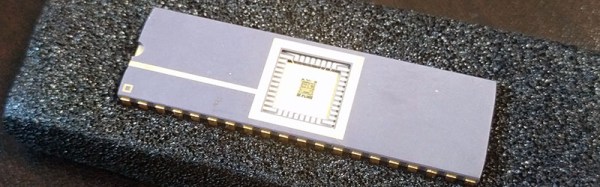
Your computer uses ones and zeros to represent data. There’s no real reason for the basic unit of information in a computer to be only a one or zero, though. It’s a historical choice that is common because of convention, like driving on one side of the road or having right-hand threads on bolts and screws. In fact, computers can be more efficient if they’re built using different number systems. Base 3, or ternary, computing is more efficient at computation and actually makes the design of the computer easier.

For the 2016 Hackaday Superconference, Jessie Tank gave a talk on what she’s been working on for the past few years. It’s a ternary computer, built with ones, zeros, and negative ones. This balanced ternary system is, ‘Perhaps the prettiest number system of all,’ writes Donald Knuth, and now this number system has made it into silicon as a real microprocessor.

Continue reading “Building The First Ternary Microprocessor”

Books You Should Read: The Hardware Hacker

There’s no one quite like Andrew ‘Bunnie’ Huang. His unofficial resume begins with an EE degree from MIT, the author of Hacking the Xbox, creator of the Chumby, developer of the Novena, the first Open Source laptop, and has mentored thousands of people with dozens of essays from his blog.

Above all, Bunnie is a bridge across worlds. He has spent the last decade plying the markets of Shenzhen, working with Chinese manufacturers, and writing about his experiences of taking an idea and turning it into a product with the help of Chinese partners. In short, there is no person better suited to tell the story of how Shenzhen works, what can be done, and how to do it.

Bunnie’s The Hardware Hacker ($29.95, No Starch Press) is the dead tree expression of years of living and working in Shenzhen, taking multiple products to market, and exploring the philosophy that turned a fishing village into a city that produces the world’s electronic baubles.

Continue reading “Books You Should Read: The Hardware Hacker”

Inside The Printrbot Printrhub

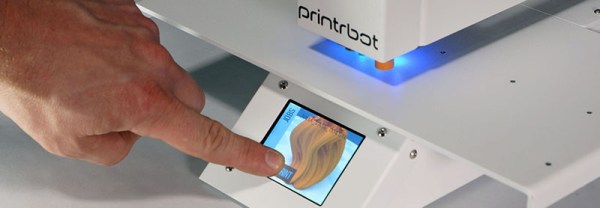
A new version of the Printrbot Simple was released this summer, and this sleek new model includes a few highly desirable features. The metal enclosure was improved, linear rails added, a power switch was thrown in, and the biggest feature — a touch screen — makes headless printing easy.

Adding a usable display and achieving reliable WiFi are big engineering challenges, and thanks to the Internet of Things it’s only going to become more common to expect those features. How did the Printrbot team implement this? [Philip Shuster] recently released a write-up of how the Printrbot Printrhub came together.

The story of the display and WiFi module in the newest Printrbot begins about a year ago with a post on Hackaday. [Philip] built the Little Helper, a little electronic Swiss Army knife capable of basic IO, sending out PWM pulses, sniffing I2C, and a few other handy features. The Printrbot team reached out to [Philip], and after a few conversations, he was roped into the development team for the Printrhub.

Departing slightly from the Little Helper, the Printrhub features the same microcontroller found in the Teensy 3, a 2.8 inch TFT display, capacitive touch sensor, microSD card slot, and an ESP-12 module to handle the WiFi connection. The display system was tricky, but the team eventually got it working. Using an ESP8266 as the WiFi module for a printer is more difficult than you would think, but that works too.

One of the more interesting challenges for 3D printers in the last few years is the development of a good printer display with wireless connectivity. Yes, those graphic LCDs attached to an Arduino still work, but a display from 1980 doesn’t sell printers. In just a few months, the Printrbot team came up with a relatively simple, very elegant display that does everything and they’re releasing all the hardware as open source. That’s great news, and we can’t wait to see similar setups in other makes of 3D printers.

Zeroing CNC Mills With OpenCV

For [Jay] and [Ricardo]’s final project for [Dr. Bruce Land]’s ECE4760 course at Cornell, they tackled a problem that is the bane of all machinists. Their project finds the XY zero of a part in a CNC machine using computer vision, vastly reducing the time it take to set up a workpiece and giving us yet another reason to water down the phrase ‘Internet of Things’ by calling this the Internet of CNC Machines.

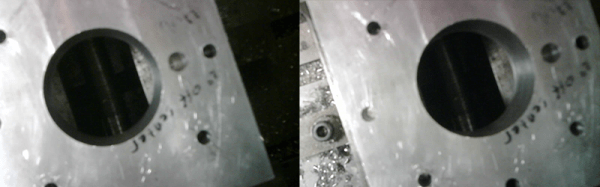
For the hardware, [Jay] and [Ricardo] used a PIC32 to interface with an Arducam module, a WiFi module, and an inductive sensor for measuring the distance to the workpiece. All of this was brought together on a PCB specifically designed to be single-sided (smart!), and tucked away in an enclosure that can be easily attached to the spindle of a CNC mill. This contraption looks down on a workpiece and uses OpenCV to find the center of a hole in a fixture. When the center is found, the mill is zeroed on its XY axis.

The software is a bit simpler than a device that has OpenCV processing running on a microcontroller. Detecting the center of the bore, for instance, happens on a laptop running a few Python scripts. The mill attachment communicates with the laptop over WiFi, and sends a few images of the downward-facing camera over to the laptop. From there, the laptop detects the center of the bore in the fixture plate and generates some G-code to send over to the mill.

While the device works remarkably well, and is able to center the mill fairly quickly and without a lot of user intervention, there were a few problems. The camera is not perfectly aligned with the axis of the spindle, making the math harder than it should be. Also, the enclosure isn’t rated for being an environment where coolant is sprayed everywhere. Those are small quibbles, and these problems could be fixed simply by designing and printing another enclosure. The device works, though, and really cuts down on the time it takes to zero out a mill.

You can check out the video description of the build below.

Continue reading “Zeroing CNC Mills With OpenCV”

Computers For The Masses, Not The Classes

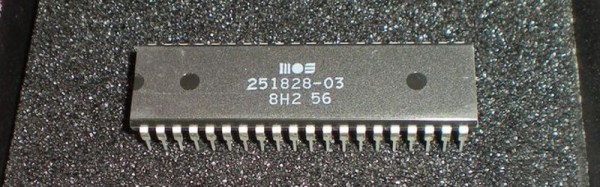
Retro is new again, and everywhere you look you’ll find films, documentaries, and TV shows cashing in on the nostalgia of their target audience. There is one inaccuracy you’ll find with this these shows: Apple computers are everywhere. This isn’t a historical truth – Commodore was everywhere, the C64 was the computer the nerds actually used, and to this day, the Commodore 64 is still the best-selling computer in history.

Commodore is gone, replaced with a superfund site, but the people who made the best computers in history are still around. At the 2016 Hackaday SuperConference, Bil Herd gave a talk on the second act of Commodore’s three-act tragedy. Bil is a frequent contributor around these parts, and as always he illuminates the 1980s far better than Halt and Catch Fire ever could.

Continue reading “Computers For The Masses, Not The Classes”

TastingFeet: Building Toes And Tongues

Noodle Feet is a robot — an artistically designed robot — that is a character from Sarah Petkus’ webcomic Gravity Road. This webcomic explores a post-human universe inhabited by robots, and dives deep into these robots’ exploration of the trash left behind from a human civilization.

Sarah’s not just drawing these robots. She’s bringing them to life. The character Noodle Feet, so named because his legs are encased in pool noodles, has been made real with an aluminum skeleton, a PCB brain, and infrared detecting eyes. At the 2016 Hackaday SuperConference Sarah gave a talk on the challenges of making this robot real and the specifics of making her robot dig its toes into carpet, slobber all over the floor, and taste with its artificial tongue.

Since last year’s talk on Noodle Feet, Sarah has vastly improved the gripping strength of her noodle’s feet. Over the last two years of construction the mechanism to extend grippy, cat-like toenails has moved from cheap hobby servos to solenoids to a clever cam system. While these toe feet worked, the grip was never quite right, and the world isn’t completely covered in shag carpet. After the break we’ll take a closer look at the improvements that Sarah made to the design and how she came up with the ideas for each new iteration.

Continue reading “TastingFeet: Building Toes And Tongues”