Hackaday Prize Entry: 1337 Haxxor Keyboards

If you’re like us, you spend most of your time in front of a computer keyboard, wondering where your life went wrong. [AnonymouSmst] has a slightly more positive outlook on life, which led them to create a truly DIY keyboard with OLEDs, Bluetooth, NFC, Analog joysticks, an ‘Internet of Things thingy’, local storage, and ostentatious backlighting. It’s a 1337 h4x0r keyboard, and one of the coolest input devices we’ve seen since that weird GameCube controller.

[AnonymouSmst] was one of the very elite, very privileged hackers that made it out to the Hackaday Munich meetup where [sprite_tm] first demoed his firmware hack that allowed anyone to play Snake on a keyboard. Here, the idea of building the ultimate keyboard was planted, and [mst] quickly began researching which keyswitches to use. Apparently, [mst] hates his neighbors and chose the obnoxiously loud Cherry Blues.

To a standard 60% keyboard layout, [AnonymouSmst] added a lot of hardware you don’t usually see in even the most spectacular mechanical keyboard builds. A few dozen WS2812 RGB LEDs were added to the build, as was an Adafruit Bluefruit module, an NFC reader, a LORA module and a ESP8266 for WiFi capability, an OLED display just because, and two analog joysticks on either side, one acting as the arrow cluster the other acting as a mouse.

We’ve seen dozens of mechanical keyboard builds over the years, but this takes the entire concept of a DIY keyboard to the next level. It’s bright, shiney, glowey, and a vulgar display of conspicuous consumption and engineering prowess. It is the perfect keyboard, if only because it was designed and built by the person who would ultimately wield it.


Hackaday Prize: 20 Projects That Are The Height Of Automation

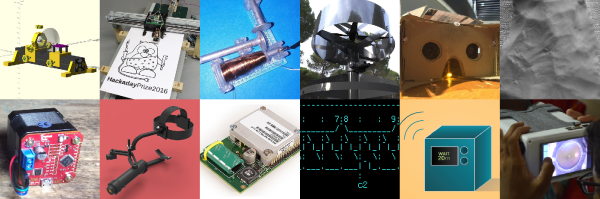
Automation makes the world go around. Whether it’s replacing elevator attendants with buttons, replacing songwriters with computer algorithms, or giving rovers on Mars the same sense and avoid capability as a Tesla, Automation makes our lives easier and better. Today we’re excited to announce the twenty projects that best demonstrate the possibilities of Automation in the running for the 2016 Hackaday Prize. These projects tackled problems ranging from improving the common stepper motor to flying Lidar around a neighborhood on a gigantic ducted fan.

The winners of the Hackaday Prize automation challenge are, in no particular order:

If your project is on the list, congrats. You just won $1000 for your hardware project, and are now moving up to the Hackaday Prize finals where you’ll have a chance to win $150,000 and a residency at the Supplyframe DesignLab in Pasadena.

Assistive TechnologiesIf your project didn’t make the cut, there’s still an oppurtunity for you to build the next great piece of hardware for The Hackaday Prize. The Assistive Technologies Challenge is currently under way challenging you to build a project that helps others move better, see better, or live better.
We’re looking for exoskeletons, a real-life Iron Man, a better wheelchair, a digital braille display, or the best educational software you can imagine.

Like the Design Your ConceptAnything GoesCitizen Science, and Automation rounds of the the Hackaday Prize, the top twenty projects will each win $1000 and move on to the Hackaday Prize finals for a chance to win $150,000 and a residency at the Supplyframe DesignLab in Pasadena

If you don’t have a project up on Hackaday.io, you can start one right now and submit it to the Hackaday Prize. If you’re already working on the next great idea in assistive technologies, add it to the Assistive Technologies challenge using the dropdown menu on the sidebar of your project page.

The Hackaday Prize is the greatest hardware competition on Earth. We want to see the next great Open Hardware project benefit everyone. We’re working toward that by recognizing people who build, make, and design the coolest and most useful devices around.

Building Better Tube Amps With Heathkit Parts

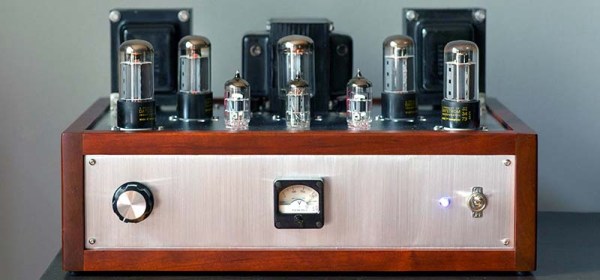
[Justin] had been trying to find a good tube amp for years, but all the best examples were either expensive or a complete basket case. Instead of buying a vintage stereo tube amp, he decided to build his own using the guts of a Heathkit AA-100, a popular tube amp from the 60s and 70s that doesn’t have a great reputation for sound quality.

This project was based on an earlier project from a decade ago that replicated the very popular Dynaco ST-70 tube amp from parts taken from the Heathkit AA-100. The schematic for this conversion was readily available on the usual tube head message boards, and a few PCBs were available for the input stage.

With the schematic in hand, the next thing for [Justin] to do was get a nice enclosure. High quality tube amps are valued as much for their appearance as they are for their sound quality, and after giving his father-in-law a few sketches, a cherry hardwood chassis stained in a beautiful golden brown appeared on [Justin]’s workbench.

The big iron for this new tube amp was taken directly from the old Heathkit, and a few hours in front of a mill netted [Justin] a chassis panel drilled out for the transformers and tube sockets. The rest of the project was a bit of assembly, point-to-point wiring, and wire management giving [Justin] a fantastic amplifier that will last for another fifty years until someone decides to reuse the transformers.

Let’s Put A Hackerspace In Prison

The Hack42 Hackerspace in Arnhem, Netherlands is one of the best hackerspaces we’ve ever seen. After taking over a decommissioned military base, the Hack42 crew has filled a compound rimmed with razor wire with eclectic gizmos, tools, and a community that keeps growing the space. At this year’s EMF camp, Hack42 member [jos] laid out his plan to found the ultimate Hackerspace. He’s going to put a hackerspace in prison to create the ultimate hacker village, a monument to technomancy, and an anti-panopticon panopticon.

[jos] recently noticed a very large, very old prison — currently used to house refugees — went up for sale. This prison, located in downtown Arnhem, Netherlands is a panopticon, a concept for prisons popularized in the 1800s, with most designs based on a circular structure with prison cells along the diameter around the circumference and a guard house in the center. This gigantic building is 55 meters (180 feet) in diameter, and 46 meters (150 feet) tall at its highest point. This gigantic prison dome could contain the White House inside its walls, a few blue whales, and could almost fit a space shuttle stack under the dome (the orbiter itself would fit just fine if there were a door).

The ambitious vision for this prison-come-hackerspace is a permanent venue not unlike other hackercamps where hackers can stay for weeks or months to build a project, a venue for like-minded people to meet up, and a place for students to do graduation projects under the wings of academic leadership. A community is one thing, but this former prison would also be the largest hackerspace by enclosed volume, opening it up to some very cool, very large builds. Inter-office quadcopter mail was mentioned in the talk.

[jos] is looking for comments, ideas, and remarks via this Google form to, “convince the money-people to fork over the funds.” If you’ve ever wanted to contribute to something big, this is your chance.

Hackaday Prize Entry: Automated Hydroponics

This team project for the Hackaday Prize is a solution to a rather important problem. Imagine growing plants for use as biomarkers for pollution. It’s a great idea, but how do you grow the plants in the first place? This team is building a space-saving hydroponic system that packs the most green into the least amount of space. It’s simple, and can be built almost entirely with parts from the local home supply store.

The design of this hydroponic system is based on a few PVC pipes, arranged vertically, joined together with a few 90 degree bends. In each course of pipe, a few holes are drilled to accept a plastic cup. This cup is filled with some sort of growing medium, and the Genuino-based controller takes care of everything else. Watering the plants, turning the lights on and off, and recording the nutrient concentration of the water is all possible with a simple microcontroller.

Right now the team has a huge stack of perforated PVC pipe and a Genuino-based brain box that takes care of everything plants need. It’s going to take a bit of time for the plants to grow, but this is still one of the most compact hydroponic systems we’ve seen.

You can check out a video of the entire setup below.

Continue reading “Hackaday Prize Entry: Automated Hydroponics”

Hackaday Links: August 28, 2016

E-paper looks awesome, but it’s a pain to work with. You need only look at the homebrew implementations of e-paper drivers and the mess of SMD components for proof of that. [jarek] wanted to play around with e-paper and developed this tiny little driver for a Teensy. It’s a fun toy, and the simplest possible circuit necessary to drive this particular e-paper module.

I am once again asking if anyone knows where to buy this computer case. No, not a complete system – I just want the case, folding keyboard, and monitor integrated into an mATX enclosure.

Back in 1985, a young [Matthias Wandel] built a remote control forklift out of a few windshield wiper motors, wood, and not much else. He’s rebuilt this toy recently, just to prove you can build anything with a stack of plywood and a wood gear template generator.

More Adafruit muppets they probably can’t call muppets. Yaaay. This time it’s J is for Joule. Watts that? A second.

The Raspberry Pi Project, one of our favorite projects in the Hackaday Prize that uses a Raspberry Pi, one of the most liked, viewed, and followed projects on Hackaday.io, and a technological tour de force the likes of which have not been seen since the invention of the steam engine got an update this week. [Arsenijs] and the rest of the Raspberry Pi Project team have released a version of their Raspberry Pi pinout helper. Previously, this tool was only used internally to the project, but since this pinout helper has such far-reaching utility they’ve decided to release a public version. Truly, they are kings among men.

This is possibly the coolest use of stacked plywood I’ve ever seen. It’s a spiral staircase, with each step made of 12 layers of plywood. The ‘spine’ of this staircase is a 3″ sch 40 steel pipe, with a proper foundation. The layer of ply are adhered to the pipe with construction adhesive, and each layer of ply is glued together with wood glue. No, it’s not up to code yet, but it was cheaper to build than just buying a spiral staircase.

[Brek] wrote a graphics library for the ubiquitous 128×64 monochromatic LCDs. It’s written for PICs, but damned if we can’t find a link to the library itself. Hopefully [Brek] will jump in the comments below.

Those really, really cheap ESP8266 modules only have 512kB of Flash in them. Here’s how you upgrade those modules to 4MB. You can do it without a hot air gun, and all you need is a few cheap Flash chips.

Here’s a sound card for a Raspberry Pi. No, that’s not a completely dumb idea. This sound card uses quality op-amps, 24-bit ADCs and DACs, and has MIDI. If you’re experimenting with Pure Data or any other Linux audio toy, this could be a useful addition to your Pi stack.

Hackaday Prize Entry: Real Life XEyes

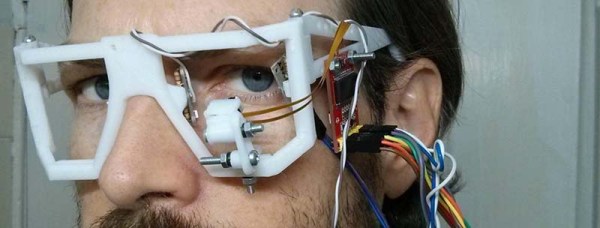
There’s a lot of tech that goes into animatronics, cosplay, and costumes. For their Hackaday Prize entry, [Dasaki] and [Dylan] are taking the eyes in a costume or Halloween prop to the next level with animatronic eyes that look where the wearer of this crazy confabulation is looking. It’s XEyes in real life, and it promises to be a part of some very, very cool costumes.

The mechanics of this system are actually pretty simple — it’s just a few servos joined together to make a pair of robotic eyes move up and down, and left to right. This entire mechanism is mounted on a frame, to which is attached a very small camera pointed directly at the user’s (real) eye. The software is where things get fun. That’s a basic eye-tracking setup, with IR light illuminating the pupil, and a compute unit that can calculate where the user is looking.

For the software, [Dasaki] and [Dylan] have collected a bunch of links, but right now the best solutions are the OpenMV and the Eye of Horus project from last year’s Hackaday Prize. It’s a great project, and a really fun entry for the Automation portion of this year’s Hackaday Prize.