Hackaday Prize Entry: A CNC Plasma Table

CNC routers and 3D printers are cool, but the last time I checked, cars and heavy machinery aren’t made out of wood and plastic. If you want a machine that will build other machines, you want a CNC plasma cutter. That’s [willbaden]’s entry for the Hackaday prize. It’s big, massive, and it’s already cutting.

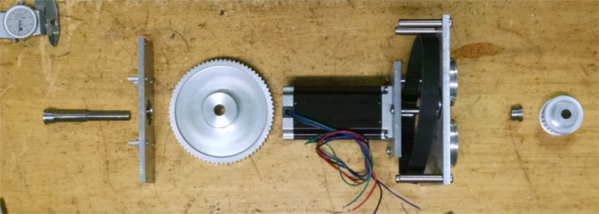
A plasma CNC machine isn’t that much different from a simple CNC router. [will]’s table controller is just a GRBL shield attached to an Arduino, the bearings were stolen from many copy machines, and your motors and drivers are fairly standard, barring the fact they’re excessively huge for a simple 3D printer.

The real trick up [will]’s sleeve is the controller interface. For this, he’s mounted a Raspberry Pi display, a big, shiny, red button, and all the associated electronics behind a beautifully rusty welded enclosure. This part of the build just sends gcode over to the GRBL shield, and is doing so reliably. Right now [will] is looking for some way to save, arrange, and queue jobs on the Pi, a problem that is almost – but not quite – the same job Octoprint does. A software for big, mean CNCs that spew exotic states of matter is an interesting project, and we can’t wait to see where [will] goes with this one.

Hackaday Prize Entry: A Raspberry Pi Password Manager

Every week there’s new a new website that has been compromised and the passwords of a few hundred thousand accounts have been leaked to a pastebin. To protect yourself you can change your passwords often, not reuse passwords, and use long compilcated strings; all of these techniques are far beyond the capacity for human memory, or even a Post-it note. Thus the age of electronic password keepers began.

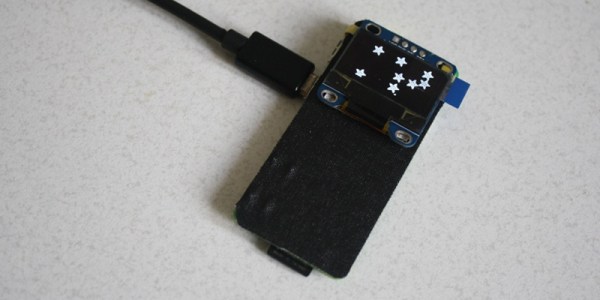
Electronic password keepers are simple devices that save your passwords and can recall them over a USB connection. The Raspberry Pi Zero functions perfectly fine as a USB device, leading [gir] to build the Raspi Zero WiFi Enable Hardware Password Manager for the Hackaday Prize.

This USB gadget uses pass, the ‘standard unix password manager’ to store all the passwords. Everything is controlled by a few buttons, a small OLED display, and of course the Raspi’s ability to become a USB HID device. This allows the Pi Zero to type passwords in just like a USB keyboard.

It’s a great project, and since the Pi Zero actually exists now, much to the surprise of its many detractors, the perfect entry for the Hackaday Prize.

Hackaday Prize Entry: Russian Roulette With A Soldering Gun

You’re driving along a lonely, dark highway with the knowledge that suicide rates are highly correlated with fatal single vehicle car accidents. A highway overpass bridge appears ahead. You might be able to make it around the guard rail. Might is the operative word. You’ve failed at everything else so far, and there’s no reason to believe this would be any exception.

The suffering will not end, but you can delay it a bit. That’s what the Internet is all about. Cat pictures. Memes. Rare Pepes. Distraction is your digital analgesic. Like this post if you agree. The problem with using distraction as a candle of hope in your empty, wind-blown existence is simply finding new things to distract yourself with. This Hackaday Prize entry is the solution to that. It’s a randomizer for Hackaday.io. Russian roulette with a soldering gun.

This Hackaday.io project randomizer works on a property unique to the greatest project hosting site. All the links have a number and the project name in the URL. Remove the project name, and the link still works. It’s a handy pseudo-URL shortener if you ever want to put a link to your project on a PCB, but also a great way to look at all the projects on .io – all you need is a bit of Python, Perl, or some other scripting language

Right now, [Greg] has a Perl script running on one of his servers (sure to be down by the time you read this), that chooses a random number, and tries to grab that Hackaday.io project. If 404 is returned, it tries again until it succeeds.


Hackaday Prize Entry: Robot Shore

Everyone knows the ocean is not a gigantic garbage can, but unless you live in the middle of Asia, below sea level, Utah, or some other inhospitable place, all trash eventually makes it to sea. This is a problem not only for the the sea and the Great Pacific Garbage Patch, but for shorelines as well. For her Hackaday Prize entry, [Erin] is building a series of robots designed to walk the shore, pick up garbage, deposit it in a bin, and do it again after the next high tide.

The key problem for a robot that picks up trash is simply finding that trash. This means cameras and a lot of computing power. Lucky for [Erin], smartphones are cheap and have excellent cameras and a ton of processing power. The brains for these robots will be built around an off-the-shelf smartphone mounted on a pan/tilt mast on the bot.

[Erin] is already testing her bot, and after a few field tests she noticed a family left behind their trash on the beach. The robot moved into action before the flying rats could choke on a bottlecap, and the cleanup operation was a success. Not bad for a prototype, and an excellent entry to the Hackaday Prize.

Intel Releases The Tiny Joule Compute Module

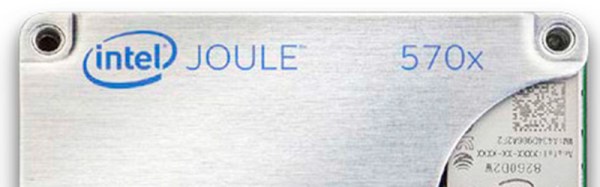
At the keynote for the Intel Developers Forum, Intel CEO Brian Krzanich introduced the Intel Joule compute module, a ‘maker board’ targeted at Internet of Things developers. The high-end board in the lineup features a quad-core Intel Atom running at 2.4 GHz, 4GB of LPDDR4 RAM, 16GB of eMMC, 802.11ac, Bluetooth 4.1, USB 3.1, CSI and DSI interfaces, and multiple GPIO, I2C, and UART interfaces. According to the keynote, the Joule module will be useful for drones, robotics, and with support for Intel’s RealSense technology, it may find a use in VR and AR applications. The relevant specs can be found on the Intel News Fact Sheet (PDF).

This is not Intel’s first offering to the Internet of Things. A few years ago, Intel partnered up with Arduino (the Massimo one) to produce the Intel Galileo. This board featured the Intel Quark SoC, a 400MHz, 32-bit Intel Pentium ISA processor. It was x86 in an Arduino format. This was quickly followed by the Intel Edison based on the same Quark SoC, which was followed by the Intel Curie, found in the Arduino 101 and this year’s DEF CON badge.

We’ve seen plenty of Intel’s ‘maker’ and Internet of Things offerings, but we haven’t seen these platforms succeed. You could spend hundreds of thousands of dollars in market research to determine why these platforms haven’t seen much success, but the Hackaday comments will tell you the same thing for free: the documentation for these platforms is sparse, and nobody knows how to make these boards work.

Perhaps because of the failures of Intel’s IoT market, the Joule differs significantly from previous offerings. Although it can be easily compared to the Raspberry Pi, Beaglebone, and a hundred other tiny single board computers, the official literature for the Joule makes a comparison between it and the Nvidia Jetson easy. The Nvidia Jetson is a high-power, credit card-sized ‘supercomputer’ meant to be a building block for high-performance applications, such as drones and anything that requires video or a very fast processor. The Joule fits into this market splendidly, with demonstrated applications including augmented reality safety glasses for Airbus employees and highway patrol motorcycle helmet displays. Here, the Joule might just find a market. This might even be the main focus of the Joule – it can be integrated onto Gumstix carrier boards, providing a custom single board computer with configurable displays, connectors, and sensors.

The Intel Joule lineup consists of the Joule 570x and 550x, with the 550x being a bit slower, a Gig less RAM, and half as much storage. They will be available in Q4 2016 from Mouser, Newegg, and other Intel reseller partners.

Introducing The Teensy 3.5 And 3.6

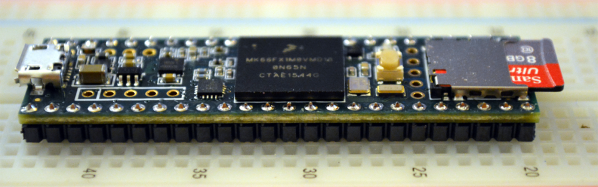
Paul Stoffregen has built a new Teensy. The latest in the line of very powerful, USB-capable microcontrollers is the Teensy 3.5 and 3.6 development boards. It’s faster, more capable, and bigger putting even more pins on a solderless breadboard.

The first Teensy was one of the first Arduino compatible boards with native USB. The Teensy 2.0 was even better with support for USB keyboards, mice, and MIDI. Even today, the Teensy 2.0 is the de facto board to use if you want to build anything like a USB keyboard. The Teensy 2.0 was followed by the exceptionally powerful Teensy 3.0, the first 32-bit Arduino compatible board, and thanks to Paul’s contributions of a pile of Arduino libraries, doing cool stuff faster has never been easier. Since the launch of the Teensy 3.0, its successors, the 3.1 and 3.2 have launched. If you want the power of an ARM microcontroller with the deepest Arduino library support, there’s only one board you should consider.

Like the launch of the Teensy 3.0, Paul is Kickstarting the launch of the latest Teensys with a crowdfunding campaign. Let’s dig into everything these new boards have to offer.

Continue reading “Introducing The Teensy 3.5 And 3.6”

Hackaday NYC Summer Party

Hackaday is going to be back in NYC next week, and we’re having a meetup. This isn’t any meetup – it’s a meetup with skeeball. No, it does not get any better than this.

Next week, August 24, at 6:30pm, we’re pulling out all the stops at Ace Bar on the Lower East Side. This event is a bring-a-hack, and we want to see what you’re working on. Bring your current project, an oscilloscope demo, blinkey clothing, hacks, wearables, or just some cool, random junk. The last time we did this, someone brought a flight data recorder from a Pan Am 747. It had 74-series and 54-series logic chips in it, and no one could figure out why.

This event will be hosted by our lovely multi-function unicorn @SophiKravitz and our NYC community manager @Shayna. Bring your friends, and bring your projects, this isn’t an event to miss.