Hackaday’s own World Create Day is just two days away. This Saturday, April 23rd, the Hackaday community will rise up, come together, have fun, share a few stories, and build something cool in the process.
When we announced World Create Day a few weeks ago, we were inundated with responses. Hackerspaces across the globe have offered up their spaces for the Hackaday community to brainstorm the latest entries for The Hackaday Prize.
We have hackerspaces from Islamabad to Adelaide and from Mumbai to Shenzhen opening their doors to the world. If you’re near any of these events, join in on the festivities. If you don’t see one in your neck of the woods, you can still host your own meetup. Just click here to get your town on the map.
What’s going on at these meetups? [Robert] and [Steven] in Adelaide are planning several events including a meet and greet, a few lightning talks, and snacks. They’re also live streaming their event. Maker’s Asylum in Mumbai is doing project demos and forming some teams for the Hackaday Prize. It’s going to be a great event at every hackerspace, and the largest distributed meetup we’ve ever done. Don’t miss this.
Even before the announcement and introduction of the Raspberry Pi 3, word of a few very powerful single board ARM Linux computers was flowing out of China. The hardware was there – powerful 64-bit ARM chips were available, all that was needed was a few engineers to put these chips on a board, a few marketing people, and a contract manufacturer.
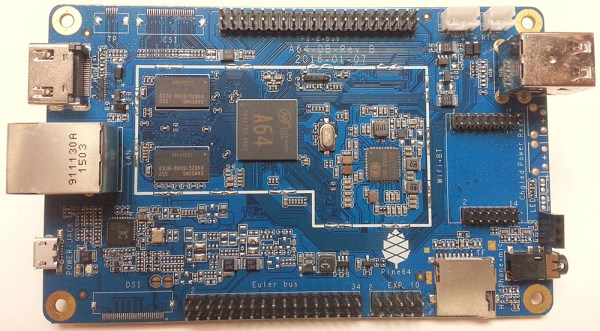
One of the first of these 64-bit boards is the Pine64. Introduced to the world through a Kickstarter that netted $1.7 Million USD from 36,000 backers, the Pine64 is already extremely popular. The boards are beginning to land on the doorsteps and mailboxes of backers, and the initial impressions are showing up in the official forums and Kickstarter campaign comments.
I pledged $15 USD to the Pine64 Kickstarter, and received a board with 512MB of RAM, 4K HDMI, 10/100 Ethernet and a 1.2 GHz ARM Cortex A53 CPU in return. This post is not a review, as I can’t fully document the Pine64 experience. My initial impression? This is bad. This is pretty bad.
[luca] has always wanted a flying robot, but despite the recent popularity of quadcopters and drones [luca] has never seen a drone that is truly autonomous. Although sometimes billed as autonomous, quadcopters and fixed wing aircraft have always had someone holding a remote, had to stay in a controlled environment, or had some off-board vision system.
Since [luca] is building a coaxial copter – something that looks like a ducted fan with a few vanes at the bottom – there will be control issues. Normal helicopters use the pitch of the blades and the torque produced by the tail rotor to keep flying straight. A quadcopter uses two pairs of motors spinning in opposite directions to stay level. With just two rotors mounted on top of each other, you would think [luca]’s coaxial copter is an intractable problem. Not so; there are bizarre control systems for this type of flying machine that make it as nimble in the sky as any other helicopter.
The design of this flying robot is a bit unlike anything on the market. It looks like a flying ducted fan, with a few electronics strapped to the bottom. It’s big, but also has the minimum number of rotors, to have the highest power density possible with current technology. With a few calculations, [luca] predicted this robot will be able to hoist an IMU, GPS, ultrasonic range finder, optical flow camera, and a LIDAR module in the air for about fifty minutes. That’s a remarkably long flight time for something that hovers, and we can’t wait to see how [luca]’s build turns out.
In the US, we don’t hear much about computing from beyond the Anglosphere. We’ve seen some home computer clones from behind the iron curtain, but getting any information about them is hard. If you find an old keyboard with a QWERTZ layout, or even a few Cyrillic characters, in the States, it’s a rarity. To date, the only French computer on Hackaday is an old Minitel dumb terminal. To help rectify this, [Jeremie Marsin], [Thierry Mazzoleni], and [Jean Paul Mari] from Quebec brought the best of the French computing revolution of the 1980s along to this year’s Vintage Computer Festival East
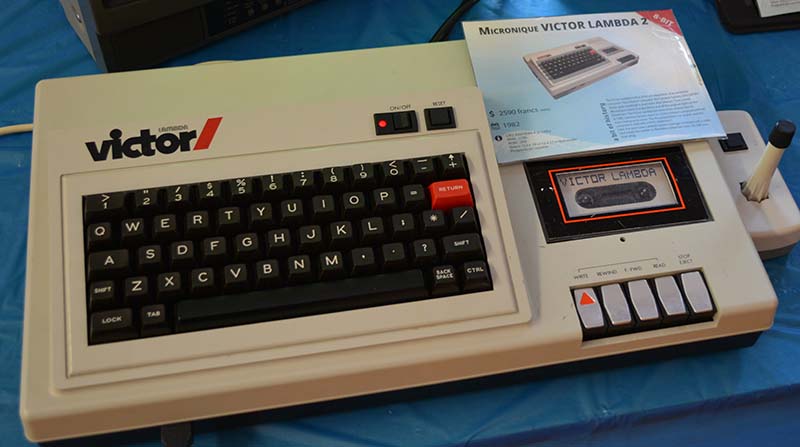
The American-designed French Victor
The evolution of the reigning champion of this exhibit begins with the Micronique Victor Lambda, a licensed copy of a purely American computer, the Interact Home Computer System. This computer featured a 2 MHz 8080A, 8 or 16 kB of RAM, and was quickly discontinued. The French company Micronique quickly bought the original designs and remarketed the computer in France.
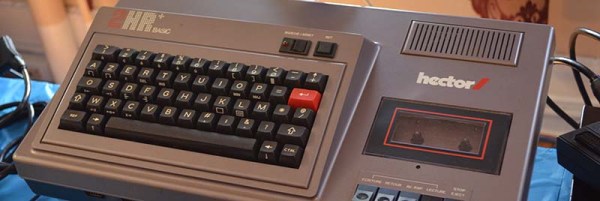
In a few short years, Micronique took this design and turned it into the Hector. This machine featured a 5 MHz Z80, 48 kB of RAM, high resolution graphics (243×231 at four colors) and included BASIC and Forth interpreters.
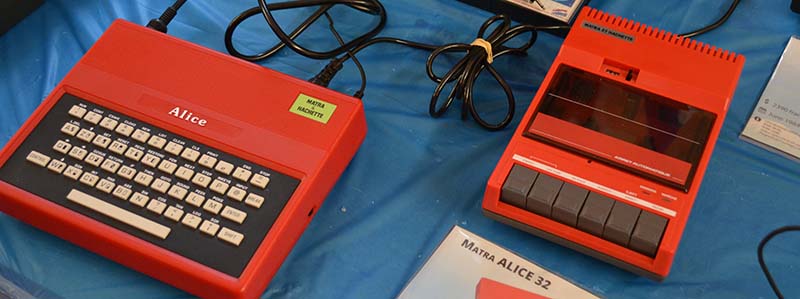
The Victor and Hector were the best home computers at the time, but for every Commodore or Apple, you need a ZX Spectrum. France’s version of this tiny computer with a terrible keyboard was the Matra Alice 32, a computer with a 1 MHz 6803, 16kB of Ram, and a real 80×25 text mode. The Alice is heavily based on the American TRS-80 MC-10, with a SCART connector and an AZERTY keyboard.
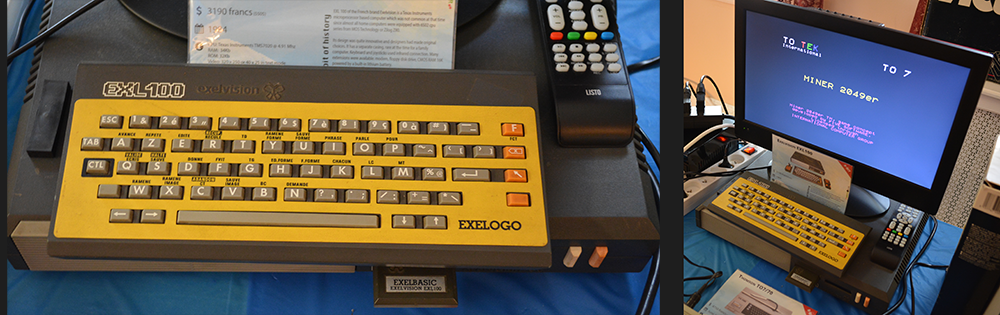
The weirdest computer [Jeremie], [Thierry], and [Jean Paul] brought out? That would be the Excelvision EXL100. The 1980s, for better or worse, were the times of the Z80 and 6502. The EXL100 was running something completely different. This home computer used a TMS7020 CPU from Texas Instruments, a speech synthesizer, and a wireless keyboard. Very strange for the time and relatively inexpensive; in 1984 this computer cost only ₣3190, or about $550 USD.
[Jeremie], [Thierry], and [Jean Paul] had an exhibit that presented the best the Francosphere had to offer to the computing world in the 80s and 90s. We haven’t seen enough early computers from outside the US, so we’re happy to have met these guys at the 11th annual Vintage Computer Festival East.
Look up ‘concrete lathe’ and you’ll quickly find yourself reading the works of [David Gingery]. His series of books on building a machine shop from scrap begin with a charcoal foundry, and quickly move to creating a metal lathe out of concrete. Before [Gingery]’s lathe, around the time of World War I, many factories created gigantic machine tools out of concrete. It’s an old idea, but you’ll be hard pressed to find anyone with a shop featuring concrete machine tools. Cheap lathes are plentiful on Craigslist, after all.
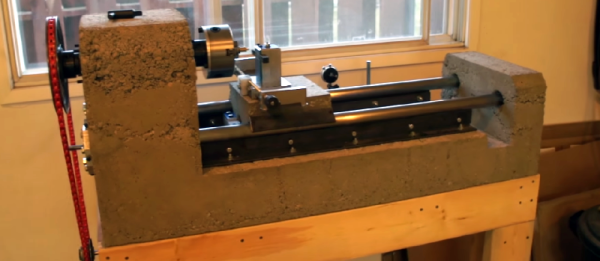
Building a metal lathe from concrete is more of a challenge. This challenge was recently taken up by [Curt Filipowski] in a five part YouTube series that resulted in a real, working lathe made out of concrete, scrap, and a lot of bolts.
The concrete lathe begins with a form, and for this [Curt] cut out all the parts on a CNC router. Creating the form isn’t quite as simple as you would think – the concrete form included several bolts that would alow [Curt] to bolt bearings, ways made out of gas pipe, and angle iron. This form was filled with concrete in [Curt]’s kitchen, and after a nice long cure, the lathe was moved up to the upstairs shop. That’s a five hundred pound block moved up a flight of stairs by a single person.
The rest of the build deals with the cast concrete carriage which rides along the polished gas pipe ways, a tool post holder milled out of a block of aluminum, and finally making some chips. While it’s not the most practical lathe – the carriage moves along the ways by turning a wheel underneath the tailstock – it does demonstrate a concrete lathe is possible.
Although we’ve never had the privilege to drive one, [skaarj] tells us Dacia made some terrible cars. The Dacia 1310, a communist clone of the Renault 12, was cheap, had sixty-two horses under the hood, and was easy to maintain. The cabin, by all accounts, is a bit lacking, giving [skaarj] the opportunity to improve the instrument cluster and dash. He’s not throwing a stereo in and calling it a day – [skaarj] is upgrading his Dacia with retro-futuristic components including a vacuum tube amp, a CRT computer display, and an unspeakably small dumb terminal.
[skaarj]’s build began with a hit and run accident. With most of the body panels on the passenger side of the car removed, [Skaarj] ground some rust, rattle canned some rust proof paint, and bondoed the most offensive corrosion. Work then began on the upgraded dash, with a few choice components chosen including an old Soviet television, a hardware neural network to determine hardware faults, and a bizarre implementation of a CAN bus on a car without any of the requisite electronics.
This is one of those projects that can go on forever; there’s a lot you can do with the dashboard of a car if you’re not constrained by a suffocating desire to appear normal. In that respect, [skaarj] has this one locked up – he’s got a vacuum tube amplifier and enough CRTs in this car to add retro satellite navigation. It’s a great entry for The Hackaday Prize, as something cool is sure to come out of this project.
This Saturday, April 23, we’re hosting a worldwide Hackaday meetup called World Create Day, and we want you to be a part of it. The 2016 Hackaday Prize is all about solving technology problems, and if you’re looking for an excuse to meet up with a few fellow tinkerers, this is it.
Right now, we have dozens of Hackaday meetup hosts planning their own get together. It’s six continents of awesome, and that’s only because winter is starting to set in on Antarctica. Today we’re taking a closer look at what’s lined up in North and South America. We have meetups from the shores of Venezuela to the birthplace of the worst president the United States has ever had. We have meetups in Baltimore and El Paso, and from Silicon Valley to New York City.
The goal for these meetups is to find fellow hackers and tinkerers, suss out a few ideas on what you’re working on, and start a project for The Hackaday Prize. We’re wrapping up the first stage of The Hackaday Prize, Design Your Concept this coming Monday, where all you need is an idea. Saturday’s World Create Day is the perfect time to brainstorm your tech solution with some friends and get it submitted ahead of the deadline. If you have an idea for the next great Internet of Things, an application for the RISC architecture that is gonna change everything, or just want to show off your flubber prototype, this is the event to go to.
This is the opportunity to find some like-minded hackers in your neck of the woods, and it’s not an event to miss. If you’re looking for a meetup in your area, check out the map here. If you’re interested in hosting one of these shindigs, fill out this form and we’ll set you up.
We’ll take a closer look at the meetups planned on other continents as the week progresses. If you’re still thinking of getting your own meetup on the map, now’s the time!


 When we announced World Create Day a few weeks ago, we were inundated with responses. Hackerspaces across the globe have offered up their spaces for the Hackaday community to brainstorm the latest entries for The Hackaday Prize.