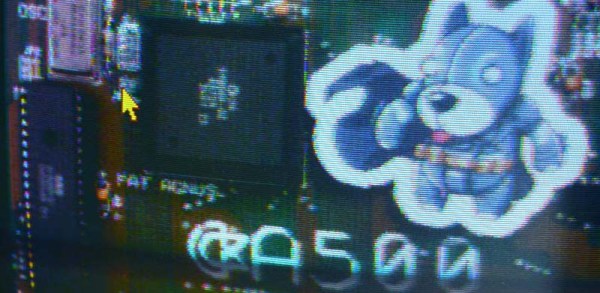
There was a time in the late 80s and early 90s where the Amiga was the standard for computer graphics. Remember SeaQuest? That was an Amiga. The intro to Better Call Saul? That’s purposefully crappy, to look like it came out of an Amiga. When it comes to the Amiga and video, the first thing that comes to mind is the Video Toaster, hardware and software that turns an Amiga 2000 into a nonlinear video editing suite. Digital graphics, images, and video on the Amiga was so much more than the Video Toaster, and at this year’s Vintage Computer Festival East, [Bill] and [Anthony] demonstrated what else the Amiga could do.
For better or worse, the most popular use for the Raspberry Pi – by far – is media centers and retro game consoles. No, the great unwashed masses aren’t developing Linux drivers for their Pi peripherals, and very few people are tackling bare metal ARM programming. That doesn’t mean creating a handheld console based on the Pi isn’t a worthy pursuit.
For their entry for the 2016 Hackaday Prize, [David] and [Jean-André] are building a portable Pi console that’s much better than an old Bondo-encrusted Game Boy enclosure stuffed with hot glue and wires. They’re doing this project the right way with a hardware accelerated display, custom software, and a high quality case.
[David] is in charge of the hardware, and that means making a very, very small handheld console. The design of this GameGirl is extremely similar to the old-school Game Boy Pocket (or Game Boy Light). There’s a D-pad, four buttons, select, start, and two ‘shoulder’ buttons on the back. The build is based on the Raspberry Pi Zero, and thanks to the Pi’s standard 40-pin header, [David] is able to configure the display to use an RGB565 DPI interface. This means the display is stupidly cheap while still leaving a few GPIO pins left over for the SPI, buttons, backlight, and PWM audio.
[Jean-André] is the other half of the team, and his contributions to open source software make him exceptionally qualified for this project. He’s the main developer for Lakka, a DIY retro emulation console, and the #5 RetroArch contributor. No, this project isn’t using RetroPie – and there’s a reason for that. Emulator hackers are spending a lot of time optimizing emulators for the Raspberry Pi, only because of RetroPi. If these emulator hackers spent their time optimizing for an API like LibRetro, you could eventually play a working version of Pilotwings 64 on the Raspberry Pi and every other platform LibRetro is available for. All the effort that goes into making a game work with a Raspberry Pi is effort that goes into making that game work for the PSP, Wii, iOS, and a PC. Yes, its philosophical pissing in the wind while saying, ‘this is what the community should do’; this is open source software, after all.
With the right ideas going into the hardware and software, [David] and [Jean-André] have an amazing project on their hands. It’s one of the most popular entries and are near the top of the charts in the community voting bootstrap effort where every like on a project gets the team a dollar for their project. GameGirl is shaping up to be a great project, and we can’t wait to see the it in action.
There have been really cool happenings in the CNC world for the past few years. There is a recent trend of portable, handheld CNC machines. Yes, you read that correctly. This SIGGRAPH paper demonstrated a handheld router with a camera and a few motors that would make slight corrections to the position of the router. Load in a .DXF or other vector file, and you become the largest CNC machine on the planet. We saw it at one of the Maker Faires, and about a year ago the team soft launched. Apparently, the Shaper router is gearing up for production and [Ben Krasnow] got the first look with a full 17-minute demonstration of [Ben] fabricating parts out of aluminum. It looks like a great tool, and we can’t wait to see this thing in production.
Octoprint is the best way to give a 3D printer a web interface. The dev for Octoprint, [Gina Häußge] used to have a sponsor for developing Octoprint. They’re gone now, which means it’s time for [Gina] to start a Patreon. If you use Octoprint, you know it’s worth more than a dollar a month.
Really bad USB power supplies are nothing new around these parts. There are cheap USB supplies that don’t have any fuses, don’t have any circuit protection, and are noisy as hell. This is the worst USB power supply the Internet has to offer. It’s from one of the relatively new designs of USB power supplies that steps down mains voltage to five USB A ports. [bigclive]’s teardown revealed this was passing half wave mains voltage to the USB ports. It can light up a light bulb. It can kill your phone. The fault? A pinhole in the insulation between the windings of the transformer.
Electronic conference badges are getting excessive, but they can be so much cooler. Here’s Atmel’s take on a high-end conference badge. It has a display, sensors, WiFi, Bluetooth, runs Android, and has 512MB of RAM, 4GB of Flash. It’s a freakin’ mini tablet meant to last for three days.
Speaking of Atmel, they’re having a few growing pains in the merger with Microchip. Employees coming to Microchip from Atmel are getting their severance benefits cut in half. Apparently, the severance benefits given to Atmel employees were not communicated to Microchip before the merger.
Raspberry Pi Zeros are back in production. There’s also going to be a mysterious new feature. Is it WiFi? No, it’s confirmed not to be WiFi. How about Ethernet? Bluetooth? an RTC? Full size HDMI port? Actual pin headers? Audio port? Improved CPU / RAM? No, children. It’s none of these.
C.H.I.P., the nine dollar computer that made some waves last summer, has on-board Flash storage. That means you don’t need to put an image on an SD card. The folks behind C.H.I.P. have recently improved the method for flashing a new OS onto their tiny board: a Chrome plugin. Yes, this sounds completely bizarre, but Chrome plugins are becoming increasingly popular for USB gadget wizardry. You can program an Arduino with Chrome and log USB power profiles with a USB tester and Chrome. You will ride eternal, shiny and chrome.
While the official history of the digital camera begins with a Kodak engineer tinkering around with digital electronics in 1975, the first digital camera was actually built a few months prior. At the Vintage Computer Festival East, [William Sudbrink] rebuilt the first digital camera. It’s wasn’t particularly hard, either: it was a project on the cover of Popular Electronics in February, 1975.
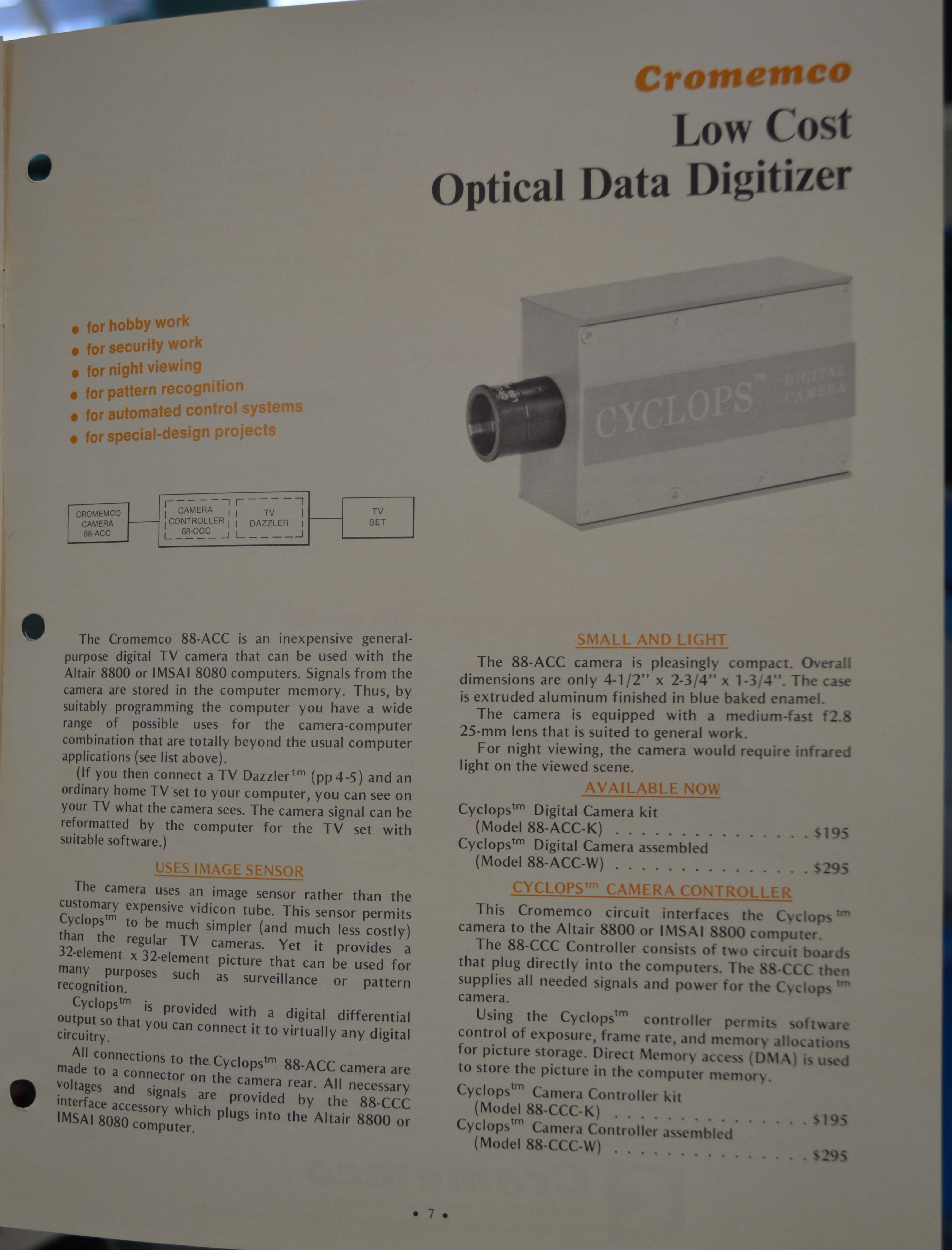
Cromemco catalog page for the Cyclops, the first digital camera
[William]’s exhibit, Cromemco Accessories: Cyclops & Dazzler is a demonstration of the greatest graphics cards you could buy for S-100 systems and a very rare, very weird solid-state TV camera. Introduced in the February, 1975 issue of Popular Electronics, the Cyclops was the first digital camera. This wasn’t a device that used a CCD or a normal image sensor. The image sensor in the Cyclops was a 1 kilobit DRAM from MOS, producing a digital image thirty-two pixels square.
The full description, schematic, circuit layout, and theory of operation are laid out in the Popular Electronics article; all [William] had to do was etch a PCB and source the components. The key part – a one kilobit MOS DRAM in a metal can package, carefully decapsulated – had a date code of 1976, but that is the newest component in the rebuild of this classic circuit.
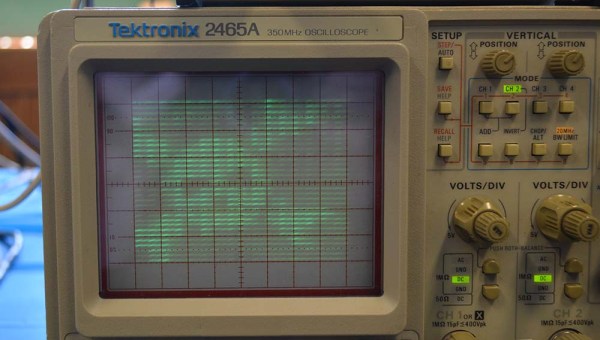
To turn this DRAM into digital camera, the circuit sweeps across the rows and columns of the DRAM array, turning the charge of each cell into an analog output. This isn’t a black or white camera; there’s gray in there, or green if you connect it to an oscilloscope.
This project in Popular Electronics would be manufactured by Cromemco in late 1975 and was released as their first product in January, 1976. The Cromemco was marketed as a digital camera, designed to interface with the MITS Altair 8800 computer, allowing anyone to save digital images to disk. This was the first digital camera invented, and the first digital camera sold to consumers. It’s an amazing piece of history, and very happy [William] was able to piece this together and bring it out to the Vintage Computer Festival this weekend.
The only useful data you’ll ever find is already digitized, but a surprising number of gauges and meters are still analog. The correct solution to digitizing various pressure gauges, electric meters, and any other analog gauge is obviously to replace the offending dial with a digital sensor and display. This isn’t always possible, so for [Egar] and [ivodopiviz]’s Hackaday Prize entry, they’re coming up with a way to convert these old analog gauges to digital using a Raspberry Pi and a bit of computer vision.
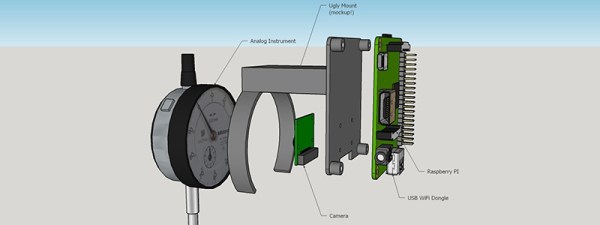
The idea behind this instrument digitizer isn’t to replace the mechanics and electronics, as we are so often wont to do. Instead, this team is using a 3D printed bracket that mounts a Raspberry Pi and camera directly in front of an analog gauge. Combine this contraption with OpenCV, and you have a device that’s just smart enough to look at a needle on a dial, convert that to a number, and save it to a file or send it out over WiFi.
It’s an extremely simple device for what [Egar] and [ivodopiviz] admit is a relatively niche application. However, if you only need digital measurements of an analog meter for a month or so, or you don’t want to mess up your steampunk decor, it’s an ingenious build.
This weekend is the Vintage Computer Festival East in Wall, New Jersey. Every year is different, but there’s a general plan for each day. On Saturday and Sunday, the exhibits rule the con, the consignment shop is busy, and the keynotes bring down the house. Friday is a little different. This is the day for ‘in the trenches’ talks from the commodore crew, classes on recapping 30-year-old computers, and this year – for the first time – a retro hackathon. It’s basically the same format as any other hackathon, but instead of bringing MacBooks and building something cool, Apple IIs and Commodore 64s were provided. This is the report on the first retro hackathon we’ve ever been to.
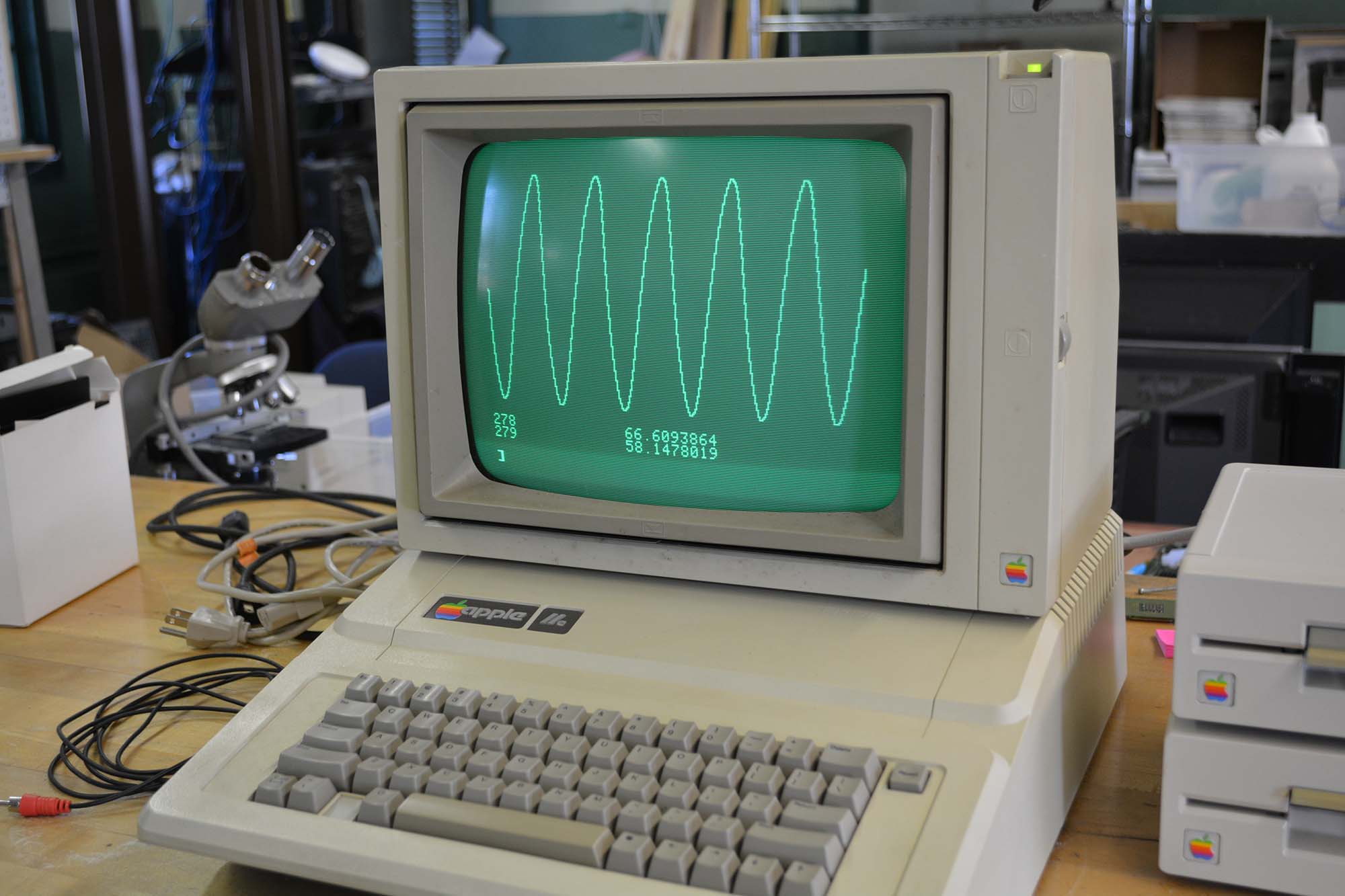
The Apple II one-liner SIN graph
First off, no one remembers how to program in BASIC. If you’re looking for a population that should remember the vagaries of the different dialects of BASIC, you would think it would be the people who came out to the middle of Jersey on Friday to talk about old CPUs. Apparently, this is not the case and several people were confused about single and double quotes in PRINT statements. Luckily, a few programming manuals for the C64 and Apple II were available, so everyone could still have fun with PEEKs and POKEs.
If you want to get people programming on some old machines, you need to give them some inspiration. The first half hour of the retro hackathon didn’t see any teams programming. Given this demographics proclivity to say, ‘I can do that better’, I typed a few BASIC one-liners in the C64 (random Truchet tiles in PETSCII) and Apple II (a SIN graph), and the people started pouring in. Yes, they could program something better than a single line of BASIC.
Sound on an Apple IIc.
What came of an impromptu retro hackathon? Hangman, in BASIC. No, it didn’t quite work, and there were only three or four possible words hardcoded into the program. Still, text mode graphics are a lost art. The Apple IIc was programmed to make fart noises. The original plan for this project was to program music. What would have been the winning entry was a line-drawing program on the C64 that looked like the enemy in Qix. That guy wasn’t there during judging. The winner of a $50 credit to the consignment shop was a kid who programmed zero-player Pong on Apple II basic. He bought a Mac Portable (non-backlit) with that prize.
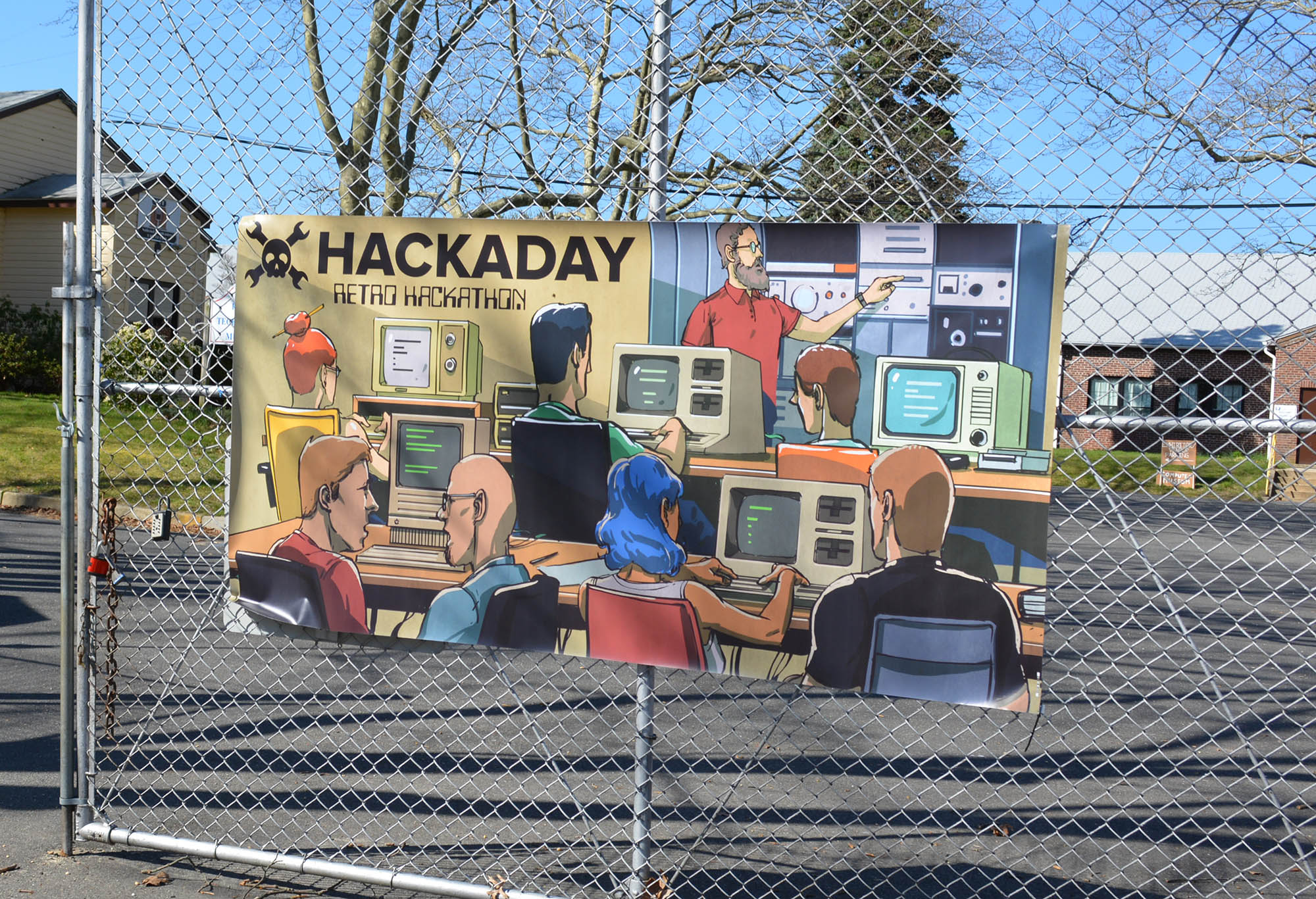
We’ve gone to hackathons, we’ve waded through the sea of MacBooks, and had a Red Bull drip installed. This retro hackathon was completely different, but somehow familiar. No, no one is going to create something new – everything that can be done on these machines in a few hours of BASIC programming has already been done. That’s not the point, though. It’s a geek pride of proving your mettle, putting your money where your mouth is, and doing it in a casual environment where everyone is friendly. This is the first retro hackathon we’ve gone to, and it won’t be the last. We’re going to do this again, once we get an Apple IIc+, a few Commodores, a Speccy, and a few good monitors. We already have the banner, anyway.
[Chris] recently got his hands on an old telescope. While this small refractor with an altitude-azimuth mount is sufficient for taking a gander at big objects in our solar system, high-end telescopes can be so much cooler. Large reflecting telescopes can track the night sky for hours, and usually come with a computer interface and a GOTO button. Combine this with Stellarium, the open source sky map, and you can have an entire observatory in your back yard.
For [Chris]’ entry into the 2016 Hackaday Prize, he’s giving his old telescope an upgrade. With a Raspberry Pi, a few 3D printed adapters, and a new telescope mount to create a homebrew telescope computer.
The alt-az mount really isn’t the right tool for the astronomical job. The earth spins on a tilted axis, and if you want to hold things in the night sky still, it has to turn in two axes. An equatorial mount is much more compatible with the celestial sphere. Right now, [Chris] is looking into a German equatorial mount, a telescope that is able to track an individual star through the night sky using only a clock drive motor.
To give this telescope a brain, he’ll be using a Raspberry Pi, GPS, magnetometer, and ostensibly a real-time clock to make sure the build knows where the stars are. After that, it’s a simple matter of pointing the telescope via computer and using a Raspberry Pi camera to peer into the heavens with a very, very small image sensor.
While anyone with three or four hundred dollars could simply buy a telescope with similar features, that’s really not the point for [Chris], or for amateur astronomy. There is a long, long history of amateur astronomers building their own mirrors, lenses, and mounts. [Chris] is just continuing this very long tradition, and in the process building a great entry for the 2016 Hackaday Prize