Hackaday Prize Semifinalist: A Mobile Node

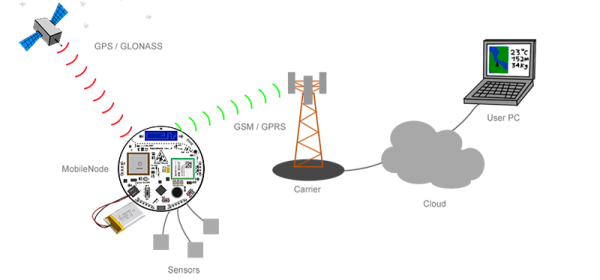
The future is the Internet of Things, or so we’re told, and with that comes the requirement for sensors attached to the Internet that also relay GPS and location data. [Camilo]’s MobileNodes do just that. He’s designed a single device that will listen to any sensor, upload that data to the Internet over GSM or GPRS, and push all that data to the cloud.

The MobileNode is a small circular (7cm) PCB with a standard ATMega32u4 microcontroller. Attached to this PCB are GSM/GPRS and GPS/GLONASS modules to receive GPS signals and relay all that data to the cloud. To this, just about any sensor can be added, including light sensors, PIR sensors, gas and temperature sensors, and just about anything else that can be measured electronically.

Of course the biggest problem with a bunch of sensors on an Internet of Things device is pulling the data from the Internet. For that, [Camilo] designed a web interface that shows sensor data directly on a Google Map. You can check out the project video below.

The 2015 Hackaday Prize is sponsored by:

Continue reading “Hackaday Prize Semifinalist: A Mobile Node”

Hackaday Prize Semifinalist: Low Cost Radiography

For the past year, [Adam] has been working full-time on developing a low-cost x-ray system for developing nations. He has more than 3,500 hours into the project. A few months ago, we announced the 2015 Hackaday Prize, with a theme of, ‘build something that matters.’ A low-cost x-ray would certainly matter to the two-thirds of the world’s population that does not have access to medical radiography, making this project a great entry for The Hackaday Prize.

[Adam]’s portable x-ray system consists of an x-ray tube encased in an epoxied, 3D printed enclosure filled with dialectric oil. This tube is tucked away inside a beautiful case with just a single 12VDC input and an easy to understand user manual. This is just very high voltages and x-rays, nothing [Adam] hasn’t handled (safely) before. The real trick is in the imaging, and for this, [Adam] is using a phosphor screen to turn that x-ray exposure into something visible, an off the shelf x-ray sensor, and a prism to adapt the sensor to the phosphor screen.

The results are incredible. After taking a few pictures of what he had on hand, [Adam] can see the bond wires inside the microprocessor of a calculator. That’s more than sufficient for medical imaging – the goal of the project – and cheap enough to send it to the far-flung reaches of the planet.

The 2015 Hackaday Prize is sponsored by:

Continue reading “Hackaday Prize Semifinalist: Low Cost Radiography”

V2V: A Safer Commute With Cars Sharing Status Updates

Every year, more than 30,000 people are killed in motor vehicle accidents in the US, and many many more are injured. Humans, in general, aren’t great drivers. Until dependable self-driving cars make their way into garages and driveways across the country, there is still a great amount of work that can be done to improve the safety of automobiles, and the best hope on the horizon is Vehicle to Vehicle communications (V2V). We keep hearing this technology mentioned in news stories, but the underlying technology is almost never discussed. So I decided to take a look at what hardware we can expect in early V2V, and the features you can expect to see when your car begins to build a social network with the others around it.

Continue reading “V2V: A Safer Commute With Cars Sharing Status Updates”

Save WiFi: Act Now To Save WiFi From The FCC

Right now, the FCC is considering a proposal to require device manufacturers to implement security restricting the flashing of firmware. We posted something about this a few days ago, but completely missed out on a call to action. Contrary to conventional wisdom, we live under a system of participatory government, and there is still time to convince the FCC this regulation would stifle innovation, make us less secure, and set back innovation in the United States decades.

The folks at ThinkPenguin, the EFF, FSF, Software Freedom Law Center, Software Freedom Conservancy, OpenWRT, LibreCMC, Qualcomm, and other have put together the SaveWiFi campaign (archive.is capture, real link is at this overloaded server) providing you instructions on how to submit a formal complaint to the FCC regarding this proposed rule.

Under the rule proposed by the FCC, devices with radios may be required to prevent modifications to firmware. All devices operating in the 5GHz WiFi spectrum will be forced to implement security features to ensure the radios cannot be modified. While prohibiting the modification of transmitters has been a mainstay of FCC regulation for 80 years, the law of unintended consequences will inevitably show up in full force: because of the incredible integration of electronic devices, this proposed regulation may apply to everything from WiFi routers to cell phones. The proposed regulation would specifically ban router firmwares such as DD-WRT, and may go so far as to include custom firmware on your Android smartphone.

A lot is on the line. The freedom to modify devices you own is a concern, but the proposed rules prohibiting new device firmware would do much more damage. The economic impact would be dire, the security implications would be extreme, and emergency preparedness would be greatly hindered by the proposed restrictions on router firmware. The FCC is taking complaints and suggestions until September 8th.

Even if you’re not living under the jurisdiction of the FCC, consider this: manufacturers of routers and other WiFi equipment will not be selling two version of hardware, one to the US and another to the rest of the world. What the FCC regulates affects the entire world, and this proposed rule would do us all a disservice. Even if you’re not in the US, tell your second favorite websites to cover this: neither Ars Technica nor Wired have posted anything on the FCC’s proposed rule, and even boingboing is conspicuously silent on the issue. You may submit a comment until September 8th here.

Hackaday Prize Semifinalist: Bendy Solar Bluetooth Tags

Last January, [DrYerzina]’s sister couldn’t find her cat. The family searched the neighborhood for two hours until the cat came out from underneath a bed, proving once again cats own humans, not the other way around. A solution to this problem would come in the form of technology, specifically as [DrYerzinia]’s entry for the Hackaday Prize, a solar-powered Bluetooth tracking device. Yes, you can go on Amazon or eBay and buy a BLE tracker, but this version comes in a handy package: it’s built of a flexible circuit board to fit just about everywhere, including on the collar of a cat.

[DrYerzina]’s Bluetooth tracker is built around an Bluetooth LE module, with a few added passives, LEDs, and other parts glued and soldered onto a double sided, flexible PCB. To this, he’s added a flexible solar cell and a flexible LiPo battery. All of this is stuffed inside an enclosure 3D printed in flexible filament.

While the Hackaday Prize is filled with wearables, [DrYerzina]’s project is at the forefront of hombrew wearable technology. Nowhere else in the prize have we seen a dedication to making a device that bends. The best part is, he’s actually building a useful device; with just 15 minutes of sunlight a day (a condition very likely for a sleeping cat), this Bluetooth tag can work for weeks.

The 2015 Hackaday Prize is sponsored by:

FCC Introduces Rules Banning WiFi Router Firmware Modification

For years we have been graced by cheap consumer electronics that are able to be upgraded through unofficial means. Your Nintendo DS is able to run unsigned code, your old XBox was a capable server for its time, your Android smartphone can be made better with CyanogenMod, and your wireless router could be expanded far beyond what it was originally designed to do thanks to the efforts of open source firmware creators. Now, this may change. In a proposed rule from the US Federal Communications Commission, devices with radios may be required to prevent modifications to firmware.

The proposed rule only affects devices operating in the U-NII bands; the portion of the spectrum used for 5GHz WiFi, and the proposed rule only affects the radios inside these devices. Like all government regulations, the law of unintended consequences rears its ugly head, and the proposed rules effectively ban Open Source router firmware.

The rules require all relevant devices to implement software security to ensure the radios of devices operating in this band cannot be modified. Because of the economics of cheap routers, nearly every router is designed around a System on Chip – a CPU and radio in a single package. Banning the modification of one inevitably bans the modification of the other, and eliminates the possibility of installing proven Open Source firmware on any device.