Hackaday Links Column Banner

Hackaday Links: April 5, 2015

[Dino] found something pretty cool at Walmart. It’s a USB Lighter; basically a car cigarette lighter that’s powered by a battery and charged via USB. A few bucks will buy you a battery, charge controller, and USB plug that will deliver over 2 amps at 3.7 Volts.

Speaking of battery chargers, here’s something from [Thomas]. He works in a hospital, and the IV pumps have a terrible charging circuit. After a few dozen chargers, they’ll give a battery error on the screen. They’re not bad, only unbalanced. [Thomas] made a simple rig with a Tenergy battery charger to rebalance the packs. No link, but here’s a pic. It beats paying $34 for a new battery pack.

Those Silhouette Cameo blade cutters don’t get enough respect. You can make vinyl stickers or an Arduino-themed pop up card.

Retroreflective spraypaint. Volvo has developed something called Lifepaint. It’s for bicycles and bicycle riders. Apparently, it’s clear when you spray it on, but if you shine a light on it – from a car’s headlight – it will reflect back. Any cool ideas here?

The Art of Electronics, 3rd edition, is finally out. Didn’t we hear about this a few months ago? Yes, we did. It’s shipping now, though, and there’s a sample. It’s chapter nine, voltage regulation and power conversion.

Ah, April Fool’s. I’m still proud of the Prince post, but there were some great ones this year. RS Components had Henry the Hover Drone, but we really like the protoboard with ground planes.

The market wasn’t always flooded with ARM dev boards. For a while the LeafLabs Maple was the big kid on the block. Now it’s reached end of life. If only there were a tree whose name ended in ~ino…

Ask Hackaday: The Latest Advances In Perfboard

It’s no secret the Hackaday tip line gets a lot of email from Kickstarter campaigns and PR firms managing Kickstarter campaigns. Most of these are terrible products. Want a five-pound battery that can’t be recharged? Yeah, stuff like that.

Every once in a while, we come across a tip that’s a completely original idea. There’s a balance between ingenuity and practicality with these ideas, and I can’t figure out where this one sits. It’s a Kickstarter for perfboard, yes, but not like any perfboard you’ve ever seen.

Busboard, or solderable breadboard

Before we dig into this, let’s get some definitions straight. Perfboard is a sheet with holes drilled on a 0.1″ grid. The holes are plated on both sides, and each hole is an individual electrical node. Veroboard, or stripboard is a bunch of holes on a 0.1″ grid. These holes are also plated, but all the holes in a column are a single electrical node. You can cut the tracks between holes, but the basic idea here is to reduce the number of wires needed to connect components. Busboard, seen left, is a continuation of Veroboard, and is laid out like a solderless breadboard.

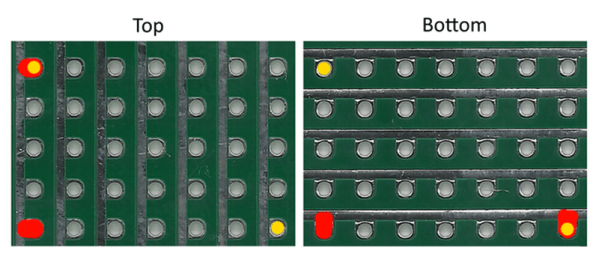
And so we come to the new invention, Perf+, the perfboard reinvented. This perfboard again is a series of plated holes on a 0.1″ grid. Alongside these holes is a plated bus. This bus does not connect to any hole; instead, a little bit of solder is used to connect it to holes on the same row or column. “Selective Veroboard,” you could call it.

Now for the real trick: on one side of the board, the plated busses run vertically. On the other side of the board, the plated busses run horizontally. This means any two holes on the protoboard can be connected as one electrical node simply with a bit of solder.

If ever there was an idea you could point to and simultaneously say, “that’s clever” and “I have no idea how to use this,” there you go. I’m pretty sure this idea isn’t better than a piece of stripboard, but it is different. If you have any idea of how to used this new, strange, and otherworldly protoboard for something useful, put a note in the comments.

CastAR Teardown

A little more than a year ago, castAR, the augmented reality glasses with projectors and retro-reflective surfaces made it to Kickstarter. Since then we’ve seen it at Maker Faire, seen it used for visualizing 3D prints, and sat down with the latest version of the hardware. Now, one of the two people we trust to do a proper teardown finally got his developer version of the castAR.

Before [Mike] digs into the hardware, a quick refresher of how the castAR works: inside the glasses are two 720p projectors that shine an image on a piece of retroreflective fabric. This image reflects directly back to the glasses, where a pair of polarized glasses (like the kind you’ll find from a 3D TV), separate the image into left and right for each eye. Add some head tracking capabilities to the glasses, and you have a castAR.

The glasses come with a small bodypack that powers the glasses, adds two jacks for the accessory sockets, and switches the HDMI signal coming from the computer. The glasses are where the real fun starts with two cameras, two projectors, and a few very big chips. The projector itself is a huge innovation; [Jeri] is on record as saying the lens manufacturers told her the optical setup shouldn’t work.

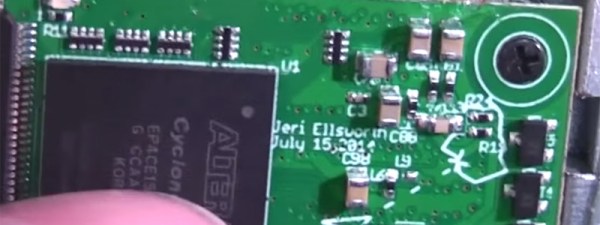
As far as chips go, there’s an HDMI receiver and an Altera Cyclone FPGA. There’s also a neat little graphic from Asteroids on the board. Video below.

Continue reading “CastAR Teardown”

A Cellular Dev Kit With A Data Plan

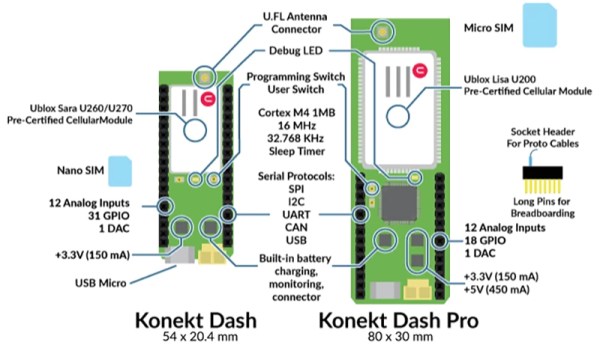
After years of futzing around with 433 MHz radios and WiFi, we’re finally seeing a few dev boards that are focused on cellular radio modules. The Konekt Dash is the latest offering that puts a small u-blox SARA cellular module on a board with a small ARM Cortex M4 microcontroller for a complete cellular solution for any project you have in mind. Yes, until we get radios that make sense for an Internet of Things, this is the best you’re going to get.

If the Konekt sounds familiar, you’re right. A few months ago, Spark introduced the Electron, a cellular dev board based on the u-blox SARA-U260 module that includes a SIM with a 1MB of data a month. Practically, it’s not much different from the Konekt, but the Dash and Dash pro offer battery management and a battery connector, two power supplies, and encryption from the board to a server. There are slight differences for about the same price, but that’s what’s great about competition.

The Konekt Dash is now a few days in to a Kickstarter campaign that includes as rewards a board and a SIM with a six months to a year’s worth of data. There are a lot of things that can’t be done with WiFi, Bluetooth, or other radio modules, and if you have something like that in mind, you won’t do better than a Konekt or Spark Electron.

An Introduction To Clock Dividers And Psychological Warfare

A while ago, [nsayer] was inspired by a Hackaday post to build one of the most insidious means of psychological warfare. I speak, of course, of the [Lord Vetinari] clock, a clock that ticks at random intervals, but still keeps accurate time. His build, the Crazy Clock, is a small controller board for off-the-shelf clock movements that adds the [Vetinari] feature to any clock by soldering only a few wires.

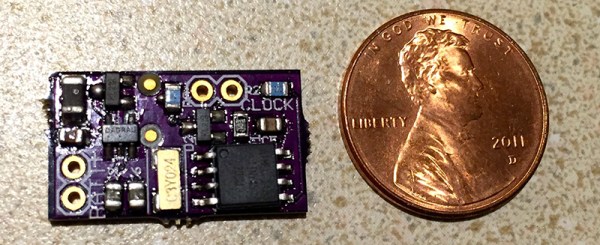
The Crazy Clock is a pretty simple device consisting of only a 32.768 kHz crystal, a microcontroller, and a few transistors to pulse the movement of a clock mechanism. While psyops is great, it recently occurred to [nsayer] that this device could be used for other build.

Since the output of the Crazy Clock doesn’t necessarily have to be connected to a clock movement, [nsayer] decided to connect a LED, generating a 60Hz flashing light for a phonograph strobe. This is easy with timer prescalers and clock dividers; the original 32.768 kHz signal is divided by 8 to produce a clock that ticks every 4.096 kHz.  Divide that again by 120, and you get 34 2/15. Yes, this is all stuff you learned in fourth grade, and if you’re smarter than a third grader you can eventually whittle a 32.768 kHz clock down to a nice, round, binary number – exactly what you need for computing time.

[nsayer] posted a 240 fps (vertical) video of his Crazy Clock blinking at 60 Hz. You can see that below.

Continue reading “An Introduction To Clock Dividers And Psychological Warfare”

DIY Seven Segment Displays

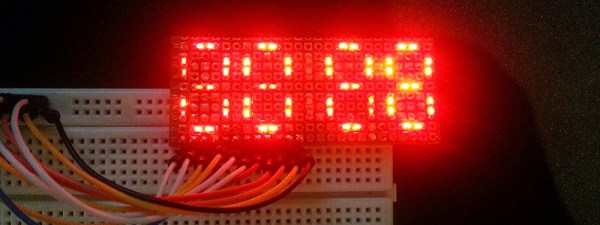
[Esai] wanted to build an electronic clock from scratch. A noble quest, but ordinary seven-segment displays are just that – incredibly ordinary. Instead of a few displays that can be bought from the usual retailers for a dollar a piece, [Esai] made his own four digit, seven-segment display on some perfboard.

Before soldering 58 SMD LEDs to a small rectangle of perfboard, [Esai] traced out each segment with a marker. Two LEDs make up each segment, and they’re all connected to a breadboard-friendly pin header with 30 gauge wire.

Each segment is connected as a single column in the LED matrix, and each digit is a row. It’s a simple design, but there aren’t any resistors on this board. Hopefully [Esai] will be using a proper LED driver with this display; you really don’t want LEDs to burn out twice a day at 1:11.

The 2G Raspberry Pi Smartphone

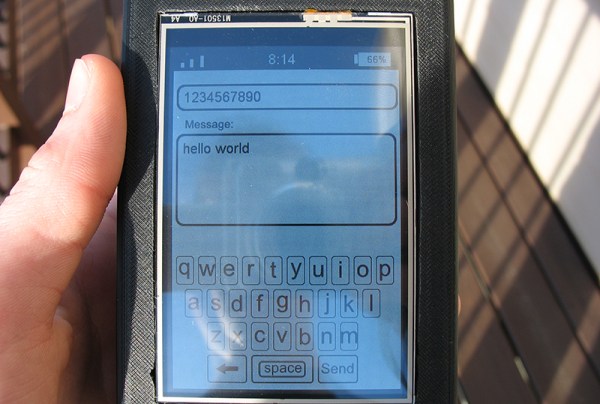
For [Tyler]’s entry to the Hackaday Prize, he’s making something that just a few years ago would be unheard of in a homebrew build. He’s making a DIY smartphone. Yes, with cheap single-board Linux computers, GSM modules, and SPI touchscreen displays, it’s possible to build your own smartphone.

Inside [Tyler]’s DIY smartphone is a Raspberry Pi Model A, a 3.5 inch touchscreen PiTFT with 480×320 resolution, and an Adafruit FONA module The connections are simple enough; the TFT is connected over SPI, and the GSM module over serial. The entire device is powered by a 1200mAh LiIon battery, charged with a powerboost board, runs an operating system written in Python capable of making calls, sending texts, and takes pictures with a Pi camera.

This is not what you would normally call a smartphone. The FONA module is 2G only, meaning you’re limited to 2G speeds and 2G networks. AT&T will be shutting down 2G networks in a little bit, although T-Mobile will be keeping them up for anyone who still has an old Nokia Brick.

That said, [Tyler]’s phone is still exactly what you want in a minimal phone: it just makes calls and receives texts, it has a camera, and unlike the Nokia, you can take it apart and repair it easily. Not that you ever had to do that with a Nokia…