Machining A Skeleton Clock In 10,000 Easy Steps

Another day, another interesting YouTube channel. [Chris]’ Clickspring channel and blog is something you don’t really see much these days: machining parts with a lathe, a mill, and no CNC. The project [Chris] is working on now is a clock based on a design by [John Wilding]. It’s very large, and all the parts are constructed out of raw brass and steel stock.

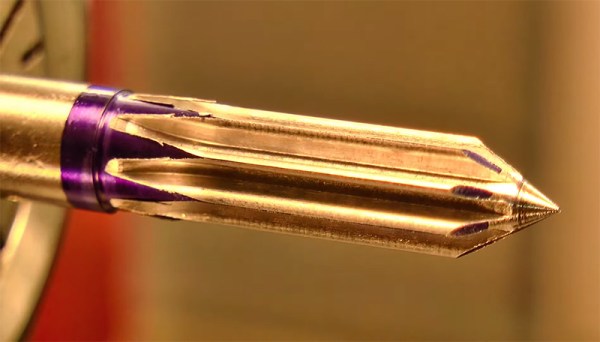
Of course making a clock isn’t just about cutting out some parts on a lathe and turning them on a mill. No, you’re going to need to make the parts to make those parts. [Chris] has already made a tailstock die holder for his lathe, a clamping tool to drill holes in rods, and a beautiful lathe carrier to hold small parts.

All of this is top-notch work, with custom tin lapping tools to put a mirror finish on the parts, and far more effort than should be necessary going into absolute perfection. The clock project is turning out great, although there are several more months until it will tick its first second.

Selected videos below.

Continue reading “Machining A Skeleton Clock In 10,000 Easy Steps”

USB PIDs For All

The USB Implementers’ Forum doesn’t make things easy for anyone building a product with a USB port. To sell anything with USB and have it work like USB should, you need to buy a USB Vendor ID, a $5000 license that grants you exclusive use of 65,536 USB Product IDs. Very few companies will ever release 65,000 products, and there are a lot of unused PIDs sitting around out there.

Now, someone has finally done the sensible thing and put an unused USB VID to work. pid.codes obtained the rights to a single VID – 0x1209 – and now they’re parceling off all the PIDs that remain to open source hardware projects.

This is not a project supported by the USB Implementers’ Forum, and is more of a legal game of chicken on the part of pid.codes. The only thing the USB-IF could do to stop this is revoke the original VID; useless, because they can’t reassign it to anyone else. The original owners of the VID, InterBiometrics, licensed their VID before transferring or sublicensing VIDs and PIDs was prohibited by the USB-IF.

You can get a PID by forking the pid.codes repo, claiming a PID, and sending a pull request. Once that’s accepted, that PID is yours forever.

8-bit Digital Photo Gun

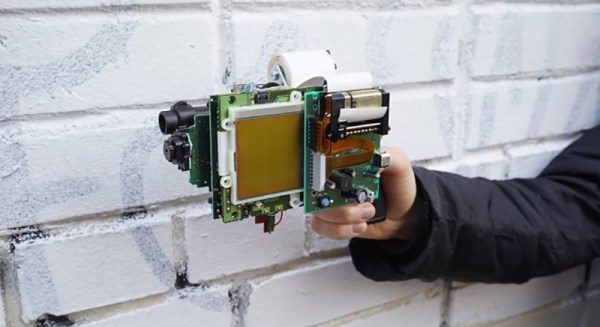
One of the first popular mass-produced digital cameras was the Game Boy camera, a terrible black and white image sensor stuck inside a highly modified Game Boy cartridge. With a Game Boy, the camera, and the Game Boy printer, it was able to produce low-resolution but still surprisingly usable images. Combine all these parts together with the best of hacker art from [vtol] and what do you get? The Game Boy Instant Photo Gun.

There aren’t many details for this build, but it looks like this is an uncased Game Boy Brick, a Game Boy camera, and Game Boy Printer assembled into something that looks dangerous and won’t get past a TSA checkpoint. That might be fixed by repurposing an old NES zapper.

We’ve seen [vtol]’s work before with a machine that probably doesn’t steal your credit card info, a levitating speaker, and something that doesn’t reference [Tarkovsky] enough. This build is right up there with the rest of them.

Thanks [Itay] for the link.

The Best Project We Never Did Yet

Back when [Caleb] was around here at Hackaday, he was tasked with making a few YouTube videos. His Portal Gun got 1.6 Million views, and we got a takedown request because of this video even though that company was more than willing to use [Caleb] as a guinea pig at CES.

This post is not about those videos. This post is about the best project we never did yet.

The grand plan for The Best Project was a zombie survival van. It’s exactly what you think it is: a van armored and armed for driving through a herd of walkers. Proposed mods included a cow catcher and roof rack, a motorized turret, a poofer (propane tanks shooting fire from underneath the van), a bartender that launches molotov cocktails, and a beautiful little contraption called an ankler. The Ankler is just a pair of chainsaws that fold out from under the van.

The base vehicle would be a 60s VW bus. [Caleb]’s a big fan of aircooled stuff, and if you think about it, 60s VWs are pretty good for the zombie apocalypse. If you’re doubting that, just ask how many tools it would take to change out the engine in your car.

Although the dream of a Hackaday aircooled zombie apocalypse van died when [Caleb] left, that doesn’t mean we’re still not considering an official Hackaday ride. All of this is still in the planning stages, but we have a few ideas; the first, and biggest, is a mobile hackerspace on a trailer. This would be a standard semitrailer, loaded up with tools, 3D printers, a laser cutters, and a couch. It would be the perfect thing to load up with swag and haul to events.

We’re considering another more sensible vehicle, and right now the top contender is an early 2000s Astro or Safari cargo van. Yes, I know what you’re thinking: the coolest vehicle we could come up with is a minivan. There’s actually some logic to this, so hear me out.

The Astro/Safari shares a lot of parts with the S10, and that means parts are everywhere. The Astro has an AWD variant, and with a 4″ lift, upgraded suspension and big, knobby tires the Hackaday van would be very, very fun to take out into the desert. It can haul eight foot sheets of plywood, they’re cheap, everywhere, and they just don’t die.

While the best idea right now is an Astro van, we’re also considering other AWD vehicles: an AMC Eagle would be cool, and I think RedBull has a few Suzuki X-90s sitting around. An M35 Deuce And A Half would be fun. A US Mail Truck would probably last forever, and if we go with the semi-trailer concept we would probably want a smaller vehicle on site wherever we park the truck. Current options for this parasitic vehicle include a Nash Metropolitan, a Trabant, a Citroen 2CV, a Renault Dauphine, a Lada, or a Yugo. Yes, they’re all ridiculous but they’re small and can fit in the back of a semi trailer.

It’s still an idea we’re throwing around, but we really need a reason to have a van before we go out and build a hackaspace on wheels, a zombie survival van, or something to launch off some sweet ramps. We don’t go to that many events, and driving a crappy old van across the country a few times a year sounds like fun but surely isn’t.

You can check out [Caleb]’s pitch video for the zombie survival van below.

Continue reading “The Best Project We Never Did Yet”

Manual Data Recovery With A Hex Editor

Let’s say you use an SD card-base portable audio recorder for work – doing an interview, perhaps. Things go well until one day, you turn the recorder off before stopping the recording. Without pressing that big red Stop button, the file doesn’t close, and you’re left with a very large 0kB file on the SD card. How do you get it back?  There are tools that will do it for you, but they cost money. You can do it yourself with a hex editor, though, and it’s actually pretty easy.

The software required for this feat of data recovery is Roadkil’s Disk Imager to dump all the bits on the SD card to an image file, the free version of ISO Buster to show the block addresses and length of each file, and the hex editor of your choice. The process starts as simply an experiment for hot to create an MP3 file by cutting and pasting bits into a hex editor. A good file was found in the hex editor, copied to a new file, and played. Everything works so far; great.

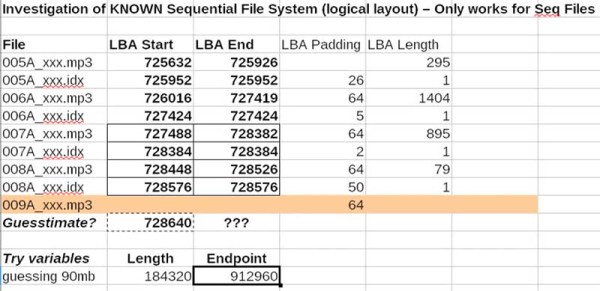
For the actual data recovery, a spreadsheet was created to make an educated guess as to where the lost file should be. Starting at this address, about 90MB of data was copied into a new hex editor window. This is where the recovery hit a snag. Because the SD card was plugged into a Mac before, a bunch of data was written on the card. This went into the first available place on the disk, which just happened to be the header of the lost MP3 file.

That’s not a problem; there’s already the header from an MP3 file sitting in a hex editor from the first experiment to see if this was possible. By copying a few hundred bytes to the front of the lost file, the file was corrected just enough that an MP3 player could reconstruct the file.

It’s not perfect – the first fifty seconds of the interview was garbled. The rest of the interview was saved, though, and that’s much better than losing the entire thing. Thanks [Lewin] for sending this one in.

Continue reading “Manual Data Recovery With A Hex Editor”

More MRRF, This Time A Roundtable

Ah, you thought we were done with our coverage of the Midwest RepRap Festival, didn’t you? No, there’s still more, thanks to [Timothy Koscielny] sending in some digital assets that were required to put this post together. This time, it’s the RepRap roundtable with [Johnny Russell] from Ultimachine, [Shane Graber] from MakerJuice, [Lars Brubaker] from MatterHackers, [Sanjay Mortimer] from E3D-Online.

The first video covers the introductions for these very prominent 3D printer developers and their views on what future advances in 3D printers will be, the differences between Delta, Cartesian, and Polar bots (there aren’t many), and when resin printers will start to pick up.

In the Q&A session, the panel fielded a few questions from the audience. Questions included how to get people into 3D modeling, an amazing question dealing with what we should be making (with the implication that we’re only making stupid plastic trinkets), and what needs work to bring 3D printing to the masses.

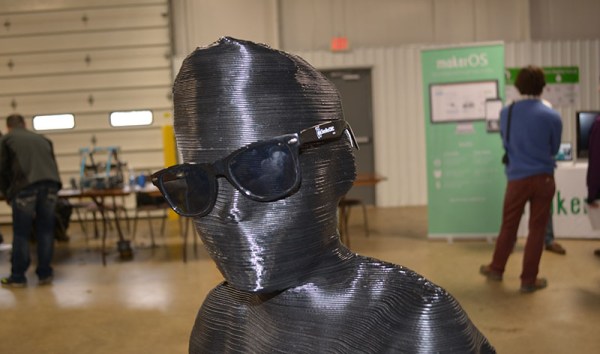
Special thanks to [Casey Hendrickson] from ninety two point three WOWO for MC’ing the RepRap roundtable and to [Timothy Koscielny] for the audio work. This isn’t it, though: I still need to dump a bunch of pictures after the break.

Continue reading “More MRRF, This Time A Roundtable”

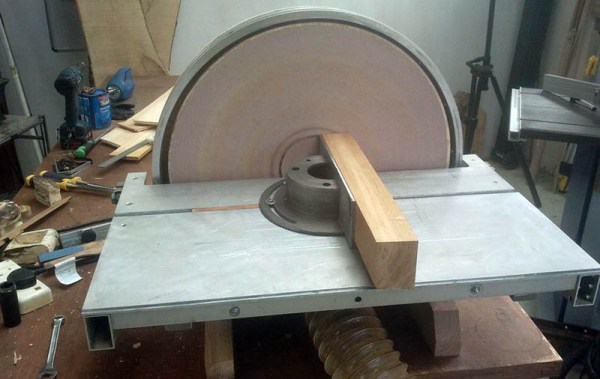
Building A 20 Inch Disk Sander

A small disk sander is a useful and cheap addition to the shop. For about $100, you can buy a cheap combination 6″ disk/belt sander that’s extremely useful. The size and cost of power tools does not scale linearly, and if you want a big disk sander you might as well make your own.

The motor for this build is a 1kW single phase motor pulled from a floor polisher found in the trash. That’s enough to push a sanding disk around, but when you get to tools this large, you need a good base, good tilt mechanism, and everything should be extremely heavy.

This build meets all those requirements while still using mostly recycled components. The work table is actually made of three pieces of recycled aluminum epoxied together. Yes, you should cringe at this, but it actually makes a little bit of sense: thinner pieces can be cut on a table saw, and if you’re extremely careful during the glue-up, you can cut the mitre slot without a mill. This frame attaches to a frame made from aluminum extrusion and filled with a homebrew epoxy granite mix. Remember, heavy is better here.

In keeping with making a huge disk sander out of stuff pulled out of the trash, the trunnions and motor hub were cast out of aluminum melted in an old propane tank furnace. Once these were cleaned up, a disk was mounted on the hub and trued up in the most unsafe manner possible.

With a few additions including a machined mitre gauge, dust collector, and legs made out of wood that’s far too pretty for a simple shop tool, this huge assemblage of trash turned out to be a great sander. You can see a few videos of it below.

Continue reading “Building A 20 Inch Disk Sander”