The Current State Of ESP8266 Development

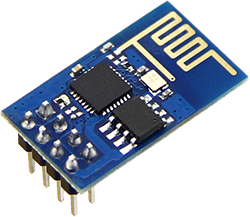
A few weeks ago we caught wind of a very cool new chip. It’s called the ESP8266, and it’s a WiFi module that allows you to connect just about any project to an 802.11 b/g/n network. It also costs $5. Yes, there was much rejoicing when this chip was announced.

Since we learned of the ESP8266, there has been a lot of work done to translate the datasheets from Chinese, figure out how the SOC can be programmed, and a few preliminary attempts at getting this module working with an Arduino. Keep in mind, very few people have one of these modules in hand right now, so all this information is completely untested. Here’s what we have so far:

Over on Hackaday Projects, [bafeigum] has been working to research the capabilities of this module. Most of the comments deal with the AT Command set for the module and figuring out what is actually returned when certain commands are called.

The ESP8266 community forum is about a week old, but already there’s a wealth of information. Most of the efforts seem to be centered on getting GCC to program this chip, something that would make the ESP8266 a single-solution chip for anything that needs WiFi and a bit of processing power. Everyone (including the great [Sprite_TM]) has currently hit a roadblock, so if you have a ton of experience with GCC and the Xtensa microcontroller, check out that thread. Failing that, we’ll have to wait until someone from Tensilica, the company behind the guts of this chip, to chime in and help everyone figure out how this thing actually works.

The Arduino-heads out there will have a much easier time. There’s already a tutorial for using the ESP8266 as a serial WiFi module. Note the ESP operates on 3.3 Volts, so connecting this module to the 5V pin means you’ll be out $5 and several weeks of shipping time.

This is an incredible amount of development in a very short amount of time, made even more remarkable by the fact that no one has one of these WiFi modules yet. When these modules do arrive to workbenches around the world, we’ll expect the Hackaday tip line to be flooded with very small and somewhat battery friendly WiFi builds.


The Reason Dead Batteries Bounce

For the last few years, very well-informed people have been able to tell if an alkaline battery is good or not simply by dropping them. When dropped from an inch or two above a hard surface, a good battery won’t bounce, and will sometimes land standing up. A dead battery, on the other hand, will bounce. Thanks to [Lee] and a few of his friends, we now know why this happens.

While hanging out with a few of his buddies, [Lee] was able to condense all the arguments on why dead batteries bounce to two theories. The first theory, the ‘bounce theory’ said dead batteries had an increase in outgassing in the battery, increasing the pressure in the battery, which increases the spring constant of the battery itself. The second theory, the ‘anti-bounce theory’, said the gel-like properties of the electrolyte worked as a sort of mass damper.

[Lee] designed an experiment to test the outgassing ‘bounce theory’ of bouncing batteries. Instead of dropping a battery, an object – in this case a brass slug – was dropped onto both good and bad batteries. There was no difference. Even after holes were drilled to vent any gasses inside the battery, the brass slug bounced off both good and bad batteries the same way.

This means the reason dead alkaline batteries bounce is due to the electrolyte. [Lee] cut open a few AA cells and found the electrolyte in a good battery was a mushy mess of chemicals. In the dead battery, this same electrolyte hardened into a solid mass. [Lee] compares this to an anti-bounce hammer.

Finally, more than a year after most of us learned about bouncing dead batteries thanks to [Dave Jones]’ video, we have an answer. It’s a chemical change in the electrolyte that turns it from a goo to a solid that makes dead batteries bounce.

Continue reading “The Reason Dead Batteries Bounce”

THP Hacker Bio: Rusty Jehangir

[Rusty]’s project for the Hackaday Prize is extremely ambitious. He’s planning on sending an autonomous craft across the ocean, from LA to Hawaii, a distance that will end up being well over 2,500 miles The best part about this project? It’s already had some time in the ocean, cruising off the coast of southern California under its own power for a distance of 20km.

Why is [Rusty] doing this? Partly because he wanted to do something no one had ever done before. For him, this meant developing a cheap underwater thruster, building an autonomous solar-powered surfboard for a months-long voyage halfway across the Pacific. It’s a small step to the goal of exploring the deep ocean with his thruster and mostly off the shelf parts, but already [Rusty] has learned a lot about electronics in a marine environment and being confident enough to let a project go on its own for months at a time.

Interview below.

Continue reading “THP Hacker Bio: Rusty Jehangir”

Scribble And The Failings Of Tech Journalism

The Scribble Pen, you may remember, is a project by bay area startup Scribble Technology that puts a color sensor and multiple ink reservoirs in a pen. We’ve talked about it before, right after they cancelled their Kickstarter campaign after netting 366% of their original goal.

Yes, they cancelled their campaign after being successfully funded. To Kickstarter’s credit, the Scribble team was asked to provide a better video of the pen demonstrating its capabilities. The team pulled the plug on the campaign, saying they’ll be back soon.

Here is the new campaign. The attentive reader will notice the new campaign is not a Kickstarter project; instead, it is a Tilt campaign. What is Tilt? It’s a platform that allows for crowdfunding, fundraising, pooling, and other ‘many wallets into one’ Internet-based projects. It’s actually not a bad idea if you’re raising funds for a charity or the Jamaican bobsled team. For crowdfunded product development, caveat emptor doesn’t quite cover it.

With more than $200,000 in the bank, you would think the questions asked in many comments on the old Kickstarter would be answered. They were. Scribble put up a new video showing the pen drawing different colors of ink on a piece of paper. This video was faked. [Ch00f] at Drop Kicker took apart the new video frame by frame and found these – ahem – scribbles were inserted in post production. The video has since been replaced on the Tilt campaign page, but evidence of Scribble deleting comments questioning this exists.

Any idea of the Scribble pen being real has been put to bed. Kickstarter threatened to remove the campaign if a better video could not be produced within 24 hours. The Scribble team cancelled their campaign to regroup and put together a better video. In two weeks, the team was only able to produce a faked video. The Scribble pen does not exist.

Case closed, you might think. Digging into videos frame by frame will tell you a lot, but it won’t give you the full picture. We know what happened with the Scribble pen, but very little about the who, why, and how this huge, glaringly obvious fraud occurred. Before we get to that, hold on to your hats – it only gets shadier from here on out.

Continue reading “Scribble And The Failings Of Tech Journalism”

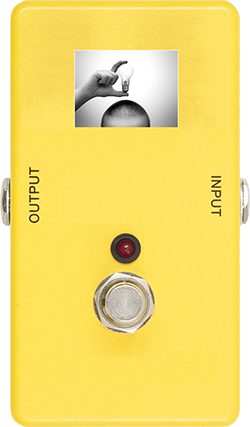
Extrinsic Motivation: An Open, Modular Effects Pedal

Microcontrollers and Arduinos are cool and all, but dealing only in the digital domain does have its limitations. In fact, most of your electron heroes didn’t begin their electronics career by blinking pins on digital outputs; they were solely in the analog domain with their radios and, yes, guitar effects pedals.

[Josh]’s entry for The Hackaday Prize was by far the most analog project of the entire contest. It’s an open source effects pedal that takes advantage of the modular design of the most popular pedals in history.

A good number of the famous circuits for turning an electric guitar into an aural experimentation are based on small circuit modules, packaged and repackaged again until the desired tone is achieved. [Josh] wants to pack these modules separately on different boards, specifically shields, although no Arduino is used, so any sound can be created.

Already [Josh] has done some research to determine what circuits and circuit modules to clone. The list should be fairly familiar to anyone with a pedalboard – Tube Screamers, Fuzz Faces, Big Muffs, and Phase 90s are at the top of the list. He may not get to the complicated digital effects like pitch shifters and digital delays, but it’s still a great project for experimentation.

You can see [Josh]’s project video below.


SpaceWrencherThis project is an official entry to The Hackaday Prize that sadly didn’t make the quarterfinal selection. It’s still a great project, and worthy of a Hackaday post on its own.

Continue reading “Extrinsic Motivation: An Open, Modular Effects Pedal”

THP Semifinalist: The Moteino

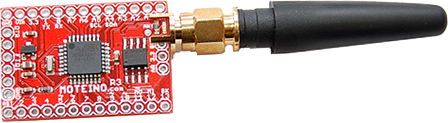
One of the apparent unofficial themes of The Hackaday Prize is the Internet of Things and home automation. While there were plenty of projects that looked at new and interesting ways to turn on a light switch from the Internet, very few took a good, hard look at the hardware required to do that. [Felix]’s Moteino is one of those projects.

The Moteino is based on the Arduino, and adds a low-cost radio module to talk to the rest of the world. The module is the HopeRF RFM12B or RFM69. Both of these radios operate in the ISM band at 434, 868, or 915 MHz. Being pretty much the same as an Arduino with a radio module strapped to the back, programming is easy and it should be able to do anything that has been done with an ATMega328.

[Felix] has been offering the Moteino for a while now, and already there are a few great projects using this platform. In fact, a few other Hackaday Prize entries incorporated a Moteino into their design; Plant Friends used it in a sensor node, and this project is using it for texting and remote control with a cell phone.


SpaceWrencherThe project featured in this post is a semifinalist in The Hackaday Prize.

Extrinsic Motivation: BASIC For Bluetooth

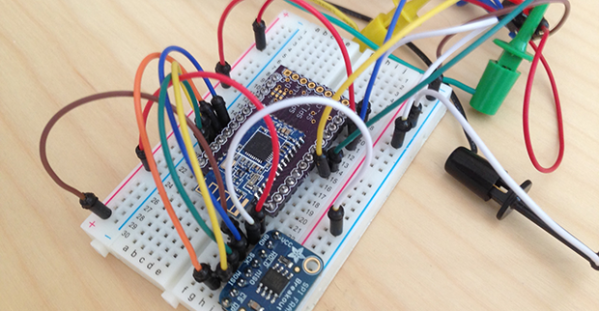
There’s a lot more to those fancy radio modules you use with your Arduino projects than meets the eye. Many of them are systems on a chip, complete with their own microcontroller and memory that can control your entire blinking LEDs project. Developing for these radio modules is a bit of a challenge, as the IDEs and compilers cost several thousand dollars. [Tim]’s entry for the Hackaday Prize looks at one of these Bluetooth LE modules – Texas Instrument’s CC2540 and CC2541 – and puts an embedded BASIC interpreter right on the chip.

[Tim]’s inspiration for this project came from looking at a few popular devices using the CC254X chip. Many of these included a microcontroller and the added costs, complexity, and power requirements that come along with an additional chip. This radio module could easily run any code an ATMega could, and adding another chip to a product seemed like a terrible waste, and certainly not in the spirit of open hardware and software.

The alternative is writing an interpreter for the CC254X chip. He’s chosen BASIC, but added a little bit of Arduino language syntax to make it even easier to develop on. Having already run through a few successful tests involving SPI, I2C and 1-wire devices, [Tim] has a basic system working, but [Tim] admits it does need a little rework to make it easier to use.

It’s a great project, and personally astonishing that it didn’t make the quarterfinal selection for The Hackaday Prize. [Tim] is still working on his project, though, in a great example of extrinsic motivation; he doesn’t need a trip to space to convince him to build something cool.

You can check out [Tim]’s two minute concept video below.


SpaceWrencherThis project is an official entry to The Hackaday Prize that sadly didn’t make the quarterfinal selection. It’s still a great project, and worthy of a Hackaday post on its own.

Continue reading “Extrinsic Motivation: BASIC For Bluetooth”