THP Hacker Bio: John Costik

A surprising amount of entries for The Hackaday Prize are medical devices, and the regulatory problems associated with that domain. [John Costik]’s Diabetes Data, Everywhere is one of the few projects that is perfect for a world where the words ‘hack’ and ‘FDA’ simply cannot be found in the same sentence.

[John]’s son was diagnosed with Type 1 diabetes at a very young age, and very early [John], his family, and the school nurse have had to deal with the nearly innumerable tasks that type 1 diabetes management entails. A Dexcom continuous glucose monitor is a big help, providing a wealth of glucose logging in a small, wearable device.

This monitor, however, is relatively locked down; the stock device is unable to push data to the Internet. [John] reverse engineered the protocol for this glucose monitor, enabling [John] to monitor his son’s blood glucose levels from anywhere on the planet.

There’s a huge community of people waiting for the technological advancements of the last thirty years, like the Internet and portable, networked devices, to make it into medical devices. [John]’s project has already gotten a bit of local news coverage, and is a perfect example of expanding the capabilities of existing devices to make his and his family’s life more convenient.

Bio/interview below.
Continue reading “THP Hacker Bio: John Costik”

Unbricking A BluRay Drive

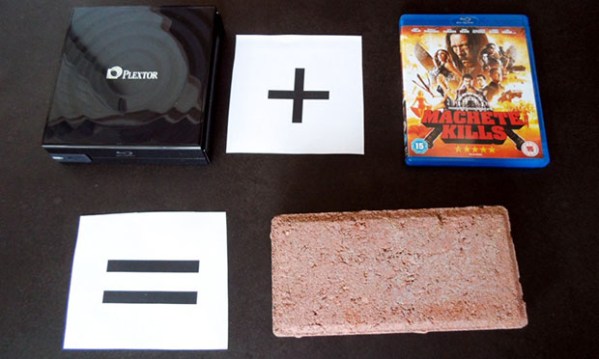
All BluRay player, devices, and drives contain a key that unlocks the encryption and DRM present on BluRay discs. Since 2007, the consortium responsible for this DRM scheme has been pushing updates and revocation lists on individual BluRay releases. Putting one of these discs in your drive will brick the device, and this is the situation [stephen] found himself in when he tried to watch Machete Kills. Not wanting to update his software, he searched for a better solution to unbrick his drive.

Every time [stephen] played or ripped a disc, the software he was using passed a key to the drive. This key was compared to the revocation list present on the drive. When a match was found, the drive bricked itself. Figuring the revocation list must be stored on a chip in the device, [stephen] broke out the screwdriver and started looking around inside the drive.

There aren’t many chips inside a modern BluRay drive, but [stephen] did manage to find a few Flash chips. These Flash chips can be dumped to a computer using a BusPirate, and comparing the dump to a publicly available ‘Host Revocation List Record’, [stephen] was able to find the location on the Flash chip that contained the revocation list.

The next task was to replace the revocation list currently on the drive with an earlier one that wouldn’t brick his drive. [stephen]’s MakeMKV install made this very easy, as it keeps a record of all the revocation lists it runs across. Updating the Flash in the drive with this old list unbricked the drive.

This is only a temporary fix, as [stephen] still can’t put a new disc in the drive. A permanent fix would involve write protecting the Flash and preventing the drive from ever updating the revocation list again. This would be a very complex firmware hack, and [stephen] doesn’t even know what architecture the controller uses. Still, the drive works, saved from terrible DRM.

Upgrading The Battery In A Wrist PDA

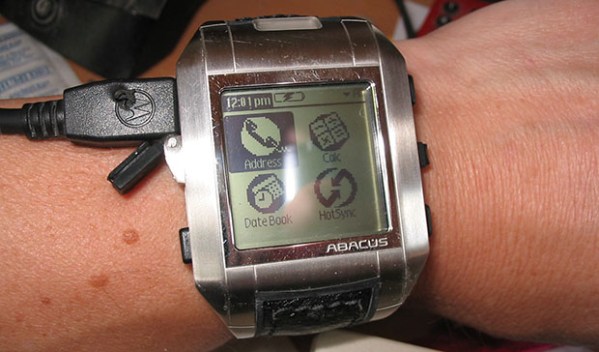
No, your eyes do not deceive you. That’s a wrist-mounted PDA. Specifically, a Fossil Wrist PDA, also known as an Abacus, that was sold from 2003 to about 2005. Yep, it’s running PalmOS. [mclien] has had this watch/PDA for a while now, and found the original 180mAh battery wasn’t cutting it anymore. He made a little modification to the watch to get a 650mAh battery in this PDA by molding a new back for it.

The original PDA used a round Lithium cell, but being ten years old, the battery technology in this smart watch is showing its years. [mclien] found two batteries (380mAh and 270mAh) that fit almost perfectly inside the battery.

The new batteries were about 3mm too thick for the existing case back, so [mclien] began by taking the old case, adding a few bits of aluminum and resin, and making a positive for a mold. Two or three layers of glass twill cloth were used to form the mold, resined up, and vacuum bagged.

After many, many attempts, [mclien] just about has the case back for this old smartwatch complete. The project build logs are actually a great read, showing exactly what doesn’t work, and are a great example of using hackaday.io as a build log, instead of just project presentation.

THP Semifinalist: Stubby, The Adorable Hexapod

After talking with a few of the judges for The Hackaday Prize, documentation will be a large factor in determining who wins and takes a trip to space, and who is left with their feet safely planted on the ground. Stubby the Hexapod is one of the most well documented projects in the running. There are already two hardware revisions for the walking mechanism, several board layouts for the controller, and more project log entries than you can shake a stick at.

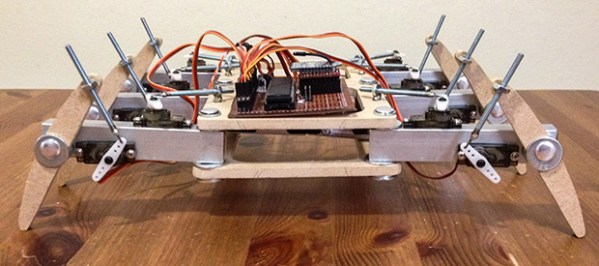
Stubby is the brainchild of [The Big One] (a.k.a. [Wyatt] with [Warren], [Princess Sparkle], and [exot] filling out the rest of the team). The project originally began as an educational robotics project meant for teaching [Wyatt]’s kids the ins and outs of robotics and electronics. He’s doing this by developing an open source hexapod robot platform, complete with a frame, electronics board, and a lot of interesting code driving 18 hobby servos.

The frame for Stubby’s first hardware revision is rather interesting; it’s able to be reproduced with nothing more than a scroll saw. The latest revision is a complete rethinking of hexapod locomotion using 2DOF legs and a more mechanical gait.

Being completely open source and very well documented, you can already make your own Stubby hexapod with a scroll saw and the files on [Wyatt]’s site. If 3D printing is more your thing, there’s also a few files to help you with that.

You can check out a few videos of the different Stubby revisions below:


SpaceWrencherThe project featured in this post is a semifinalist in The Hackaday Prize.

Continue reading “THP Semifinalist: Stubby, The Adorable Hexapod”

Hackaday Links: September 7, 2014

Like Adventure Time? Make your own BMO! It’s a little more expressive than the Adafruit version we saw earlier due to the Nokia LCD. It’s got audio playback too so it can talk to football.

A few years ago, [Matt] made a meat smoker with a PID controller and an SSR. Now the same controller is being used as a sous vide. PID controllers: the most useful kitchen gadget ever.

[Josh] keeps his server in a rack, and lacking a proper cable management solution, this means his rack is a mess. He adapted some Dell wire management arms to his system, using a PCI card bracket to attach the arm to the computer.

[Dr. Dampfpunk] has a lot of glowey things on his Youtube channel

Another [Josh] built a 3D tracking display for an IMU. It takes data off an IMU, sends it over Bluetooth, and displays the orientation of the device on a computer screen. This device also has a microphone and changes the visualization in response to noises.

Remember the pile of failure in a bowl of fraud that is the Scribble pen? Their second crowdfunding campaign was shut down. Don’t worry; they’re still seeking private investment, so there’s still a chance of thousands of people getting swindled. We have to give a shout-out to Tilt, Scribble’s second crowdfunding platform. Tilt has been far more forthcoming with information than Kickstarter ever has with any crowdfunding campaign.

THP Hacker Bio: Michael R Colton

With many hackers out there realizing how much you can do with a few RF blocks connected to a computer, it’s no surprise software defined radio would make a showing in the semifinalists for The Hackaday Prize. [Michael]’s project is the PortableSDR, a small, self-contained unit that handles just about everything below 30MHz. No, [Michael] isn’t dealing with gigahertz accessible with fancier SDRs, but that’s not the point: PortableSDR is meant to do everything – vector analysis, a neat waterfall display, transmit and receive – in a small, portable package you can take anywhere. It’s also fairly cheap to build, and of course completely open source.

This isn’t [Michael]’s first rodeo; he’s built a number of equally cool projects before. He was kind enough to send in a short bio, available below.

Continue reading “THP Hacker Bio: Michael R Colton”

More WiFi Modules For IoT Madness

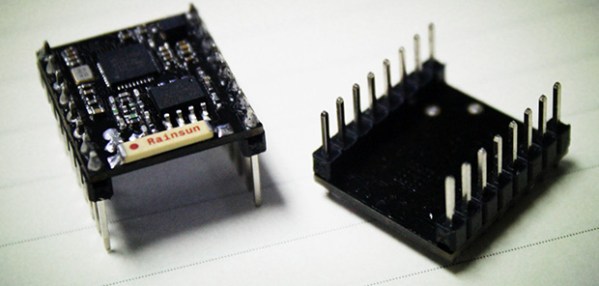
The last year has brought us CC3000 WiFi module from TI, and recently the improved CC3200 that includes an integrated microcontroller. The Chinese design houses have gotten the hint, putting out the exceptionally cheap ESP8266, a serial to WiFi bridge that also includes a microcontroller to handle the TCP/IP stack and the software side of an 802.11 connection. Now there’s another dedicated WiFi module. It’s called the MT7681, and it’s exactly what you would expect given the competition: a programmable module with the ability to connect to a WiFi network.

Like TI’s CC3200, and the ESP8266, the MT7681 can be connected to any microcontroller over a serial connection, making it a serial to WiFi bridge. This module also contains a user-programmable microcontroller, meaning you don’t need to connect an Arduino to blink a few pins; UART, SPI, and a few GPIO pins are right on the board. The module also includes an SDK and gnu compiler, so development of custom code running on this module should be easier than some of the other alternatives.

You can pick up one of the MT7681 modules through the usual channels, but there’s an Indiegogo campaign based in China that takes this module and builds a ‘dock’ around it. The dock has a relay, temperature/humidity sensor, a few GPIO pins, and a USB serial connection for use as an Internet of Things base station.

For anyone looking for a little more computational horsepower, there’s also a few mentions and press releases announcing another module, the MT7688, This is a very small (12mm by 12mm) module running Linux with 256 MB of RAM and 802.11n support. This module hasn’t even hit the market yet, but we’ll be on the lookout for when it will be released.

Thanks [uhrheber] for sending this one in.