Hackaday Links: April 27, 2014

hackaday-links-chain


The HackFFM hackerspace in Frankfurt finally got their CO2 laser up and running, and the folks there were looking for something to engrave. They realized the labels on IC packages are commonly laser engraved, so they made a DIP-sized Arduino. The pins are labelled just as they would be on an Arduino, and a few SMD components dead bugged onto the pins provide all the required circuitry. Video here.

A few years ago, we heard [David Mellis] built a DIY cell phone for an MIT Media Lab thingy. Apparently it’s making the blog rounds again thanks to the Raspi cell phone we featured yesterday. Here’s the Arduino cell phone again. Honestly we’d prefer the minimalist DIY Nokia inspired version.

The Raspberry Pi is now a form factor, with the HummingBoard, a Freescale i.MX6-powered clone, being released soon. There’s another form factor compatible platform out there, the Banana Pi, and you can actually buy it now. It’s an ARM A20 dual core running at 1GHz, Gig of RAM, and Gigabit Ethernet for about $60. That SATA port is really, really cool, too.

[Richard] has been working on a solar-powered sun jar this winter and now he’s done. The design uses two small solar panels to charge up two 500F (!) supercapacitors. There’s a very cool and very small supercap charging circuit in there, and unless this thing is placed in a very dark closet, it’ll probably keep running forever. Or until something breaks.

Here’s something awesome for the synth heads out there: it’s an analog modeling synthesizer currently on Indiegogo. Three DCOs, 18dB lowpass filter, 2 envelopes and an LFO, for all that classic Moog, Oberheim, and Roland goodness. It’s also pretty cheap at $120 USD. We really don’t get enough synth and musical builds here at Hackaday, so if you’re working on something, send it in.

A glass-based PCB? Sure. Here’s [Masataka Joei] put gold and silver on a piece of glass, masked off a few decorative shapes, and sandblasted the excess electrum away. [Masataka] is using it for jewelery, but the mind races once you realize you could solder stuff to it.

Hackaday Retro Edition: Hackadaying At 300 Baud

SONY DSC

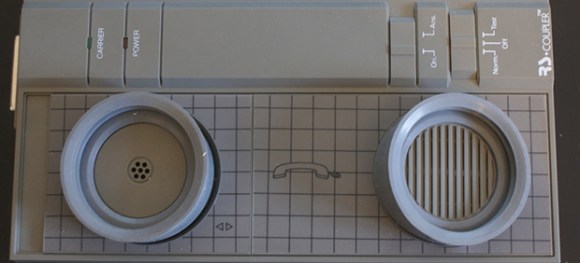
For a bottom of the barrel website like our retro edition, there’s little reason to have a fast Internet connection. Even the fastest hands in the land can barely type faster than 300 baud. The problem with low-speed connections is the overhead involved, as [Pierre] discovered when he dug out an acoustic modem from the ’80s and loaded up our retro site.

While this isn’t the first modem ever made – that’s 1960s tech – but it does operate at the same speed – 300 bits per second, or slower than you reading this sentence. [Pierre] stuck a desk phone into the modem’s cups, plugged it in to a phone line simulator, and connected to a Raspberry Pi equipped with another modem. From there, it was pretty easy to set up a terminal at 300 baud.

A serial connection isn’t a connection to the Internet, however, and at 300 baud, PPP is nearly impossible. The overhead of encapsulating packets is just that high. SLIP is a much better choice to send IP packets over a slow serial connection, but [Pierre]’s mac doesn’t include the proper tools.

[Pierre] ended up using the serial connection between his Mac and Raspi with Zterm. From there, Lynx and Bob’s your uncle.

There’s an unsurprisingly long video of [Pierre] loading up the retro site below, as well an unsurprisingly long video of speedtest.net running at 56k.

Continue reading “Hackaday Retro Edition: Hackadaying At 300 Baud”

Sci-Fi Contest Roundup: Alien Autopsy And Jacking On

There’s still a few days left in our sci-fi contest, and unless you really pull out the stops today, it might be too late to get your entry in. Even though the contest is wrapping up, a lot of projects are wrapping things up and posting their finished projects. Here’s a few good ones.

These puns are awesome

chestbursterThe folks at the LVL1 hackerspace had the idea of making a life-sized game of Operation. This plan changed when someone at the hackerspace had the great idea of making it an alien autopsy. The game play remains the same, but this time the puns are awesome.

The play field is a life-sized alien, stuffed with metal-lined holes that set off a buzzer whenever the modified hemostat touches the side. Inside these holes are incredible puns that include, “Farscraped knee”, “Phantom Tentacle”, a “Tattoine removal”, “Jeffries Tuberculosis”, “HALatosis, “Babelfish in the Ear”, and “Grabthar’s Hammertoe”

The hackerspace took their alien autopsy game to the Louisville 2013 Mini Maker Faire where it was a huge hit. We’re thinking some of the puns were a little too obscure for the general population, but the attention to detail is impressive; there’s a 3D print of Pilot from Farscape. Awesome.

Jacking On

jackingon

In the Futurama universe, immoral robots get their fun by “Jacking On”, or supplanting their 6502-based CPUs with a ton of electricity. This is contraindicated by Bender’s operational manual, but a robot needs his fix, right?

[RodolpheH] and [pierrep] are building one of these jack dispensers, but instead of simply supplying a whole lot of electricity through a jack, they’re creating a Raspi-powered wireless audio streaming device. Plug some speakers into the jack, connect to the Raspi, and you’ve got a very cool audio system on your hands.

The team is going all out with the design of their jack dispenser, using random bits of plastic stuff for the enclosure and a USB-powered plasma ball for the top. It impresses random strangers, and that’s the only thing that’s important, right?

Improved Thermocouples On A Microcontroller

ktype

If you’re reading a thermocouple with one of those fancy schmancy SPI thermocouple amplifiers, this one isn’t for you. If, however, you’re still going through those old-school analog thermocouple amplifiers like the AD595, [miceuz] has just the thing for you. He’s come up with a library for embedded devices that reads the temperature of a k-type thermocouple with +- 0.03°C of accuracy.

As with anything dealing with natural phenomena, the voltage generate by the bimetallic junction of a thermocouple probe is decidedly non-linear. This is a problem when dealing with embedded devices, as that would mean using floating point arithmetic, greatly increasing the amount of code. [micuez] found the NIST tables for a K-type thermocouple and interpolates the actual temperature of the thermocouple probe from the NIST data. The usual way of measuring thermocouples – a polynomial unction of some sort – has an error of about 0.06°C. [miceuz]’s library has an error of less than half that, all while using less code.

The library doesn’t support temperatures below zero, but this is still a work in progress. Still, if you’re looking for a very accurate library for a forge, crock pot sous vide build, or a toaster  oven reflow controller, you can’t do better than [miceuz]’s work.

The Arduino Operating System

WGPIOhile Arduino and its libraries are the quickest way to interface with a sensor and blink an LED, sometimes you shouldn’t have to write and compile code to do something exceptionally simple. [Oliver] realized most of the overly simple functions of a microcontroller could be done from a command line running on that microcontroller and came up with the MiniPirate, the Arduino command line tool.

The MiniPirate is just a sketch compiled on the Arduino that allows pins to be set high or low, set a PWM value, or reading and writing I2C bytes. It’s basically an extremely slimmed down version of the Bus Pirate meant for extremely simple modifications of circuits and peripherals.

[Oliver] demos his MiniPirate by taking a DS1307 real-time clock, wiring up the I2C bus, and writing values to set the time. It’s a very simple implementation meaning he needs to write everything in hex, but it’s still easy enough to find a use in many other projects.

Sci-Fi Contest Roundup: Thinking 4th Dimensionally

Notwithstanding [John Titor] and his time travelling ’67 Corvette convertible, the coolest time machine on wheels has to be the DeLorean from Back to the Future. BTTF is apparently a very popular theme for our sci-fi contest, with a lot of great entries.

You mean to tell me  you made a time machine? Out of a Hyundai Accent?

fluxAfter a careful bit of research, it appears the Hyundai Accent (GLS) has both a higher top speed and faster 0-60 time than a DeLorean, and that’s before the installation of time circuits, a flux capacitor, and plutonium reactor. [docbrownjr] and [Jennifer] decided their Accent was the perfect vehicle for a time machine conversion and decided to add a Mr. Fusion  to the mix.
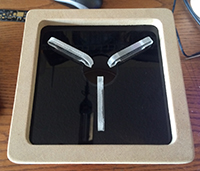
Like the on-screen version, this version of a Mr. Fusion is made from a kitchen appliance. With the original Krups coffee grinder out of production, the team settled on an iced tea machine. There will, however, be copious amounts of dry ice involved,  as will half-empty beer cans and banana peels.

WiFi-enabled Flux Capacitor

ledAfter knocking his head on a toilet, [Beamsjr] came up with a great idea – a networked flux capacitor, able to display the Teamcity build progress.

This build is going all out with custom PCBs – one for the controller board, and three for the shift registered LEDs underneath the acrylic knobbies in the flux capacitor. WiFi is provided by the TI CC3000 module, with the main microcontroller being an ATmega 328p,

Time circuits on

segmentsHonestly, we’d be a bit disappointed if this contest didn’t have a BTTF time circuit build entry. Luckily for us, [atheros] and [bwa] are on top of things with their time circuit clock, complete with an alarm and FM radio receiver (FM isn’t going to work in 1955, guys).

Unlike a few other time circuit builds we’ve seen over the years, the guys are doing this one up right, with 14-segment LEDs for the month display. They’re etching their own boards for this one, and it’s looking like it’ll be a very cool project when it’s complete.

Overengineering A USB Hub

hub

Like many of us, I’m sure, [Nick] doesn’t like digging around behind his computer case for a spare USB port and ended up buying a small USB hub for his desk. The hub worked perfectly, but then [Nick] realized an Ethernet port would be a nice addition. And a DC power supply. Then feature creep set in.

What [Nick] ended up building is a monstrosity of a desk hub with two 24V,  5V, 3.3V 50 Watt DC outputs on banana plugs, a five-port USB hub, four-port Ethernet switch, three mains sockets, 32 digital I/Os, UART, SPI, and I2C ports, a 24×4 LCD or displaying DC current usage and serial input, cooling fans, and a buzzer just or kicks.

The case is constructed out of 6mm laser cut acrylic, and the electronics are admittedly a bit messy. That said, this box does seem very useful and even plays the theme from Mario Brothers, as seen in  the video below.

Continue reading “Overengineering A USB Hub”