A Real Malware In A Mouse

mouseagain

After reading an April Fools joke we fell for, [Mortimer] decided to replicate this project that turns the common USB mouse into a powerful tool that can bring down corporations and governments. Actually, he just gave himself one-click access to Hackaday, but that’s just as good.

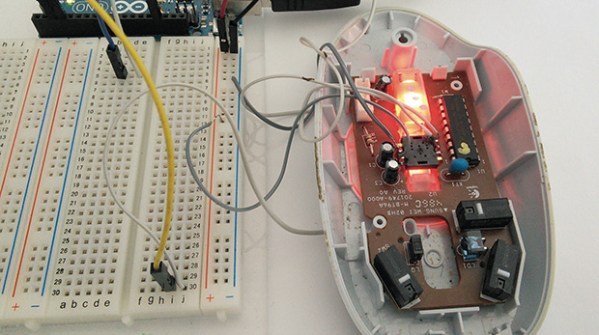
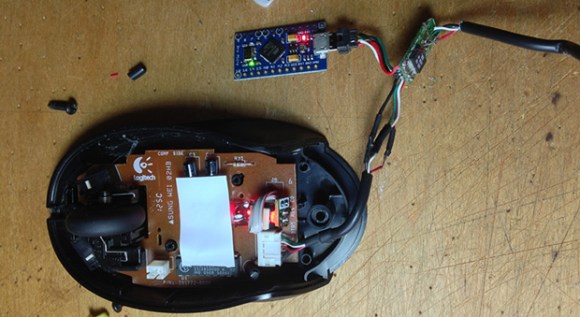
The guts of this modified mouse are pretty simple; the left click, right click, and wheel click of the mouse are wired up to three pins on an Arduino Pro Micro. The USB port of the ‘duino is configured as a USB HID device and has the ability to send keyboard commands in response to any input on the mouse.

Right now, [Mortimer] has this mouse configured that when the left click button is pressed, it highlights the address bar of his browser and types in http://www.hackaday.com. Not quite as subversive as reading extremely small codes printed on a mousepad with the optical sensor, but enough to build upon this project and do some serious damage to a computer.

Video of [Mort]’s mouse below.
Continue reading “A Real Malware In A Mouse”

Controlling The Garmin HUD With Bluetooth

HUD

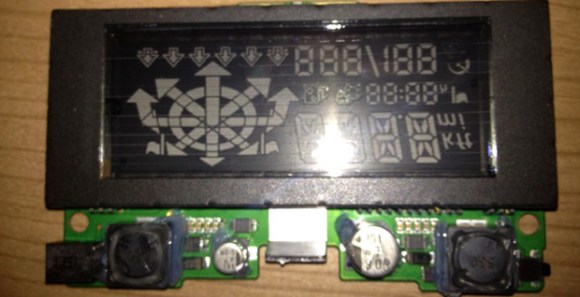
The Garmin HUD is a very neat device, putting all your navigational info, from ETA, what lane you should be in, and distance to your next turn right on your windscreen in a heads-up display. The only problem with the Garmin HUD is that it only works with the official Garmin app, despite being a Bluetooth device. Now, someone is finally digging in to the Garmin HUD protocol, allowing anyone to control this HUD from a cell phone, tablet, or computer.

Being completely unable to disassemble the Navigon app for the HUD, [gabonator] decided the only thing to do would be to open up the device and take a peek at some of the packets travelling between the microcontroller and bluetooth module.

[gabonator] expected human readable ASCII characters, but after looking at the nonsense decoded from his oscilloscope and decoding them manually, he tried simply looking at the display in operation to understand how the protocol worked. He got it all decoded, and managed to get a Sygic Navigation program working with this Garmin HUD. You can check out a video of that below.

Thanks [Kevin] for the tip.

Continue reading “Controlling The Garmin HUD With Bluetooth”

Reflowing With A Hair Straightener

final

Around here, reflow ovens usually mean a toaster oven, and if you’re exceptionally cool, a thermistor and PID controller. There are, of course, a thousand ways to turn solder paste into a solid connection and [Saar] might have found the cheapest way yet: a hair straightener with a street value of just £15.

We don’t expect the majority of the Hackaday demographic to know much about hair straighteners, but [Saar] has done all the work and came up with a list of what makes a good one. Floating plates are a must to keep the PCB in contact with the heating element at all times, and temperature control is essential. [Saar] ended up with a Remington S3500 Ceramic Straight 230 Hair Straightener, although a trip to any big box store should yield a straightener that would work just as well.

One modification [Saar] added was a strip of Kapton tape to one of the ceramic heating elements. It’s not a replacement for a toaster oven or real reflow oven, but for small boards it works just as well.

Video below.

Continue reading “Reflowing With A Hair Straightener”

Malware In A Mouse

Keyloggers, in both hardware and software forms, have been around for a long, long time. More devious keyloggers are smart enough to ‘type’ commands into a computer and install Trojans, back doors, and other really nasty stuff. What about mice, though? Surely there’s no way the humble USB mouse could become an avenue of attack for some crazy security shenanigans, right?

As it turns out, yes, breaking into a computer with nothing but a USB mouse is possible. The folks over at CT Magazine, the preeminent German computer rag, have made the Trojan mouse (German, terrible Google translation)

The only input a mouse receives are button presses, scroll wheel ticks, and the view from a tiny, crappy camera embedded in the base. The build reads this camera with an Arduino, and when a certain pattern of gray and grayer pixels appear, it triggers a command to download a file from the Internet. From there, and from a security standpoint, Bob’s your uncle.

Looking through the camera inside a mouse is nothing new; it’s been done over the Internet and turned into the worst scanner ever made. Still, being able to process that image data and do something with it is very cool. Just don’t accept mouse pads from strangers.

Danke [Ianmcmill] for the tip.

Frankenstein, The Open Source Engine Control Unit

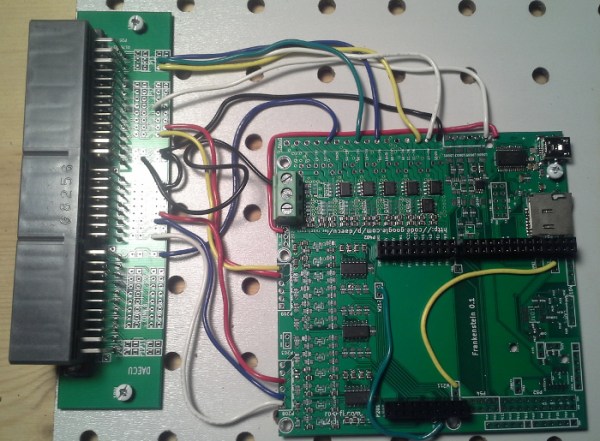
The Engine Control Unit is a vital part of every car made in the last 40 years or so, but unlike just about every other electronic device, open source solutions just don’t exist. [Andrey] is trying to change that with rusEfi, a project that hopes to bring together hardware, software, and engines in one easy to use package. He’s even designed Frankenstein, a full ECU ‘shield’ for the STM32F4 Discovery dev board.

This isn’t the first time we’ve seen [Andrey]’s adventures in building an ECU. An earlier board was also powered by the STM32F4 Discovery, and he actually drove his 96 Ford Aspire around using this homebrew ECU. It was only firing on two cylinders, but that was only a loose solder connection.

Of course building an ECU from scratch is worthless without the proper firmware that balances and engine’s fuel economy and performance. This sort of testing must be done empirically and [Andrey] has a Kickstarter going for the development of this firmware and some dyno time. No rewards, but it’s worth chipping in a buck or two. I did.

Videos below.

Continue reading “Frankenstein, The Open Source Engine Control Unit”

Recycling Plastic With Liquid Nitrogen

Ln2

Recycling 3D printer filament isn’t a new idea, and in fact there are quite a few devices out there that will take chunks ABS, PLA, or just about any other thermoplastic and turn them into printer filament. The problem comes when someone mentions recycling plastic parts and turning them into filament ready to be used again. Plastics can only be recycled so many times, and there’s also the problem of grinding up your octopodes and companion cubes into something a filament extruder will accept.

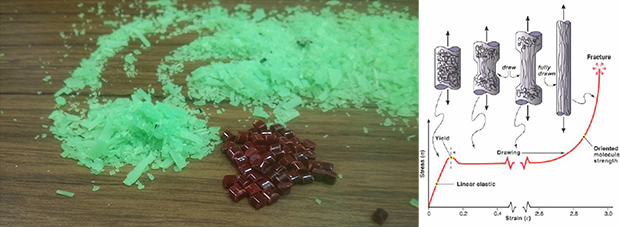
The solution, it appears, is to freeze the plastic parts to be recycled before grinding them up. Chopping up plastic parts at room temperature imparts a lot of energy into the plastic before breaking. Freezing the parts to below their brittle transition temperature means the resulting chips will have clean cuts, something much more amenable to the mechanics of filament extruders.

The setup for this experiment consisted of cooling PLA plastic with liquid nitrogen and putting the frozen parts in a cheap, As Seen On TV blender. The resulting chips were smaller than the plastic pellets found in injection molding manufacturing plants, but will feed into the extruder well enough.

Liquid nitrogen might be overkill in this case; the goal is to cool the plastic down below its brittle transition temperature, which for most plastics is about -40° (420° R). Dry ice will do the job just as well, and is also available at most Walmarts.


The Auto Parking Mecanum Robot

mecanum

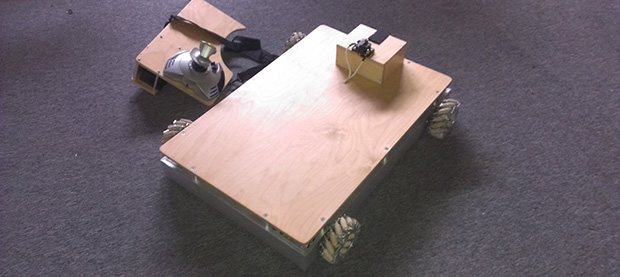
A while back, Hackaday visited the Clark Magnet School in Glendale, California to sneak a peek on their STEM-focused curriculum, FIRST robotics club, awesome A/V classroom, and a shop that puts most hackerspaces to shame. We saw a few builds while we were there, but [Jack]’s auto parking mecanum robot was in a class by itself. It deserves its own Hackaday post, and now that [Jack] is on Hackaday Projects, he’s sharing all the details.

The most impressive aspect of [Jack]’s build is the mecanum wheels; the side plates for the wheels were designed by [Jack] himself and machined on his school’s Haas mill. When the plates came out of the mill they were flat, and each of the fifteen little tabs on the plates needed to be bent at a 45 degree angle. With a CNC jig and a lot of time on his hands, [Jack] bent the tabs for all eight plates.

In addition to the plates, the rollers were custom made from non-expandable polyurethane poured into a CNC milled mold. That’s a one-part mold; [Jack] needed to make sixty of these little parts, one at a time.

The electronics are built around an Arduino Mega communicating with a joystick via an XBee. [Jack] found the relays in the off-the-shelf motor board couldn’t handle the current, so he replaced them with much, much larger ones in a hack job we’d be proud to call our own handiwork. There’s also a little bit of code that allows this motorized cart to pull off the best parallel parking job anyone could ever wish for. You can see that and a few videos of the construction below.

Continue reading “The Auto Parking Mecanum Robot”