Cloning The Trinket For A USB Volume Knob

A while back, [Rupert] wrote a blog post on using V-USB with the very small, 8-pin ATtiny85. Since then, the space of dev boards for 8-pin micros with USB has exploded, the most recent being Adafruit’s Trinket. [Rupert] liked what he saw with the Trinket bootloader and decided to clone the circuit into a useful package. Thus was born an awesome looking USB volume knob complete with a heavy aluminum knob, rotary encoder, and RGB LED strip.

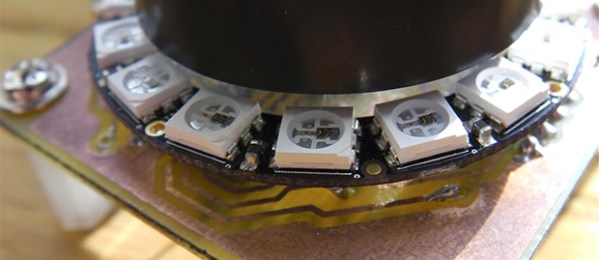
[Rupert] got his V-USB/ATtiny85/rotary encoder circuit working, and at the expense of a ‘mute’ control, also added an awesome looking RGB LED ring powered by Adafruit’s Neopixels. The PCB [Rupert] fabbed is pretty well suited for being manufactured one-sided. If you’ve ever wanted an awesome volume knob for your computer, all the files are available form [Rupert]’s blog.

Just as an aside, [Rupert] has been working on getting the Trinket bootloader working on the ATtiny84, a very similar microcontroller to the ’85, but with eight analog pins. It’s a neat device that I’ve made a small V-USB breakout board for, but like [Rupert], I’m stuck on porting the bootloader. If anyone has the Trinket/Gemma firmware running on an ATtiny84, send that in. We’ll put it up.
Commodore 64 Power Glove Is So Bad

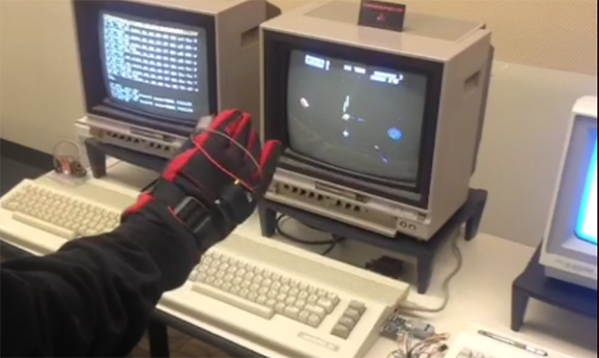
The Nintendo Power Glove was terrible. Really, really terrible. Thanks to modern components, though, it’s possible to recreate the Power Glove experience in a way that doesn’t suck so much. That’s what [Leif] did with his motion sensing glove for the Commodore 64.

Instead of rolling his own IMU and putting it in a glove, [Leif] is using SonicWear SoMo, a glove originally designed to generate MIDI data for performance pieces. Inside this glove is a 9 DOF gyro/accelerometer/magnetometer, uC, battery, and XBee that can be easily reprogrammed to do something a little more (or less) useful than simply sending MIDI notes and commands.

[Leif] reprogrammed the XBees to use I/O line passing instead of sending serial data, and connected the recieving XBee to the C64 joystick port through a very simple circuit with a hex inverter.

All the code to turn a SonicWear glove into a C64 controller is available on the Github, and there’s a neat demo video of [Leif] demoing his glove at the VCF Midwest late last month.

3D Printering: A Makerbot In Every School Follows The Oregon Trail

printering

Gather ’round, children and I’ll tell you a tale of how everyone from the ages of 16 to 40 has played Oregon Trail.

Back when Apple was just starting out, [The Steves] thought it would be a good idea to get the Apple II into the hands of schoolchildren across the United States. They did this with educational pricing, getting Apple IIs into newly created ‘computer labs’ in schools across the country. These new computers – from my experience, anyway – were used as a replacement for the old Selectric typewriters, and on rare occasions a machine that played the MECC classics like Oregon Trail.

Fortunately, a few students were bright enough and had teachers who were brave enough to allow BASIC programming, PEEKs and POKEs. This was the start of a computer revolution, a time when grade schoolers would learn a computer wasn’t just a glorified word processor or dysentery machine, but something that would do what you told it to do. For those kids, and I’m sure a few of them are reading this, it was a life changing experience.

Now it appears we’re in the midst of a new revolution. If this horribly named column isn’t enough of a clue, I’m talking about 3D printing. Yesterday, Makerbot announced they were going to fill in for Apple in this physical revolution by trying to get a Makerbot into every school in the country.

Continue reading “3D Printering: A Makerbot In Every School Follows The Oregon Trail”

Sailing With An Autopilot

sailboat

After seeing an autopilot for a kayak a few days ago, [Mike] thought he should send in his version of a water-borne autopilot. Compared to something that fits in a one-man kayak, [Mike]’s creation is a monstrous device, able to keep a largeish sailboat on a constant heading.

To keep track of the ship’s bearing, [Mike] is using a very cool digital compass that uses LEDs to keep a steady heading. Also included is an amazingly professional and very expensive 6 axis IMU. To actually steer the ship, [Mike] is using a linear actuator attached to the tiller powered by a huge 60 Amp motor controller. The actuator only draws about 750 mA, but if [Mike] ever needs an autopilot for a container ship or super tanker, the power is right there.

For control, [Mike] ended up using an Arduino, 16-button keypad, and an LCD display. With this, he can put his autopilot into idle, calibration, and run modes, as well as changing the ship’s heading by 1, 10, and 100 degrees port or starboard.

From a day of sailing, [Mike] can safely say his autopilot works very well. It’s able to keep a constant heading going downwind, and even has enough smarts to tack upwind.

Videos below.

Continue reading “Sailing With An Autopilot”

Printing Printed Circuit Boards

circuit

We really respect the old timers out there and their amazing ways of crafting PCBs; they used black tape on clear acetate sheets to create single layers of PCBs with a photoetching process. Now creating a PCB is a simple matter of opening up a CAD package, but like the old timers we’re still dealing with nasty chemicals or long shipping times from China.

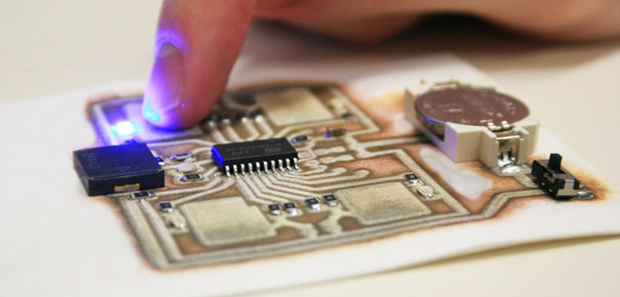
The EX¹, a new robot on Kickstarter – hopes to change that. They’ve created a PCB fabrication process that’s as simple as printing something with an inkjet printer. Just put in a piece of substrate – anything from Kapton to acrylic to fabric – and in a few minutes you have a single-sided PCB in your hands.

The printer dispenses two chemicals, silver nitrate and ascorbic acid, that react and produce traces and pads for the circuit. Right now, the EX¹ is limited to single-side boards, but experiments on creating multi layer boards are ongoing.

In any event, we’re really impressed with how simple the EX¹ setup actually is. Inkjet is a mature, well understood technology with more than enough resolution for simple homebrew circuits, and the AgNO3 + Vitamin C formula could easily be adapted to an inkjet printer modification.

Building A Better Serial Camera

If your next project does anything with cameras or machine vision, you’ll probably be looking at something like a USB webcam attached to an ARM board or a netbook. Sometimes, though, that setup blows will blow your budget – power or otherwise – out of the water. For small projects, you’re limited to small, serial-accessible cameras, and in that domain you really don’t have a lot of choices.

[Ibrahim] realized the cheapest serial cameras are about $35, and with basic image processing that cost skyrockets up to about $100. He set out to build his own alternative, and ended up with an awesome serial camera module that should only cost about $15 in quantity.

The module is built around an STM32F4 microcontroller running at 168 MHz. This micro has a DCMI port to which a OV9650 camera is attached. The resolution ends up being 1280×1024, far better than other serial cameras.

Already [Ibrahim] has the hardware working and a few demo apps. He has a real time color tracking demo (video below) up and running and a machine vision repo for his tiny camera. Now if we could only get a few of these boards on Tindie.

Continue reading “Building A Better Serial Camera”

Hackaday Links: November 10, 2013

hackaday-links-chain

[Henryk Gasperowicz], the wizard of electrons who makes LEDs glow for no apparent reason, has put up another one of his troll physics circuits. We have no idea how he does it (he does say he’s using wireless energy transmission) so a few solution videos would be cool, [Henryk].

Altoids tins make great electronic enclosures, but how about designing your PCBs to fit mint and gum containers? Here’s a Trident USBASP, a tiny Tic Tac ISP thingy, and a Mentos USB to JTAG interface.

By the end of this week, the PS4 will be out, along with the new PS4 camera. It’s a great camera – 1280×800 at 60Hz – but unless someone develops a driver for it, it shall forever remain tethered to a PS4. Luckily, there’s a project to develop a PS4 camera driver, so if you have some USB 3.0 experience, give it a shot.

Multimeter teardowns? [David]’s got multimeter teardowns. It’s an HP 3455A, a huge bench top unit from the 80s. This is, or was, pro equipment and strange esoteric components definitely make a showing. ±0.01% resistors? Yep. Part two has some pics of the guts and a whole ton of logic.

The US Air Force Academy just moved their embedded systems course over to the MSP430. Course director [Capt Todd Branchflower] just put all the course materials online, with the notes, datasheets, and labs available on Github.