Making A Phono Preamp For A First Electronics Project

Nearly everyone’s first electronic project is something that blinks a LED. There are a million ways to go about this ‘Hello World’ project of electronic design; 555 timers, microcontrollers, or maybe even discrete components if you’re really cool. When [miceuz] was asked by a friend to help with his first electronic project he eschewed the usual blinking LED project and taught him how to build something he actually needed: a phono preamp for an old turntable.

Back in the day when vinyl was king, albums needed to be mastered to play on a record player. The mastering process cuts some of the bass and increases the treble. When the record is played, this process needs to be reversed. It’s a preamp that does this job by attenuating the high frequency sounds and boosting the thumping bass.

[miceuz] found a nice DIY RIAA preamp  project and found a nice little op amp  somewhere in his parts bin. After laying out the circuit, [miceuz] etched a few boards and taught his friend how to solder SMD components.

Of course the project didn’t work the first time around, but after poking around with a meter and checking out the old turntable, the preamp came to life with the clang of chords from an old record. If you’d like to build your own, you can get the files from [miceuz]’s git.

OpenPLC, For Industrial Automation To Halloween Displays

Stepping out onto just about any factory floor you’ll find complex automatons building anything and everything imaginable. These machines need to be controlled somehow and before the age of computers these manufacturing robots were controlled with relays wired together to produce a multitude of actions. Relays, no matter how reliable and bulletproof the are, can’t be programmed without rewiring the entire machine. Now, factories have programmable logic controllers to take care of their automation tasks.

[Thiago] built his own programmable logic controller and released it as open hardware.Included in the OpenPLC are four 24V inputs, four 24V outputs (two with PWM), 0-10V analog inputs, and USB, SPI, and I2C for programming and expansion.

If you’re building anything from an industrial machine in your garage, or simply want really awesome Halloween (or Christmas) decorations, the OpenPLC can take care of driving all the solenoids, motors, and actuators needed. With the extendable I2C and SPI busses, it’s possible to add a plethora of sensors to bring a project to life.

The OpenPLC is based on an ATMega328 and is compatible with Arduino code. There are a few extension boards for digital and analog IO, as well as Ethernet.

Homebrew Guitar Tuner Also Includes MIDI Out

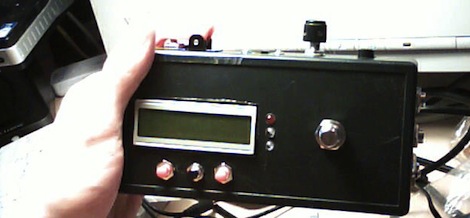
A few years ago, [Frédéric]’s brother in law wanted a guitar tuner for Christmas. Instead of going out and buying one, [Frédéric] broke out the soldering iron and built one from scratch.

[Frédéric]’s tuner is built around an ATMega168 uC on a Real Bare-Bones Board with an LM386 amplifier. The display is a standard 20×2 LCD character display, and the interface is torn from the pages of stomp box schematics with a very hefty foot switch.

Detecting the frequency of a note played into [Frédéric]’s tuner involves a fair bit of math. To measure the frequency, the Arduino samples the waveform coming from the input jack. This signal is delayed for a fraction of a second and the area underneath the real and delayed waveforms is measured. This delay slides across the original waveform until the area between the real and delayed samples are minimized. At that point, delayed wave form will be exactly one cycle behind the real signal, and the cycles per second can be calculated. It’s called the YIN algorithm, and you can read more about it here.

Since [Frédéric] already knew the exact frequency being played into the tuner, he figured it would be trivial to add a small analog audio to MIDI converter. This feature (as shown in the video after the break) turns the sounds from a guitar into MIDI notes. It’s monophonic and probably a little superfluous, but still very cool.

Continue reading “Homebrew Guitar Tuner Also Includes MIDI Out”

Small Server For Model Trains

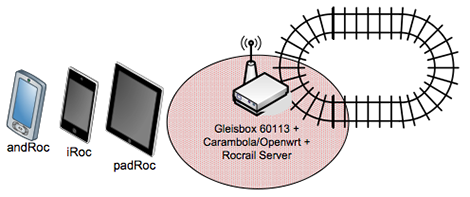
For reasons we can’t comprehend, model train layouts are  incredibly popular in Germany. [Gerhard] is one of those model train aficionados that has moved far beyond a layout with a transformer controlling the speed of the train; he sent in a tip for a very tiny Rocrail server he built to control the locomotives moving across his layout.

[Gerhard] uses Rocrail – a control system for train layouts large or small. Rocrail comes in both client and server configurations. The client is able to run on iDevices or Android. [Gerhard]’s server runs on a very tiny Linux computer tucked away under the layout.

Instead of a Raspberry Pi ([Gehard] couldn’t get one in time for this build), he used a Carambola board. The Rocrail server is installed on this single board computer and connects to a CAN bus controller. It’s a step up from [Gehard]’s previous CAN/Ethernet gateway built around OpenWRT, and makes the entire device much smaller.

[Gehard] doesn’t have a video of his layout in action, but after the break you can see how much the German people love their model trains at Miniatur Wunderland in Hamburg.

Continue reading “Small Server For Model Trains”

Gyrocam Keeps The Horizon Level Even When The Camera Isn’t

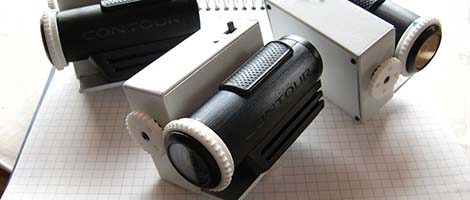
[Derek] likes to get a little bit of drivers-eye footage when racing his motorcycle, but there’s an inherent problem with mounting a camera to a moving and tilting platform. When he leans into turns, the camera can’t keep the horizon level. Cinematography and electronics go well together. so [Derek] built a horizon-stabilized camera mount for motorcycle videography.

The build was inspired by footage shot from [Valentino Rossi’s bike in 2010. Of course the professional model costs a small fortune, but [Derek] managed to make his own out of 3D printed parts and a hobby servo.

Based on the Contour Roam camera, [Derek] had a pair of gears printed at Shapeways to fit over the camera and attach to a servo. The electronics are an ATMega32 with a L3G4200D gyroscope. When the ‘micro detects a change in the gyroscope it rotates the servo in the opposite direction, keeping the horizon in the video level.

It’s a very cool build, and judging from the action videos after the break, makes for awesome track footage.

Continue reading “Gyrocam Keeps The Horizon Level Even When The Camera Isn’t”

A Beautiful Pinhole Camera Takes Wonderful Photos

With digital cameras in everything and film slowly disappearing from shelves, everyone loses an awesome way to learn about photography. Pinhole cameras allow anyone to build a camera from scratch and also learn about those crazy f-stops, exposure times, and focal planes that Instagram just won’t teach you. [Matt] put up a great tutorial for building your own pinhole camera, and the project looks easy enough for even those who are still playing around with their cell phone cameras.

For film, [Matt] used 120 film, a medium-format medium that is sill available for purchase and processing in some areas. Because [Matt]’s pinhole is relatively large and made out of very thin material, the camera could take very large pictures – much larger than standard 35mm fare. If you’re using a smaller camera projecting a smaller image onto the film, 35mm would be the way to go as it greatly decreases the difficulty of finding film and a processing center.

[Matt]’s camera is constructed out of laser-cut plywood. Because he’s producing extremely wide images with his camera (6 x 17cm), [Matt] needed to curve the film around the focal plane of the camera to keep the entire image in focus.

The mechanics of the camera are simple – just a pair of knobs to wind the film and a small metal shutter. [Matt] added a shutter release cable to open and close the aperture without moving the camera and had a wonderful camera perfect for capturing either sirs and madams or Civil War battlefields.

Motion Sensing Fog Machine

Our favorite holiday is just around the corner, so there’s no surprise in seeing a few builds to scare children turning up in the tip jar. [Greg] also loves Halloween and apparently puts on a good show – he always uses a fog machine on his porch on All Hallow’s Eve, but triggering it at the right time is always a pain.

This year, [Greg] decided to build a motion-sensing fog machine. His machine featured a wired remote with a light to signal when the fog machine is ready and a button to start the pump. This remote runs at 120V AC, but [Greg] figured he could stick a small USB phone charger in the remote and power an ATtiny85 microcontroller.

The actual circuit is just a piece of perfboard, a large, old relay from Sparkfun, and a PIR sensor [Greg] picked up last year. Whenever the PIR detects movement, the Tiny85 activates the fog machine for 5 seconds and disarms itself for another 10, until it sees movement again. Just the thing for a little interactive ambiance for [Greg]’s Halloween display.

Video after the break.

Continue reading “Motion Sensing Fog Machine”