3D Mapping Of Huge Areas With A Kinect

The picture you see above isn’t a doll house, nocliped video game, or any other artificially created virtual environment. That bathroom exists in real life, but was digitized into a 3D object with a Kinect and Kintinuous, an awesome piece of software that allows for the creation of huge 3D environments in real time.

Kintinuous is an extension of the Kinect Fusion and ReconstructMe projects. Where Fusion and ReconstructMe were limited to mapping small areas in 3D – a tabletop, for example, Kintinuous allows a Kinect to me moved from room to room, mapping an entire environment in 3D.

The paper for Kintinuous is available going over how the authors are able to capture point cloud data and overlay the color video to create textured 3D meshes. After the break are two videos showing off what Kintinuous can do. It’s jaw dropping, and the implications are amazing. We can’t find the binaries or source for Kintinuous, but if anyone finds a link, drop us a line and we’ll update this post.

Continue reading “3D Mapping Of Huge Areas With A Kinect”

Dot Matrix Printer Spits Out Any Tweet Mentioning @KWF

Earlier this month, [Kenneth] picked up an old dot matrix printer at the Silicon Valley Flea Market and subsequently found two cases of tractor feed printer paper. It’s a marriage made in heaven for a dot matrix twitter printer.

[Kenneth] used a BeagleBone – a tiny single board computer running Linux – to connect to the Internet and fetch any new tweets mentioning KWF every minute or so. The BeagleBone spits out these tweets over the USB port which is connected to the ancient printer by means of a cheap adapter cable.

Interestingly, [Kenneth] wrote the code for this project as a shell script. A lot of effort went into scrubbing the input of any escape characters, but he still implores his admirers to not attempt to break his project.

In case you’re wondering, at couple Twitter accounts announced this post’s headline to the Twitterverse when this story was published. This should have immediately sent [Kenneth]’s printer into motion, recording that harsh mistress that is sending a build log of a Twitter connected device into Hackaday.

After the break you can see [Kenneth]’s demo. Be sure to share this post on Twitter!

The Biggest CNC Machine Can Build A House


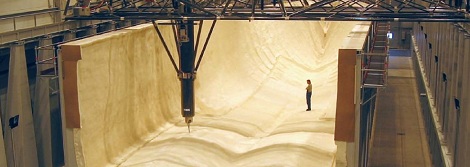
If it’s true that those with the biggest toys win, a few lucky engineers over at EEW Maschinenbau in Germany just earned a gold medal; they have access to a gigantic CNC machine that is large enough to machine a house.

This machine was originally built to manufacture molds for fiberglass wind turbines that are over 50 meters in length. Because building a 50-meter-long CNC machine wasn’t overkill enough, engineers at EEW Maschinenbau settled on a design that is 151 meters long, or almost 500 feet. Of course the HSM-Modal, as this machine is called, can only make parts 151 meters long in the x dimension. The y-axis has a span of 9 meters while the z-axis goes from 0 to 4.25 meters off the ground. Large enough to build cars, ship hulls, and even houses out of a single block of material.

There’s a bunch of technical documentation on the EEW website and a PDF going over the specs. Not only can this gigantic mill machine molds much like an embiggened desktop CNC router, this thing can do drilling, sawing, grinding, plasma cutting, and even extrusion just like a Makerbot.

If you’ve got the cash, EEW Maschinenbau will build you one of these gigantic machines. We can’t imagine how much that would cost, though.

via the Adafruit blog

A Personal Manufacturing Stack Exchange

Over on Stack Exchange, there’s a proposal for a new CNC/3D printer site. It’s a personal manufacturing stack exchange, and hopefully we’ll see some awesome discussion when it’s eventually created.

Stack Exchange is already well-known for hosting the most useful programming site as well as awesome sites/forums covering everything from LaTeX to grammar. The proposed Personal Manufacturing site is sure to provide a ton of advice and discussion covering the hardware, software, electronics, and toolchains of CNC routers, RepRaps and mills.

The personal manufacturing stack exchange hasn’t been created yet – a few more people still need to commit to use it. Once that’s done, though, we’re sure to see a lot of very helpful advice and discussion from the Stack Exchange community.

Kudos to [Michael] for sending this in.

OpenCV Knows Where You’re Looking With Eye Tracking

[John] has been working on a video-based eye tracking solution using OpenCV, and we’re loving the progress. [John]’s pupil tracking software can tell anyone exactly where you’re looking and allows for free head movement.

The basic idea behind this build is simple; when looking straight ahead a pupil is perfectly circular. When an eye looks off to one side, a pupil looks more and more like an ellipse to a screen-mounted video camera. By measuring the dimensions of this ellipse, [John]’s software can make a very good guess where the eye is looking. If you want the extremely technical breakdown, here’s an ACM paper going over the technique.

Like the EyeWriter project this build was based on, [John]’s build uses IR LEDs around the edge of a monitor to increase the contrast between the pupil and the iris.

After the break are two videos showing the eyetracker in action. Watching [John]’s project at work is a little creepy, but the good news is a proper eye tracking setup doesn’t require the user to stare at their eye.

Continue reading “OpenCV Knows Where You’re Looking With Eye Tracking”

GPU Programming For Easy & Fast Image Processing

If you ever need to manipulate images really fast, or just want to make some pretty fractals, [Reuben] has just what you need. He developed a neat command line tool to send code to a graphics card and generate images using pixel shaders. Opposed to making these images with a CPU, a GPU processes every pixel in parallel, making image processing much faster.

All the GPU coding is done by writing a bit of code in GLSL. [Reuben]’s command line utility takes that code, sends it to the graphics card, and returns the image calculated by the GPU. It’s very simple for to make pretty Mandebrolt set images and sine wave interference this way, but [Reuben]’s project can do much more than that. By sending an image to the GPU and performing a few operations, [Reuben] can do very fast edge detection and other algorithmic processing on pre-existing images.

So far, [Reuben] has tested his software with a few NVIDIA graphics cards under Windows and Linux, although it should work with any graphics card with pixel shaders.

Although [Reuben] is sending code to his GPU, it’s not quite on the level of the NVIDIA CUDA parallel computing platform; [Reuben] is only working with images. Cleverly written software could get around that, though. Still, even if [Reuben]’s project is only used for image processing, it’s still much faster than any CPU-bound method.

You can grab a copy of [Reuben]’s work over on GitHub.

Brewing Beer With LEGO

[Matt] sent in a set of YouTube videos walking us through his LEGO Mindstorms controlled brewery.

[Matt] is using a RIMS brewing setup that recirculates and heats the mash to extract more starch from the grain. This results in a Maillard reaction in the mash and creates a richer, maltier flavor.

To control his RIMS setup, [Matt] is using a LEGO Mindstorms brick with a few LEGO temperature sensors attached to his plumbing. The LEGO provides all the temperature and pump control for a proper RIMS setup, perfect for the homebrewer who doesn’t want to bother with an Arduino or other microcontroller board.

As a small aside, the astute Hackaday reader will note our beer hacks category is woefully underpopulated. It’s nearly summer now and the perfect time to start brewing. If you’ve got a beer hack, be sure to send it in.

After the break you can see all of [Matt]’s RIMS/LEGO brewery videos, or you can check out his YouTube channel.

Continue reading “Brewing Beer With LEGO”