Connecting Toy Blocks With A Universal Construction Set

We were all children at one time, and surely some of us remember the pain of trying to make one type of building block work with another type of block. The folks at the Free Art and Technology Lab have an answer for your inner child: adapters that connect any type of building block to any other type of building block.

The project is called the Free Universal Construction Kit. This  “gee, I wish I thought of that ideas” is a set of 79 play set adapter that allow any child to mix up their Duplo, Fischertechnik, Gears! Gears! Gears, K’Nex, Krinkles, Lego, Lincoln Logs, Tinkertoy, ZomeTool, and Zoob building sets in any way imaginable. Most of these adapters are up on Thingiverse, ready to be printed out with a 3D printer or sent to Shapeways.

An interesting aspect of the work of the F.A.T. Lab is the legal and intellectual property aspect; since this is the product of reverse-engineering several building sets,  it’s entirely possible the manufactures of these toys wouldn’t want adapters out in the wild. The team really covered their bases, though. Of the ten toy systems included, eight are no longer patent protected, much to the chagrin of the company behind MEGA Bloks. Adapters for the  two remaining systems – Zoob and ZomeTool – won’t be released until the patents run out in 2016 and 2022, respectively.

Check out the video after the break for the wonderful ‘a-ha moment’ one of the inventors had when watching his 4-year-old son playing with Tinker Toys and K’Nex.

Continue reading “Connecting Toy Blocks With A Universal Construction Set”
Isomorphic Piano Keyboard Is Button Madness

[nikescar] sent in a link to a huge isomorphic MIDI keyboard. We might have missed it the first time around, but that doesn’t diminish such a great looking project.

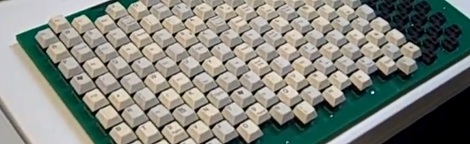
According to the project page, this humongous keyboard is the work people at Louisville Soundbuilders’ efforts to clone the AXiS-64 MIDI controller. Instead of looking like a ‘normal’ piano keyboard, this isomorphic keyboard puts notes in a hexagonal pattern. This keyboard layout is very useful – fingerings for chords are the same across all keys – but these keyboard layouts are fairly rare and MIDI controllers are expensive as a result.

To make the keyboard in the video velocity sensitive, there are two layers of PCBs. The top layer uses Cherry key switches, while the bottom PCB is an array of tact switches. Measuring the time between the top and bottom key presses gives the on board microcontroller velocity information that is converted to MIDI notes. This setup has a few downsides, namely the huge amount of switches, components, and pins needed for two keyboard matrices.

The project page hasn’t been updated for a few months, so we’re pretty curious about the current status of this build. If any of the Louisville Soundbuilders have an update on this project, send it on in.

Getting A Home Built Scanner From ’92 Up And Running Again

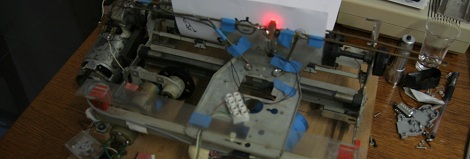
In 1992, [Arpi] didn’t have much time for Ninja Turtles, Nintendos, and other wonderful wastes of time his fellow geeks were raised on. He was busy building a scanner for his Commodore 64. Although this very impressive build could have been lost to the sands of time, he pulled his project out of the attic for a “Try to use it again” party. Although this party is not a formal competition, we’re going to say that [Arpi] walked home that night with the most geek cred.

While there are no build details, there is a bunch of info to be gleaned from the gallery about how this machine was built. We’re pretty sure a good majority of the build was a typewriter at one point, and it looks like there’s a windshield wiper motor in there somewhere. Like this completely unrelated but similar build, [Arpi]’s scanner uses a photoresistor and a few LEDs to transfer image data to the custom software. In case you were wondering, yes, the ancient 5 1/4 floppy disk was still readable – one of the few advantages of the huge sectors on these disks.

Check out the videos of this scanner in action after the break, and if you’ve got a decades-old hack sitting in your attic (remember that acoustic modem you built?), send it in on the tip line.

Continue reading “Getting A Home Built Scanner From ’92 Up And Running Again”

Motor Controller Also Does Nyan Cat

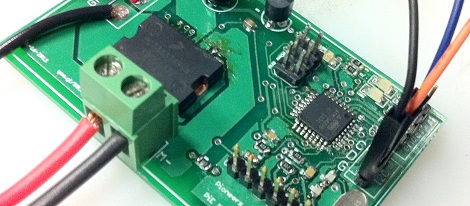
As a freshman at UC Berkeley, [Keegan] has been helping out with his school’s Pioneers in Engineering program that gives high school students some hands on experience with engineering principles, usually by building robots. This year, [Keegan]’s project is a motor controller that just so happens to play the nyan cat song over the motor PWM output.

The motor controller is meant to replace the Pololu simple motor controller the PiE team is currently using. Onboard is an H-bridge chip and an ATmega328 that takes commands from an I2C bus. The ‘328 is loaded up with the Arduino bootloader making the firmware very accessible – a good thing for the high school students that will be building and programming these robots.

[Keegan] put up the Eagle files for the board up on the PiE Wiki. For now, just enjoy the dulcet tones of the pop tart cat theme song after the break.

Continue reading “Motor Controller Also Does Nyan Cat”

StorageBot Finds All Your Components, Makes Your Storage Drawers Feel Inadequate

Your experience with making things, building projects, and hacking hardware is directly proportional to the amount of components you have on hand; as our experience grows, so do our space and storage requirements, it seems. [Danh Trinh] must have decades of experience, because his StorageBot robotic parts drawer is as awesomely absurd as it is clever and useful.

At first glance, StorageBot just looks like a bunch of small parts drawers mounted to the wall with LED strips along the top and side. The magic happens when [Danh] walks up to the wall-mounted laptop and commands StorageBot to find a component with his voice. A video is worth a thousand words, so you might as well head to the video for the best description available

To get the StorageBot to listen to his voice, [Danh] downloaded Microsoft’s speech recognition SDK and built a VB app to turn his voice into a location of what drawer contains the part he requested. Once StorageBot finds the row and column of the requested part, a pair of stepper motors behind the wall of parts drawers swing into action. Soon enough, the drawer containing the requested part pops out, and [Danh] can go about his business building more awesome stuff.

Because a few paragraphs can’t convey exactly how cool [Danh]’s StorageBot is, take a look at the videos after the break.

Continue reading “StorageBot Finds All Your Components, Makes Your Storage Drawers Feel Inadequate”

Twittertape Machine Keeps Track Of Your Social Media Stock.

During the gilded age, oil magnates, entrepreneurs, and robber barons would have a ticker tape machine in their study. This machine would print stock and commodity prices and chart these men’s assets climbing higher and higher. A lot has changed in 100 years, as now [Adam] can be kept apprised of what @KimKardashian, @BarackObama and @stephenfry ate for breakfast with his Twittertape machine.

Interestingly, [Adam]’s build didn’t start off as a tarnished lump of 100-year-old brass; he built his beautiful ticker machine out of old clock movements he picked up on eBay. Even though the shiny part of the build only holds the roll of paper, it’s still a wonderful build. Right now the machine is connected to Ethernet, but he’s planning on adding WiFi and a few batteries for a completely wireless build.

Unlike the other ticker tape machine we saw this week, [Adam] did away with the loud clashing of gears and solenoids found in 100-year-old ticker machines. This ticker machine prints on cash register receipt paper and a very small thermal printer in the base. Although [Adam]’s build doesn’t sound like two robots trading blows, there’s no ink needed and no danger of the letter wheel becoming misaligned and misspelling everything.

Check out [Adam]’s build in action after the break.

Continue reading “Twittertape Machine Keeps Track Of Your Social Media Stock.”

Automated Sky Tracking To Catch UFOs

If you were to try to take a picture of a UFO, how would you do it? Sit by the side of a road in Nevada near Area 51? Pie tin on a string? A French team of UFO enthusiasts put together an automated UFO detection device (Google translate) out of a disco light and CCTV camera so long nights of watching the skies can be automated.

The build uses a disco light with an altitude and azimuth mount to constantly scan the skies on the lookout for strange, unexplained lights. Attached to this swiveling mount is a camcorder and a CCTV camera that streams video to the command and control laptops for image analysis.

In addition to object tracking, there’s also a diffraction grating in front of the CCTV camera. The team behind this project previously used this for some very low tech spectroscopy (translation) to identify emission lines in a light source. Light that have a signature including Oxygen and Nitrogen will probably be ionized air, while less common elements may be the signature of “advanced propulsion.”

While this build is going to detect a lot of satellites and meteors, there’s a definite possibility of capturing an unexplained phenomenon on video.