Insanely Kludgy Pen Plotter Actually Works

This pen plotter, held together with structural epoxy, is an amazing piece of engineering, and almost as impressive as a bridge made entirely out of Bondo.

[Brian] at the Rochester, NY hackerspace Interlock needed to build something for the BarCamp geek “unconference.” To lure BarCamp attendees over to the Interlock table, they needed a small tabletop device with whirring motors that was able to make some decent swag. Hacking together a pen plotter sounded like the perfect project.

The mechanics of the build were scavenged from old printers and scanners. [Brian] decided to use pin-feed card stock, so the take-up wheels from an old dot matrix printer was sacrificed as well. This paper feed mechanism serves as the Y axis, and the X axis rides above the paper on precision rods. The pen holder is supported by a tiny solenoid.

Things start getting crazy at the software level. grbl was loaded onto an Arduino with a stepper driver shield, and vector text drawings were printed. After a bit of live-action hackery, [Brian] figured out how to plot captured webcam images. OpenCV captures and does a trace outline. This is converted to vectors with autotrace, and from EPS to HPGL by pstoedit. A Python script then cleans up the HPGL and converts it to G code and sends it to the printer. Confused? So are we, so just check out the video of the plotter in action after the break.

Continue reading “Insanely Kludgy Pen Plotter Actually Works”

Preparing For The Zombie Apocalypse

Every reasonable person prepares for the future. Whether it’s matching your employer’s 401k contributions, making sure you have bread and milk before a snow storm, or saving for your kid’s college fund, planning for the future gives you a comfortable life. [Gord] has exceptional foresight; he build an awesome Louisville Decapitron for the upcoming zombie apocalypse.

It’s an urban legend that a bullet to the brain will stop a zombie. Instantaneous trepanation is devastating in the living, but we’re talking about the undead here. A melee weapon is what you’re after, and you’ve got to cut off the head. [Gord] based his project around a Louisville Slugger. The blade is a 20 inch long piece of plasma cut mild steel. It’s just a prototype to get the balance figured out; the final version will be done in carbon steel.

The tang of the blade fits into two notches in the bat. The blade is secured with two custom fabricated spacers that are perpendicular to the blade. We’re not quite sure of the nomenclature of the resulting weapon (it’s some type of battle axe, we’re sure), but we couldn’t think of a better way to decapitate the undead.

Old-school Projector Turned Digital

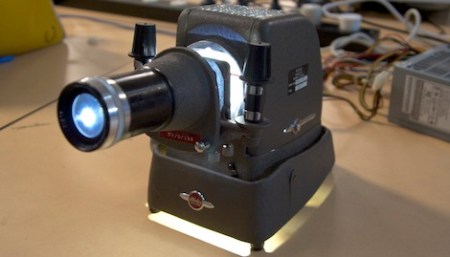
Who hasn’t thought about turning a 1950s slide projector into a digital projector? [Matt] did, but unlike most of us, he actually did it.

[Matt]’s friend [Angus] found an old, single-slide, sans-carousel slide projector in the trash. It’s a wonderful piece of ancient technology with a fabric insulated power cord and bakelite lamp socket. This projector was upcycled to the 21st century by adding a 10 Watt LED and a Nokia 1200 LCD.

For the electronics, [Matt] used an ATmega88 microcontroller. There’s an infrared receiver so the remote from an in-car CD player can be used to advance the slides and turn the projector on and off. The LCD is controlled by a bit of bit-banging from the Mega88, using hard-coded images of Che Guevara, Hendrix, Space Invaders and some old-school Macintosh/Lisa icons. Unlike the screen printed t-shirts at American Apparel, Che is the only authentic image in this project; this projector might have been made after Guevara came to prominence.

With a 10 Watt LED, it’s not the brightest projector on the planet and the picture is a little washed out in a bright room. With dim lighting, it’s a very good project even if the images are static.

Color Organ Tiki-o’-lantern

The Halloween parties this weekend are over, but that doesn’t mean there’s not time for a few more to finish a build before children start knocking on doors tonight. [formori] at Lakehead University wanted to do something spectacular for a pumpkin carving contest, so he and a few other EE students came up with a tiki-o’-lantern with music.

The guys at Lakehead figured a color organ flashing LEDs in the eyes and mouth of the tiki would be a very good and easy project. The circuit they used is a simple Op-amp setup like one we’ve seen earlier. The entire pumpkin is powered by a 9 V battery and the music is played with an iPod. There are two colors of LEDs – high frequencies flash a blue LED in the eyes and low frequencies flash a red LED in the mouth.

Aside from the added A/V stuff, [formori]’s pumpkin is one of the best we’ve seen on Hack a Day this year. Check out the Youtube of 1st place winner of the Lakehead pumpkin carving contest after the break.

Continue reading “Color Organ Tiki-o’-lantern”

Arduino Controlled Four Socket Outlet

Never get between a man and his salami. [Mike] needed a way to control temperature, humidity and airflow with his meat curing setup. Of course he could modify a refrigerator and humidifier to be controlled separately, but [Mike] decided the best course of action would be to control line voltage with an Arduino.

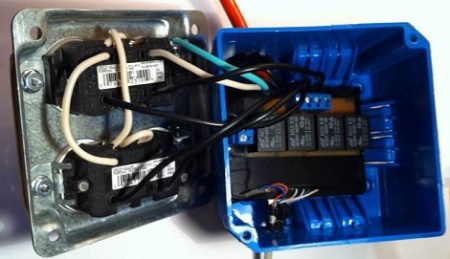
[Mike] started his build with a four socket wall housing he picked up at Home Depot for a few dollars. After wiring up each outlet so it can be controlled independently, he set out designing a four port relay board. This was a pretty simple build – four 10 Amp relays and a few terminal blocks. The PCB was designed in Eagle as a single-side board for ease of manufacturing.

The relay board is meant to fit inside the blue box along with the four sockets, so a few holes were drilled for the power and control wires. The entire assemblage was put together and tested out. [Mike] posted a video of his controllable outlet flashing a light bulb at 10 Hz. Check out that light switch rave after the break.

Continue reading “Arduino Controlled Four Socket Outlet”

Two DJ Hero Controllers Turned Into A Giant Etch A Sketch

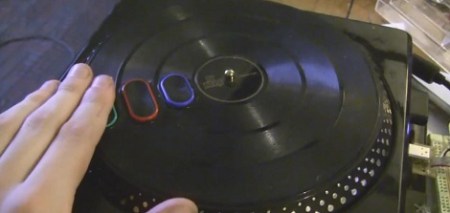
[Ryan] sent in a little project he’s been working on. After he got his hands on a pair of DJ Hero controllers, he figured he needed to pull controller data off them.

After plugging in his two DJ Hero controllers to a breakout board, [Ryan] discovered the turntables communicate on an I2C bus. A Teensy was thrown into the mix, and work began on decoding the turntable output. [Ryan] figured out that by pulling 23 bytes from the turn table, he was left with the necessary data. Byte 20 is the state of the green, red, and blue buttons, byte 21 is the distance traveled, and byte 23 indicates clockwise or counter-clockwise. After [Ryan] figured out how to pull data off his DJ Hero controllers, the only thing left to do was build a giant Etch A Sketch on a 55 inch TV.

By the time the Etch A Sketch was completed, [Ryan] figured out that he had a gigantic rotary encoder – perfect for some classic MAME action. He started up MAME and loaded up Cameltry and Off The Wall. The DJ Hero controllers seem to work just fine, even if the hunched-over [Ryan] can’t beat the levels.

PocketStation As Two-factor Authentication

[DarkFader] sent in his build that implements two-factor authentication on a Sony PocketStation.

The PocketStation was a PS1 accessory intended to be a competitor to the Dreamcast VMU. [DarkFader] wrote an app for his PocketStation using a fabulous PocketStation emulator and uploaded it with the PS3 memory card adapter and MCRWwin.

The PocketStation app (available here) takes a key and hashes it with the current time to generate a six digit code. Combined with Google’s support for two-factor authentication, [DarkFader]‘s memory card provides access to his Google profile.

Two-factor authentication is also used in RSA SecurID key fobs that were compromised earlier this year. This lead to a huge number of companies being penetrated. For a single person, obscurity is a reasonable (but still ultimately futile) means of providing a little more security, but a PocketStation hack is still pretty cool.

Check out the video after the break that shows [DarkFader] using his PocketStation token.

Continue reading “PocketStation As Two-factor Authentication”