DIY Drum Triggers & Recreating [Bonzo]’s Vistalites

[Rob] has been working on his drum trigger build, and he’s finally decided to share it with us. His drum heads and triggers don’t look like anything we’ve ever seen, but he’s pretty confident he has a good kit in the works.

The first unconventional of the build is the drum triggers. The triggers are piezo elements folded up or cut down to fit inside highlighter bodies. These piezo/highliter/drum triggers were filled with melted candle wax to make sure the piezo doesn’t rattle around. [Rob] seems to have taken an empirical approach to cutting up piezo elements – smaller elements are less responsive, so they’ll be used for the zones of the drum head.

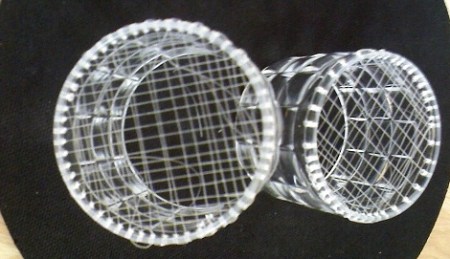
[Rob]’s drum heads are made from tennis and badminton raquets. The implementation is actually kind of clever: [Rob] restrings the raquets on the bias to vary the feel and responsiveness of the head. Check out the Flickr photoset of the build here.

The ultimate goal of [Rob]’s build is a “glass” drum set certainly inspired by [John Bonham]’s Vistalites. Whenever [Rob] puts up a video playing Moby Dick on his new kit, we’ll be sure to put it up.


Bomb Disposal Robot With Lego Gripper

[Krash] had a lot of fun hacking up his Spy Gear TRAKR; we’re just lucky he was able to move a suspicious Shrek doll before it detonated.

The now discontinued Spy Gear TRAKR serves as the basis for [Krash]’s build. This tiny remote-controlled toy transmits video back to its remote and makes us very jealous of the awesome toys our nephew has. Thankfully, the engineers behind the TRAKR made it extremely hackable, as proved by Hack A Day’s very own [Phil Burgess].

[Krash] began his build by putting a few male headers in the GPIO pins on the TRAKR’s board. After that, the TRAKR SDK was downloaded. He used a few Snap Circuits to verify his TRAKR software was working, then set off to build a Lego gripper arm. The arm is powered through an H-bridge IC [Krash] found alongside the rest of his Snap Circuits stuff.

Not a bad build for what amounts to a pile of toys. Check out [Krash]’s video of his bomb disposal bot after the break.

Continue reading “Bomb Disposal Robot With Lego Gripper”

Cheap OLED Display For Your TI Launchpad

The guys over at the 43oh forums have been working on an OLED display booster pack for the TI Launchpad. The booster pack is now available in the 43oh store and is pretty cheap to boot.

The TI Launchpad is an awesome little dev board with a ravenous fan base. We’ve seen a lot of projects on Hack a Day use a Launchpad – everything from intervalometers to chicken coops. Unfortunately, the MSP430 doesn’t have the market penetration of the ‘board that shall remained unnamed,’ so it’s not very common to see a new Launchpad “shield.”

[bluehash] on the 43oh forums has been hard at work for the past month to put together his OLED booster pack. The display is 128×64 pixels with an incredible amount of brightness that we would expect from an OLED display. The software for the display is based on the SSD1306 driver with two font packs – Courier New large and small. Not a bad little piece of kit for an under appreciated dev board.

Here’s Your Flying Car

We’ve seen quadrocopters galore over the past few years. We’ve never seen one big enough to lift a person until now.

[Thomas], [Stephan], and [Alexander] of e-volo have been working on a gigantic, human-lifting multicopter for a few years now. A few days ago, their prototype took to the air carrying a fully human pilot. There aren’t a whole lot of details on their build, but from what we can tell the flight was powered entirely by batteries.

The test vehicle looks to be a study in minimalism. The landing gear looks to be a repurposed yoga ball, and the chassis is just four pieces of aluminum tube welded into a cross. The the power plant for the prototype is four brushless motors in each quadrant of the vehicle. That’s right – there are 16 motors spinning around the pilot.

This isn’t the first time we’ve seen a build based on Doctor Robotniks designs. Earlier this year, some guy in China built a very nice deathtrap an octocopter. The e-volo team definitely has the leg up in safety considerations – they have actual design and engineering studies

The good news is the e-volo team wants to improve their prototype and sell it to the masses. The bad news for Americans is the FAA hasn’t taken too kindly to electric flying machines. The team is working on a hybrid drive version, and as long as the weight is kept down, we can always get an ultralight cert.

Check out the video of some 16-blade hovering action after the break.

[youtube=http://www.youtube.com/watch?&v=L75ESD9PBOw&w=470]

Annoy Your Sound Guy Even More

“I can’t hear myself in the mix,” “yeah, man, I’ll be there at 8,” and “dude, we need like four more mics.” Each and every one of these words is documented in actuarial tables and doesn’t bode well for your sound tech’s risk of a stroke. Luckily, there’s an even better way to kill your sound guy and this time, it’s actually pretty clever.

[@dop3j0e] at the Stuttgart hackerspace Shackspace came up with the Noiseplug. It’s a very small build that could almost fit into a quarter-inch jack. It’s all SMD with a tiny (unknown) ATtiny9 microcontroller powered by a watch battery.

The music coming out of the Noiseplug is really interesting. All the code on the microcontroller is a one-liner written in C. Similar ‘algorithmic chiptune’ programs can be run on any PC: check out these three examples.

These potential entries to the International Obfuscated C Code Contest throw chars into an 8-bit PCM stream. Piping the output of these programs to /dev/audio would generate an actual song – written entirely in one line of C.

Of course, [@dop3j0e] could have made his Noiseplug a little less annoying, but sound techs are underappreciated for a reason, right?

Check out the Noiseplug in action after the break along with a few one-liner C songs.

Continue reading “Annoy Your Sound Guy Even More”

LED Sexting Belt Buckle

For some ungodly reason, [Scott] has a friend that wanted a ‘sexting themed’ Halloween costume. We won’t try to make any presumptions of the creativity or mental stability of [Scott]’s friend, but the SMS scrolling LED belt buckle he came up with is pretty cool.

The belt is based around a $13 scrolling LED belt buckle [Scott] found online. There was a problem with the belt buckle, though. Thirteen dollars means [Scott] didn’t get a whole lot of features with his buckle, so there are only 3 buttons on the entire device: letter up, letter down, and enter. Instead of pressing a button 80 times to get a lowercase ‘z,’ an Arduino was thrown into the mix to take care of all the button pressing.

The Arduino sketch could now input any message into the belt buckle in a matter of seconds. All that was left to do is taking care of the SMS to text part of the build. For this, [Scott] used the Sparkfun USB Host Shield and a custom Android app. Whenever an SMS is received on the phone, the message is sent through the USB shield to the Arduino and output on the belt buckle.

We won’t make any assumptions about the content of the messages during the Halloween party, but at least the video demo of the build is family friendly. Check it out after the break.

Continue reading “LED Sexting Belt Buckle”

Turning LEDs Into A Camera

[Udo] figured out how to turn a bunch of LEDs into a very low resolution camera.

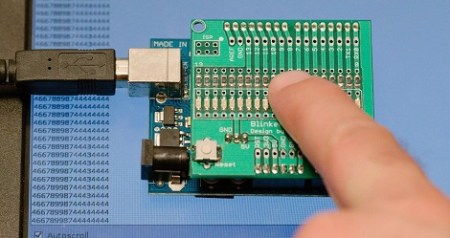
The build is based around [Udo]’s Blinkenlight shield he’s been developing over the past year. The camera operates under the idea that there’s really not much difference between a LED and a photodiode; LEDs can do light emission and detection. In actuality, the LED ‘camera’ isn’t all that different from a linear CCD array, the type of image sensor in flatbed scanners.

After connecting his Blinkenlight shield to his Arduino and computer, [Udo] wrote a sketch that would capture 17 values from his LED camera. These values are shot over the serial connection where high levels of light show up as smaller numbers and low light levels are understood as larger numbers.

[Udo] has been doing a lot of other cool stuff with his Blinkenlight shield, like a persistence of vision experiment and pretending to be [Michael Knight]. Check out the video after the break for a demo of [Udo]’s linear LED camera.

Continue reading “Turning LEDs Into A Camera”