Ball Of Dub Has Lots Of Wub

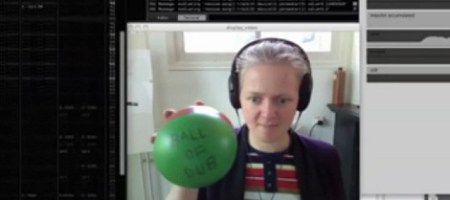
[Lizzie] from LustLab sent in her Ball of Dub that turns a few accelerometer and a digital audio workstation and turns everything into an aural experience of wubs and dubs. The Ball of Dub can turn just about anything into dubstep, and does so with a fairly interesting user interface.

There isn’t a build log for the Ball of Dub, but  the folks at LustLab did send in a basic overview of her project. Inside the ball, there’s a Razor IMU from Sparkfun that is attached to the ever-popular XBee wireless transceiver. A tiny program on an Arduino calibrates the gyroscope and accelerometer and sends that data to the DAW at 50Hz.

The host computer is running Renoise, a very popular tracker that can accept MIDI and OSC input. A Processing app parses the ball spin, free fall and impact, averages them over a period of time, and pipes that into the OSC input of Renoise. In [Lizzie]’s video, the ball spin is sent to a low-pass filter on the baseline track, and the average impact is applied to the vocal track.

This isn’t the first time we’ve seen some fairly strange ways to modulate wub; we saw real instruments covering Skrillex earlier this month. The Ball of Dub wins in the simplicity department, though.


Bluetooth For Android Open Accessories

[Ytai], the lead developer for the IOIO breakout board for the Android Open Accessory kit, figured out how to control just about anything from an Android phone wirelessly over Bluetooth.

When [Ytai] first announced the IOIO breakout board for Android devices, one of the commentors on his post said a standard Bluetooth dongle could stand in for the USB cable between the phone and the IOIO. Wireless control of home automation project and robots was just too good of an idea to let go, so [Ytai] dove into this new Bluetooth project.

After getting a cheap Bluetooth dongle from DealExtreme, [Ytai] found btstack, a lightweight Bluetooth stack that was perfect for an embedded environment. Dealing with the USB driver for a no-name Bluetooth adapter didn’t come as easily, but after a few long nights, [Ytai] emerged victorious.

He still has a few more problems to overcome. Namely, supporting environments where more than IOIO board is available. [Ytai] is thinking about adding support for WiFi dongles, something we’d love to see. Check out [Ytai]’s demo of wireless control of a servo after the break.

Continue reading “Bluetooth For Android Open Accessories”

Halloween Hacks: Arc Reactor Costume

Halloween is the time of year where you can dress up as a pirate, muppet, or superhero and no one will bat an eye. During this holiday of expanded social permissiveness, [Nbitwonder] decided that building an Arc Reactor from Iron Man would be appreciated by his engineering cohort.

The ‘body’ of the reactor was manufactured on the RepRap Mendel we covered from beginning to end. A few minutes with Google Sketchup was all that was needed to generate the files and send them to the printer. In a few short hours, [Nbitwonder] had the body of his Arc Reactor.

The board design was thrown together in Eagle and etched. 11 blue SMD LEDs were thrown into the mix along with some borrowed resistors. Pieces of a hard drive spindle and a little bit of wire rounded out the parts list, and everything was assembled with the DIYers favorite tool, the hot glue gun. Not a bad job for a few hours of work.

The files for the Arc Reactor are up on Thingiverse along with a Flickr photoset.

Hackaday Links: October 28th, 2011

An accidental radial engine

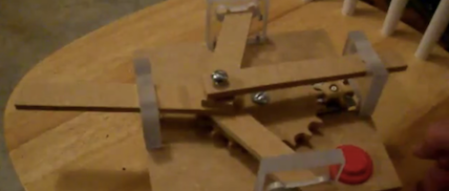
Hack A Day’s very own [Jeremy Cook] was trying to figure out how to push four ‘arms’ out one at a time. What he came up with is a very nice model of a radial engine. Everything was cut on a CNC router and a motor from an air freshener provides the power.

Using a candle to produce light

[Chris] sent in his Candela Amplifier. It’s a Pentium 4 heat sink with a very bright Cree Xlamp LED attached to the base. A bunch of Peltier thermoelectric units are attached to the underside of the heat sink. Put the whole thing on top of a candle, and you can light a room. With a candle. Oh, he’s selling these, by the way.

Objectification and video games?!

We really feel sorry for our lady readers. Guys have so many choices for Halloween costumes, but just about every costume available for women can be reduced to, “Sexy [noun].” Whelp, here’s the Sexy Game Boy, just in time for Halloween. [kazmataz] gets a few bonus points because she went with the DMG-01. It’s better than Sexy Chewbacca, so she’s got that going.

Prototypable 32-bit uCs

[Ng Yong Han] wrote in to tell us about some newish 32-bit PICs that are floating around. The datasheet for the PIC32MX1xx/2xx chips is pretty interesting – USB support and an audio and graphics interface. Oh, they come in PDIPs for ease of prototyping as well. We haven’t seen much from the PIC microcontroller faction recently (Atmel is winning the holy war, it seems). Anybody feel like building something with these?

Makerbot dual extruder


[Lomo] at TU-Berlin is taking a class in rapid prototyping. He built a second print head for his department’s Makerbot Cupcake with a few other students. The result are pretty impressive, although from what we’ve seen, it’s generating the G-code that’s a pain in the butt.

Pololu Compatible Relay Driver

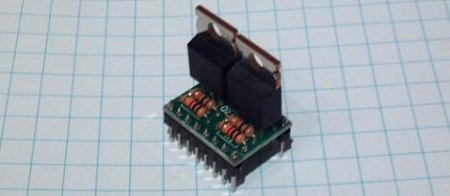
[Bart] built a couple dozen Pololu compatible relay drivers.

If you have a Reprap, you’re probably familiar with the Pololu stepper motor driver. These tiny pieces of kit provide stepper motor control for Gen 6, RAMPS, or Sanguinololu Reprap electronics. There’s a small problem with all these boards, though; there’s no way to control any high-power devices from these boards except for stepper motors. Controlling a spindle for a home-built CNC router would be great, but apart from attaching a Dremel to your x-axis, you’re just about out of luck.

[Bart]’s relay driver takes the step and direction inputs from the stock Pololu stepper driver and connects each of those to a MOSFET. From there, a relay can be hooked up to the driver to control the spindle for a router, or a whole bunch of fans for a homebrew laser cutter.

The schematic and Gerber files are up on [Bart]’s webzone. The part count is very low, and the entire board could easily be built on a piece of perfboard. Check out the demo on the other side of the jump.

Continue reading “Pololu Compatible Relay Driver”

3D Printed Electromechanical Computer

A few nights ago, [Chris Fenton] was hanging out at NYC Resistor putting in some time on his electromechanical computer project. You might remember [Chris] from his tiny Cray that he’s putting an OS on. It seems [Chris] is going back in time about 150 years and has set his sights on a 3D printed version of [Babbage]’s Analytical Engine.

The Analytical Engine was is a remarkable feat of engineering and machining. It was the first programmable computer. Shame, then, that it was never built in the 1800s. [Chris] isn’t building a glorified calculator like [Babbage]’s polynomial-computing Difference Engine – he’s going all out and building something with conditional looping.

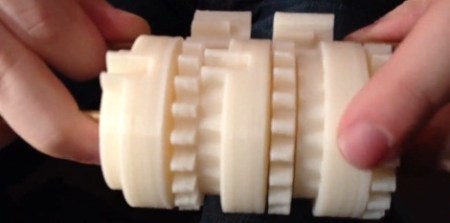
[Chris] calls his device an electromechanical computer, so we’re assuming it won’t be crank driven like the version in the British Science Museum. Right now, he’s constructed the decade-counting gears that are vitally important for the ALU of his design. All the parts were printed on a Thingomatic, so we’re betting [Chris] is going to be relying heavily on the MakerBot automated build platform for the thousands of parts he’ll have to fabricate.

Check out the video from NYC Resistor after the break.
Continue reading “3D Printed Electromechanical Computer”

Now Pictures On The Internet Can Be Faked

We know it’s shopped, but we can’t tell because of the pixels. PhD student [Kevin Karsch] along with a few other friends will be presenting their methods to render objects into preexisting photos at SIGGRAPH Asia next month.

The paper (PDF…) covers how [Kevin] et al. go about putting impossible objects into photos. The user first defines the geometry of the picture; legs of tables are defined and the table top is extruded from these legs. The lights are then defined by drawing a bounding box and with a little bit of algorithmic trickery, a 3D object is inserted into the scene.

Comparing the results to the original picture is jaw-dropping. For us, photoshopping a bunch of billiard balls on a pool table would take hours, and it would never look quite right. [Kevin]’s work for SIGGRAPH can do the whole scene in minutes and produces results we couldn’t dream of.

There’s no downloadable software yet, but the algorithms are there. Check out the video demo of the techniques and results after the break.

Continue reading “Now Pictures On The Internet Can Be Faked”