Hackaday Links: September 15, 2011

Open-source Mars rover

[Seth King] wasn’t satisfied with current robotics platforms that don’t work well outdoors. He started the Open Rover Kickstarter with the end goal of having a 6-wheel robot with a rocker-bogie suspension just like the Mars landers. We’re sure it’ll be an interesting platform.

Adding a Flash to a key fob video camera
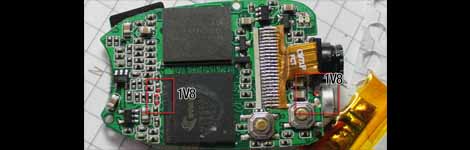
[doctormord] picked up a key fob “spycam” and was surprised that there wasn’t any onboard illumination. Then again, that would probably defeat the purpose of the “spycam.” A transistor, LED and resistor later (translation), he had a camera with a light. Pics here.

Automated WEP cracking
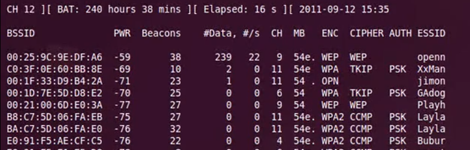
This is a video of [Elliott] using his autocrack script to crack a WEP wi-fi network. It took [Elliott] less than a minute to crack a network he set up. Lesson: don’t use WEP.

Adding wi-fi to a laptop the fast way
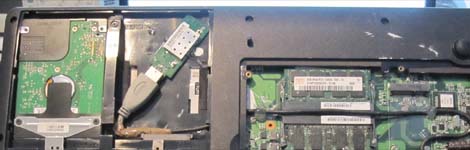
This laptop used to have a broken Mini-PCIe wi-fi adapter. [Mikko] fixed the wireless by taking out the old card and hooking up a USB wi-fi adapter. He soldered the USB leads directly to the back of an internal USB port and used hot glue “to prevent bad things from happening.” A very easy, fast, and cheap way of fixing a broken wireless adapter.

Han Solo’s soldering iron
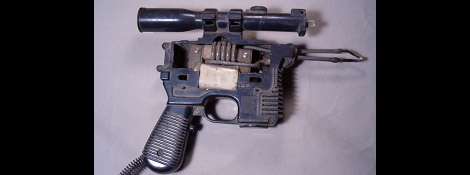
When [Craig] was 15, he broke the Bakelite casing of his father’s soldering iron. Being a good son, he fixed it by gutting his original Star Wars Han Solo blaster. Nice, but not as great as Starsong from My Little Pony.
Build Your Own CT Scanner

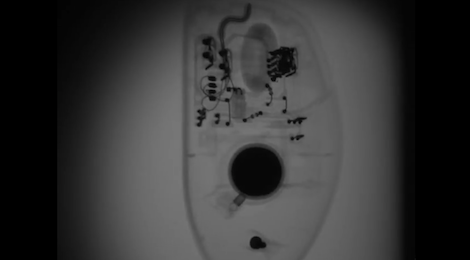
[Linas] built himself an x-ray generator for a scholarship contest. We assume this wasn’t enough of a challenge for [Linas] because after the x-ray generator was done, he used his project to model objects in 3D (Google Translate link). It’s an amazing build, leaving us feeling sorry for the guy that came in second place to the home-made CT scanner.

The theory behind a CT scanner is fairly simple – take a series of x-rays of an object around an axis of rotation. From there, it’s a fairly simple matter to digitize the x-ray images to produce a 3D model. The hard part is building the x-ray generator. [Linas] used directional x-ray tubes, a few power supplies and from what we can gather x-ray film instead of a CCD sensor. The film was scanned into a computer and reassembled to get a 3D image.

[Linas] doesn’t seem too keen on giving away the schematics for his build to any old joker on the Internet because of the high voltage and radiation components of his build. Still, it’s an amazing build.

Check out the YouTube demo of [Linas]’s CT scanner imaging an old computer mouse and a reconstruction of the same data done in MATLAB after the break.

Continue reading “Build Your Own CT Scanner”

Record Sound Without A Microcontroller

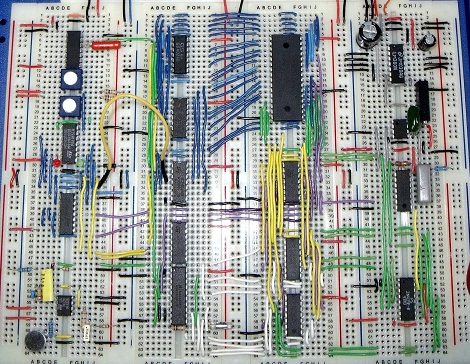
For his A-level electronic course work, [Andrew] decided to build a digital sound recorder that doesn’t use a microcontroller.

[Andrew]’s build captures audio from an on board microphone at 8000 samples/second. The audio is digitized into 8-bit sound data and sent to an SRAM. The recording and playback functions are controlled entirely by 4000-series logic chips. He admits the sound quality is pretty poor; this is mostly due to the 8kHz sample rate. In some circles, though, a terrible sample rate is seen as being pretty cool so we’re not going to say [Andrew]’s build is useless.

There’s some pretty smart design choices in [Andrew]’s build, like a cut off filter on the microphone set at 4000 Hz (the Nyquist frequency of his system).  For the recording medium, he used an SRAM that can hold about half a megabyte of data. At 8000 samples/second,  [Andrew]’s build can store a little more than 60 seconds of audio. The build may not be a logic chip computer, but there’s not any question in our mind that [Andrew] learned something. Check out [Andrew]’s 66-page coursework report here (PDF warning).

Making Better CNC Halftone Pictures

[Jason] was messing around with CNC machines and came up with his own halftone CNC picture that might be an improvement over previous attempts we’ve seen.

[Jason] was inspired by this Hack a Day post that converted a image halftone like the default Photoshop plugin or the rasterbator. The results were very nice, but once a user on the JoesCNC forum asked how he could make these ‘Mirage’ CNC picture panels, [Jason] knew what he had to do.

He immediately recognized the algorithm that generated the Mirage panels as based on the Gray-Scott reaction-diffusion algorithm. With this algorithm, dark areas look a little like fingerprints, meaning the toolhead of the CNC router can cut on the X and Y axes instead of a simple hole pattern with a traditional halftone. After a little bit of coding, [Jason] had an app that converted an image to a reaction-diffusion halftone which can then be converted to vectors and sent to a router.

It’s a very neat build and we imagine that [Jason]’s pictures would cost a bit less than the commercial panels. Check out the video after the break to see the fabrication process.

Continue reading “Making Better CNC Halftone Pictures”

A Laser Cutter Challenge

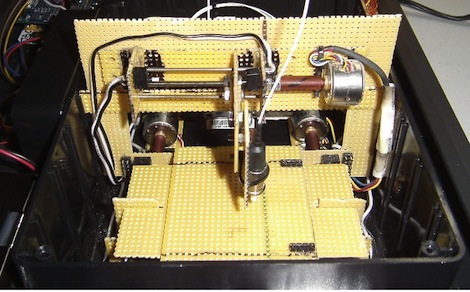
When the Louisville hackerspace LVL1 was discussing the purchase of a new laser cutter, a member said, “I could build one before you get around to buying one.”  The gauntlet was thrown down, a challenge was set, and the race was on to build a tiny laser cutter before the hackerspace took delivery of their new laser cutter.

The mechanical aspect of the build is fairly simple. The X axis is simply a stepper motor, threaded rod and laser module mounted on a carriage. This carriage moves along the Y axis with the help of two stepper motors for either side. Everything was mounted on more perfboard than reason would suggest.

For the electronics of the project, three motor drivers were made with a few logic chips and the laser firing relay was stolen from test equipment developed for LVL1’s trans-Atlantic balloon build. Motor and laser control was handled by an Arduino to keep the build simple because the contest was over after the first laser was finished cutting a square.

LVL1 is now working on a second version of the winner of the laser cutter challenge. They’re planning on a touchscreen interface that will cut a plastic blank about the size of a credit card. We can’t wait to see the results of that build.

Upverter: It’s Like Github For Hardware

If there’s one thing we’ve noticed about hardware hackery and electronics project, it’s that all the resources to build a project are scattered about the Internet on forums, blogs (heh), and personal web pages. Enter Upverter. The fellows who started Upverter had the same observation, and after some Y Combinator funding, launched what they hope to be “The Github of electronics” and the “Google Docs of hardware design.”

Upverter has the features we would expect – forking, versioning, and integration with Github for a project’s code. Already there’s a few cool projects, like a PIC programmer, a TV-B-Gone, and a tiny version of Conway’s Game Of Life.

We’re not ready to wave the banner of an Upverter fanboy quite yet. There’s quite a number of components available in the schematic editor, but from our experience the component library could use some refinement both by weeding out duplicates and increasing the number of parts. We’d also like to put a zoom control for the schematic view on our wish list. Upverter doesn’t have a PCB editor either, but from this post from a VC rag, the team is working on one. While this is really just nitpicking – Upverter launched less than 24 hours ago – we’ll be happy to see the some projects roll in on the tip line that are hosted on Upverter.

EDIT: link to the Google cache, because we probably Slashdotted it. It’s up for now.

Upload Firmware Over Ethernet

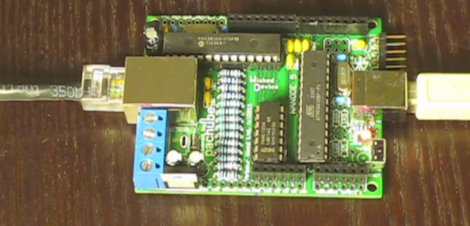
The team at Wicked Device has been working on working on a way to upload Arduino sketches over Ethernet for the Nanode and Arduino Ethernet boards. The team has gotten far enough along to show the world, and the new boot loader shows a lot of promise.

A new boot loader was needed to perform this magic. The boot loader sets up a TFTP with a server over DHCP or a static IP. An unmodified .hex file is downloaded from the server and the sketch starts up. The team is still working on a way to push new apps to the board over Ethernet, but that feature is expected to be completed sometime soon.

Booting over Ethernet isn’t a new idea – TFTP was proposed for this very purpose. Because Wicked Device’s Ethernet-enabled boot loader only works over a local connection and requires a press of the reset button, it should be considered an alpha build. That being said, the boot loader works as advertised, so check out the demo video after the break.

Continue reading “Upload Firmware Over Ethernet”