Building An Optigan-like Instrument

[Olli] sent in his writeup of a musical instrument he made called the Black Deck. [Olli]’s instrument was inspired [Jimi Tenor]’s photophone – a transparent disk attached to a fan and photocell.

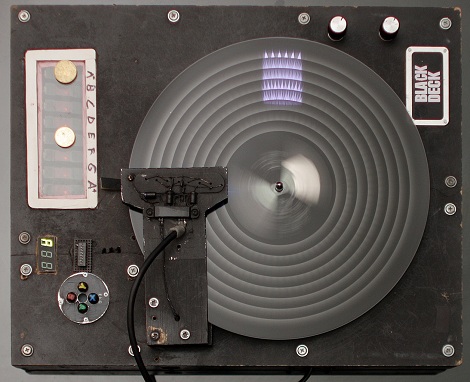
A transparent disk is placed on the turntable [Olli] rescued during a dumpster diving expedition. A light shines though the optical disk and is picked up by phototransistors. After writing a program to generate an A minor scale onto a transparency, [Olli] connected his contraption to a stereo and heard his creation speak. To control the individual tracks (or notes) on the disk, [Olli] made a keyboard out of photoelectric switches that control which note is played.

Superficially, [Olli]’s instrument resembles an Optigan. While [Olli]’s instrument is capable of producing waveforms, the Optigan is able to reproduce sampled instruments. That being said, we think [Olli]’s Black Deck would feel comfortable next to the Optigans of Kraftwerk and Devo. Check out the YouTube demo of the Black Deck in action after the break:
Continue reading “Building An Optigan-like Instrument”

PCB Drill From R/C Car Parts

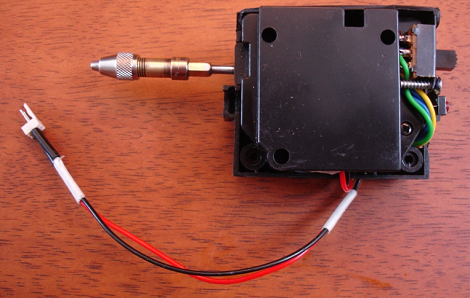
[Sid] makes a few PCBs a month and the hardest part of his fabrication process is always drilling the through-holes. He has a PCB hand drill that usually results in a sore index finger. After a few unsuccessful attempts of using a full-size electric drill and not wanting to invest in a commercial solution, [Sid] made a PCB drill from a broken R/C car.

The toy car was donated by [Sid]’s 4-year-old after a terrible crash. [Sid] took the gearbox from the car and added a small circuit to control the direction of the drill. After attaching the drill chuck to the former R/C car axle and adding the power leads to a 5 Volt adapter, a PCB drill press was born.

Most of the parts for this build were salvaged from the toy car’s radio control circuit. Except for the chuck from [Sid]’s hand drill and a few switches, everything on this build was pulled from a broken remote control car. While the build is a lot simpler than this semi-automatic PCB drill, [Sid]’s drill seems to work well. Check out the demo video after the break.

Continue reading “PCB Drill From R/C Car Parts”

Bluetooth Cassette Adapter

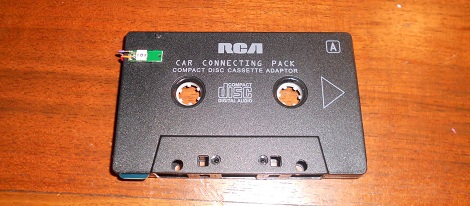
Today, with iPods that can hold entire music collections and cell phones that stream music from the Internet, the lowly cassette seems like an anachronism. [Matt] still has a cassette deck in his truck, but wanted Bluetooth connectivity for his stereo. The obvious solution was to stuff Bluetooth headphones into a cassette adapter.

Audio cassette adapters are dead-simple devices. They’re really just a tape head, stuffed into the shell of a cassette and a wire going out to a media player. To put Bluetooth into his adapter, [Matt] got a cheap pair of Bluetooth headphones and tore them apart. He was left with a circuit board, battery, and two earphones. [Matt] cut off the leads to the ear phones and wired them to the cassette adapter head. After a little bit of modifications to the case, [Matt] had a functional Bluetooth-cassette adapter.

While it’s true [Matt] could have gotten a ready-made Bluetooth cassette adapter shipped from China to his door for $10, there’s not much fun in just buying one. Kudos to [Matt] for going the home-brew route.

The Weighted Companion Cube Will Never Threaten To Stab You And, In Fact, Is A Subwoofer

From the techPowerUp! forums comes an awesome weighted companion cube subwoofer built by the metonymical user named [Cube].

This build started off as a coffee table that was to have an oval glass top (no word if the edges were going to be blue or orange). The guts of the cube are taken from a 400 Watt sub. As any good sub builder would, [Cube] kept the air volume and port tuning of the donor box.

We’ve seen a companion cube sub before that featured EL wire for a ‘glowing cube’ effect, but [Cube] may have taken things a little too far by including glowing rings on each side of the cube. The rings lit by 2,500 LEDs mounted on pieces of perspex and wired point-to-point. While [Cube] claims he’s ‘not a electronics guru,’ he certainly has a lot of patience to assemble those lights.

Check out [Cube]’s YouTube build video after the link. Credit to [Todd] for sending this one in.

Continue reading “The Weighted Companion Cube Will Never Threaten To Stab You And, In Fact, Is A Subwoofer”

Improving Your Welder Without A Microcontroller

We’re always impressed when a piece of hardware is torn apart, rebuilt and ends up exceeding the capabilities of the original device. [Dave] and [Will]’s home-built TIG welder is no exception to that rule.

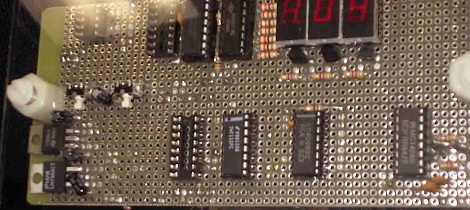
When [Dave] and [Will] started working on converting a simple AC stick welder to a welder with every function imaginable, they decided to keep it simple. After looking at some high-price commercial welders they came up with a list of features they wanted to have and decided to implement this in TTL and CMOS logic. The guys didn’t want to go with a microcontroller solution because not everyone can code, and discrete chips are very easy to troubleshoot given minimal tools.

For the high voltage part of the build, the original flyback transformer was replaced with a neon sign transformer and homebrew spark gap and capacitor. The plans for a homebrew spark gap and cap didn’t quite work out so they were replaced with commercial units. The guys included schematics and a PCB layout (PDF warning) of their build. It’s always great to see an amazing logic chip build, and improving an existing tool never hurts.

Thanks to [Franci] for sending this one in.

Engine Hacks: Build A Turbojet From Junkyard Parts

Turbo chargers from cars are readily available and easily modified, so why not modify a turbo into a jet engine?

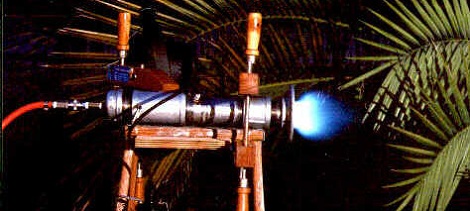
While [Mike]’s junkyard jet made the rounds on the Internet over a decade ago, the theory behind the homebrew turbojet is still sound. After pulling a turbo out of a 1983 Nissan Pulsar, [Mike] built a combustion chamber out of 2-inch pipe fittings. The propane fuel is ignited with a simple motorcycle spark plug and produces a hot and powerful blast of air twenty feet from the exhaust.

We suppose [Mike] wasn’t satisfied with such a puny engine made out of junk, so he decided to step it up a notch and improve his engine. After some development, [Mike] managed to build another jet out of a larger turbo that doesn’t require a constant spark. The newer engine produces ‘hurricane force wind’ 10 feet from the exhaust. We’re not sure how much thrust that translates into, but we’re a little surprised this engine hasn’t been mounted to a go-kart yet.

Check out the walk through and demo of the junkyard jet after the break.

Continue reading “Engine Hacks: Build A Turbojet From Junkyard Parts”

Laser Etched PCB Production

Like most of us, [reonarudo] isn’t satisfied with the current methods of homebrew PCBs, so he put a laser on a reprap and started burning some boards.

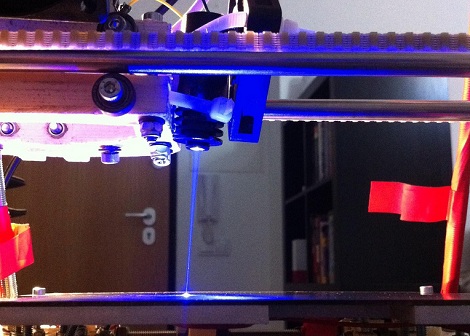
The basic procedure is to cover a copper clad board with matte black spray paint. A laser was installed on the X carriage of the reprap. [reonarudo] used cad.py to convert the board files into g-code and fired up his laser. The quality of the boards is highly dependent on the accuracy of the laser so after working through some mechanical problems [reonarudo] managed to make some passable boards.

We’ve seen just about every manufacturing method imaginable applied to PCB production. Etch resist and toner transfer do the job and a reprap milling machine is pretty neat, but lasers are so much cooler. While it may not be perfect (yet), printing PCBs with a laser shows a lot of potential. Check out a video of [reonarudo]’s bot burning some copper after the break.

Continue reading “Laser Etched PCB Production”