Robot Band Covers [Marilyn Manson]

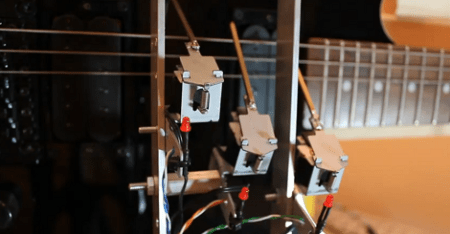
[James] built himself a robotic band from obsolete computer parts. The band needed something to play, and [Marilyn Manson]’s Beautiful People fit the bill. While it’s not the Rock-fire Explosion, having the [James]’ band cover [Marilyn Manson] is nearly as terrifying.

[James]’ original plan was to cover Mad World, but the stepper motors were drowning out the music for that song. While trying fix the cello problem the servos started acting up and reminded him of a certain song. While it’s not faithful to the original, we really like the arrangement on this version.

Continue reading “Robot Band Covers [Marilyn Manson]”

DIY Robot Remote Control

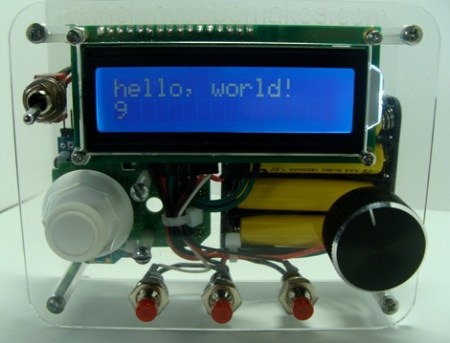
[Patrick] wanted a remote control to control some of the robots he’s built. He also wanted to get some data back from his robots, so an inexpensive off-the-shelf solution wouldn’t be up to the task. Like all good geeks, [Patrick] decided to build what he needed.

For analog control, [Patrick] decided to use a Wiimote nunchuck. This turned out to be a very good choice – the nunchuck has a 2-axis joystick and 3-axis accelerometer in one small, easy to interface package . The wireless radio is taken care of with an XBee module. For the microcontroller, custom “lcd backpack” was created that provides an I2C port for the nunchuck, inputs for the buttons and the single pot, and 2 serial ports for the FTDI and XBee.

Continue reading “DIY Robot Remote Control”

Impressive Steampunk Keyboard

This amazing steam punk keyboard was sent in to the tip line, and while it’s not necessarily a ‘hack’ in the purest sense, the level of quality in the build is incredible.

Each key was crafted from brass tubing that was later filled with a wooden dowel and covered with the key cap label. While there’s no mention of how the key caps were made, we do especially like the abstract Windows Key label. After the PCB for the keyboard matrix was enclosed in a bit of plywood, the hand tooled leather was applied to the front. The name plaque that was hand engraved with a modified screwdriver is especially nice.

The build is based around the amazing Das Keyboard with Cherry Blue switches, one of the only keyboards currently being manufactured that comes close to the feel of the One True Keyboard. While it’s not a keyboard built from scratch, it’s still one of the best steampunk builds we’ve seen, most likely because not a single gear was glued to the project.

Android Controlled T-shirt Cannon

Every year, Qualcomm hosts the “Battle of the Schools.” This year the goal was to build homemade contraptions that would be judged on how cool they are. [Doug DeCarme], [Shaver Deyerle], and [Zach Rattner] – three Qualcomm employees at Virginia Tech – built an Android controlled t-shirt cannon for this event and ended up tying with Michigan State for first place.

The cannon is built around an Arduino Uno and a BlueSMiRF Bluetooth modem. [Doug DeCarme], the Android developer of the group, put together an app that would fire each barrel independently. The valves for the cannon are just 150 PSI inline sprinkler valves, bought from the local Home Depot. From the project breakdown, the team spent less than $150 on entire project.

From the video, we see that they’re getting some pretty good distance firing t-shirts at 160 PSI. Although we question the wisdom of using PVC as a pressure vessel holding 160 PSI, changing the PVC to a proper air reservoir wouldn’t be that hard.

Arduino Video Sampler

[gijs] sent in an Arduino video sampler he’s been working on. The sampler is able to capture, pause and play a short video forwards and backwards.

The video capture circuit is based on the Nootropic Design video experimenter. We’ve seen a few project use this video experimenter board, but never with such smooth video. The sampler samples frames at a resolution of 128×96 and stores everything in a 256Kbit SRAM. A back-of-the-envelope calculation tells us that the sampler can hold a little under a second of video, more than enough to do something cool.

[gijs] says there is a 1 bit version and a 1.5 bit version of his video sampler. While we’re busy wrapping our minds around what half a bit is, he’ll be upgrading the 1.5 bit version to 2 bits. He’s also ordered some PCBs and expects to have a kit out by October. Check out a demo after the break.

Continue reading “Arduino Video Sampler”

Did Microsoft Steal The Kinect?

In 2009, while Microsoft was busy designing and marketing what would become the Kinect, [Carlos Anzola], an inventor, tinkerer, and self-ascribed geek from Bogotá, Colombia, had been working for years on a nearly identical gesture interface for the PC. His creation, the Human interface Electronic Device, or HiE-D – pronounced ‘Heidi’ – was capable of gesture recognition years before Microsoft would release the Kinect.

After developing his gesture recognition device in 2007, Microsoft showed interest in [Carlos]’ device – going so far as to request a prototype. Microsoft suggested that he should apply for a patent on his technology. [Carlos] did just that, sending in patent applications to both the United States Patent and Trademark Office and the World Intellectual Property Organization a mere two days before the announcement of Project Natal and a full seven months before Microsoft applied for their Kinect patent.

Since the release of the Kinect, [Carlos] has been showing the HiE-D around Bogotá and has put a few videos of his technology up on Youtube, one of which can be seen below. You can also check out his Youtube channel for some great demos.

[youtube=http://www.youtube.com/watch?v=f5jfOJ3TwyI&w=470]

Continue reading “Did Microsoft Steal The Kinect?”

Omniwheel Robot

Like all of us, [Jonathan Guberman] has a list of projects and builds that ‘will get done when I have time.’ His Kiwi drive robot is no exception. It’s intended to be one piece of a much larger project, but he decided to document it anyway (we think in the hope of getting is rear in gear).

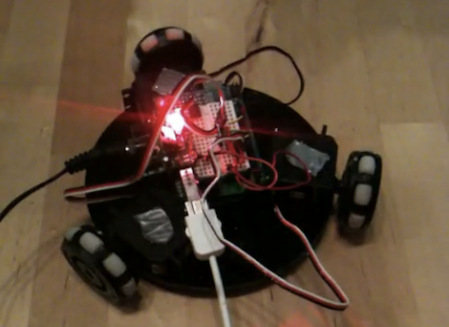
The robot uses a holonomic drive to get around. A holonomic drive uses three fixed wheels placed 120 degrees apart. The wheels can be independently controlled and with some vector addition the robot can move in any direction and rotate 360º inside its own wheelbase. Of course the wheels will have to be able to roll in two dimensions, so an omniwheel is used. Everything is controlled with a Wiimote nunchuck, and the movement is very smooth.

[Jonathan] has had a few projects featured on Hack A Day before, like his Mechanical Pac-Man and his adorable Portal turret plushie. [Jonathan] really demonstrates his artistry and skill in his project, so we’re really wondering what his ‘larger project’ actually is. Take a guess in the comments section, that might get [Jonathan]’s rear in gear.

Check out the video of the omnidirectional robot after the break.

Continue reading “Omniwheel Robot”