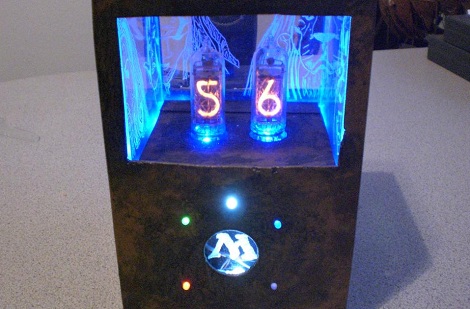
Magic: The Gathering Nixie Life Counter

Someone sent in a tip that pointed us to this Magic: The Gathering forum thread where a user named [DistortedDesigns] made a life counter for Magic: The Gathering out of Nixie tubes. While there’s not many details for this build, it’s just too cool to be forgotten in a single forum.

The project began by etching some plexiglas. There’s some earlier examples of [DistortedDesigns]’ work that look very professional. The electronic are extremely simple – the 25 LEDs run off of 2 AA cells, and the nixies run off of 2 C cells. We were wondering when [DistortedDesigns] would drop the A-bomb, but it looks like this build doesn’t use a microcontroller.
Continue reading “Magic: The Gathering Nixie Life Counter”

Controlling An Infuriating Game With An Accelerometer

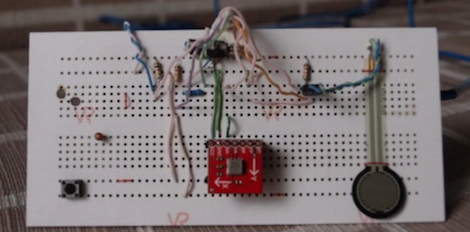
[Daniel] just made a motion controlled game controller to go with his infuriating game. Thankfully, [Daniel] posted the source for this game so first time players already know the level select codes.

The controller is based on an Arduino Uno with what looks to be a Sparkfun 2-axis accelerometer providing the tilt sensing. A similarly sourced half-inch force sensitive resistor and temperature sensor control the ‘jump pads’ in the game. A small vibrating pager motor strapped onto the controller as a rumble pack.

Continue reading “Controlling An Infuriating Game With An Accelerometer”

Klout Klok Tracks Your Popularity, Time

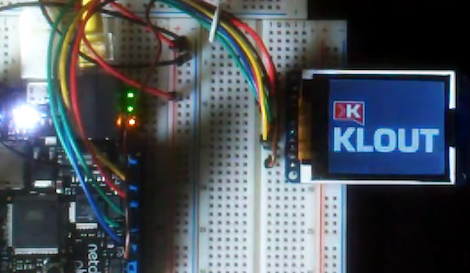
[Fabien Royer] has been playing around with Netduinos and he just came up with a really awesome project that will display the time and social media popularity. It’s a very nice build, and we’d guess that his social media influence is going to go up very shortly.

Klout is a service that connects to your Facebook or Twitter profile and tells you how much influence you have on a scale of 1 to 100 (possibly 10 to 100. see this). To build the Klout Klock [Fabian] used a Netduino Plus, a good choice because of the integrated ethernet port. The Netduino connects to the Klout API to either satiate vanity or admit prestige. The display is an adafruit TFT screen.

Continue reading “Klout Klok Tracks Your Popularity, Time”

Followup: Portable SID Player Is Now PC Output

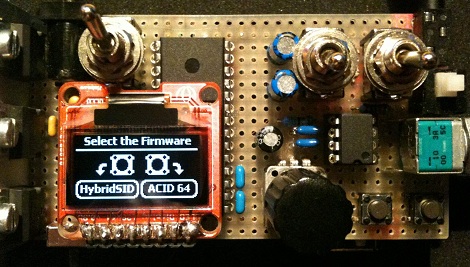
When we first covered [Markus]’ portable SID player we starting dreaming about an alternative universe circa 1987 that included a pocket-sized music player called the Commodore ePod. [Markus]’ updated firmware that connects his SID player to a PC will have to do for now, we suppose.

Continue reading “Followup: Portable SID Player Is Now PC Output”

RC Transmitter Does Everything

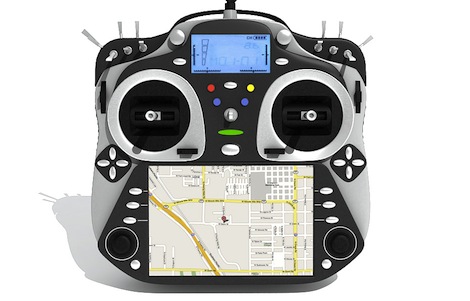
[Demetris] sent in a tip about a project he’s working on: an Open Source Remote Control transmitter. This is one of the most impressive looking RC transmitters we’ve ever seen. The OSRC could be great for a small UAV – just get the GPS position from the aircraft and map it with the transmitter’s screen. There’s also support for a video downlink so flying around New York City is possible with a single device.

Continue reading “RC Transmitter Does Everything”

[Jeri Ellsworth] Builds A Software Radio

[Jeri Ellsworth] has been working on a direct conversion receiver using an FPGA as an oscillator and a PC sound card DSP. Being the excellent presenter she is, she first goes through the history and theory of radio reception (fast forward to 1:30), before digging into the meat of the build (parts 2 and 3 are also available).

Continue reading “[Jeri Ellsworth] Builds A Software Radio”

DIY Book Scanner Processes 600 Pages/hour

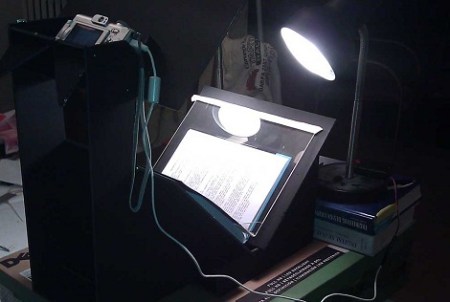
Like any learned individual, [Justin] has a whole mess of books. Not being tied to the dead-tree format of bound paper, and with e-readers popping up everywhere, he decided to build a low-cost book scanner so an entire library can be carried in a his pocket. If that’s not enough, there’s also a complementary book image processor to assemble the individual pictures into a paginated tome.

The build is pretty simple – just a little bit of black craft board for the camera mount and adjustable book cradle. [Justin] ended up using the CHDK software for the Cannon PowerShot camera to hack in a remote trigger. The scanner can manage to photograph 600 pages an hour, although that would massively increase if he ever moves up to a 2-camera setup.

Continue reading “DIY Book Scanner Processes 600 Pages/hour”