Antenna Cannon For Amateur Radio

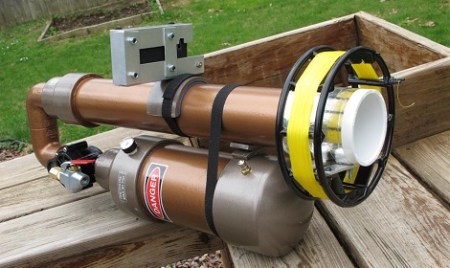
As an amateur radio enthusiast, [Andrew] sometimes has to set up impromptu antennas up to 160 meters in length. The easiest way to get these antennas off the ground is to drape them over trees, a feat normally accomplished by lofting fishing line into the air with a slingshot or bow and arrow. [Andrew] thought slings were so last century, so he came up with a spud gun inspired antenna launcher.

The launcher is built out of PVC and launches a foam filled tennis ball that can reel out 150 yards of Spectra line. In a moment of brilliance, [Andrew] decided to add an augmented reality HUD. The display is actually [Andrew]’s phone running an app called Geocam that provides him with a display of elevation and azimuth overlaid on the phone’s camera feed. The results of [Andrew]’s build are fairly impressive. The cannon was able to lob a tennis ball over a 110 foot tree at half the pressure rating of the PVC. The grouping was pretty tight as well, more than sufficient to run a line over a tree.

[Andrew]’s antenna cannon is an awesome piece of work and unlike most french fry cutters, it’s a useful tool. If you’re interested in seeing 160 meter antennas heaved over the tops of trees, amateur radio field day is next month week, June 25th and 26th.
Official Kinect SDK Released

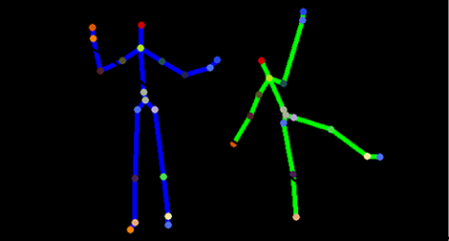
Microsoft just released the beta of the Kinect for Windows SDK. Although, “Microsoft does not condone the modification of its products” it appears Microsoft have changed their tune and released APIs for C++, C# and Visual Basic seven months after the Kinect was officially hacked.

We’ve seen libraries being developed since the launch of Kinect, culminating in the OpenKinect project. The Microsoft release covers the same ground as the OpenKinect project, and will hopefully improve on attempts to get audio out of the Kinect.

We’ve seen Kinect hacks run the gamut from telepresence, to robotics, to 3D modeling, so the Kinect seems like a great tool in the builder’s arsenal. The Kinect is a wonderful tool, and even though most of the functionality has already been replicated by the open-source community, it’s nice to know there’s official support for all the great projects we’ve seen.

PVC Boombox Is Not A Potato Cannon

After [Luke] built a suitcase mini-ITX rig for LAN parties he was left with one problem: he didn’t have any speakers and he didn’t want to use headphones. Not wanting to do something boring like a USB-powered speaker setup, he built a PVC Boombox.

Built around 3 inch PVC pipe, the boombox houses an off the shelf 15 W amplifier, bluetooth receiver, and charge controller. [Luke] found a deal on a dozen 1400mAh lithium ion batteries and despite the standard, “if you don’t know what you’re doing, don’t use lithium” trope commonly given as advice, he forged ahead anyway. [Luke] picked up a power converter that charges the batteries and provides some protection. The batteries are charged though wall power with a transformer and a huge cap scrounged from an ATX power supply.

[Luke] is pretty pleased with his boombox. Not only does it put out some decent quality sound, the battery life should be tremendous. It’s not a ground-up build, but we think it’s a pretty nice project. [Luke] will be taking the ‘boomtube’ to the Detroit Maker Faire next month, so if you see him make sure to say hi.

Homebrew Heat Gun From Scrounged Parts

A Hack a Day reader needed a tool to solder a lot of SMD parts, so he built a DIY heat gun, and we’re impressed with the results.

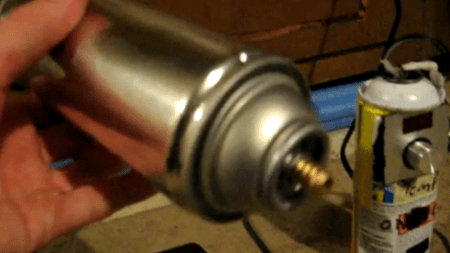
After trawling the internet looking for ideas for his heat gun, [MRGATZ85] found that most builds used the ceramic element from cheap soldering irons. Experiments in this direction didn’t go very well because the ceramic element in these irons tends to fall apart very easily. In a moment of inspiration, [MRGATZ85] realized he had an old vaporizer lying around and decided to take it apart. To his surprise, the vaporizer element was a great size, self-contained, and most importantly free. After fabricating a case out of high-temperature foam, aerosol cans, and deadbolt parts, [MRGATS85] was left with a very nice build.

Aside from SMD work, a heatgun can be a very valuable tool for PCB stripping and being used for solder reflow. We’re a little surprised we haven’t seen a homebrew heat gun in quite a while. Even though the element is surrounded by high-temperature foam, the gun still gets a little hot to the touch. We’re hoping that will eventually be under control; it’s a very useful build otherwise.

Check out the image gallery, or the video demo after the break.

Continue reading “Homebrew Heat Gun From Scrounged Parts”

Turning Beer Cans Into Bells With 35kV

It looks like we now have another way to annoy ourselves with extremely high voltage.

The bells operate under the same principles as the electrostatic see-saw we covered last month. A voltage is applied to one can while the other can is grounded. An insulated pendulum is placed between each can, and with a little coaxing can be made to oscillate back and forth between the cans. As the pendulum touches the charged can, it is repelled as it gains the charge and moves to the grounded can. There, the charge is released and the cycle continues again. A homemade Cockcroft Walton multiplier is used to generate the +35kV needed to get the pendulum moving.

[Ben Franklin] invented the Franklin Bells while he was investigating electricity in the 1750s. Originally an extension of the kite & key experiment, the bells were historically used to warn of approaching thunderstorms – when the bells rang, the atmosphere was charged and lightning could strike. Even though the voltage between the bells is huge, very little current is drawn – the Oxford Electric Bells have been ringing since 1840 using the same electrostatic battery.

GPS Without GPS

Open Electronics just released a neat little board that can place you on a map without using GPS.

The board works on the basic principles of a cellphone network – the ‘cell’ network is a series of towers that are placed more or less equidistant to each other. Save for the most desolate parts of the country, a cell tower usually communicates with a phone one or two miles away. Usually, several cell towers can be seen, so the position of a cellphone can be pinpointed to within 200-350 feet. Translating cell towers to latitude and longitude is easily done by querying a Google database that was created for the mobile version of Google Maps.

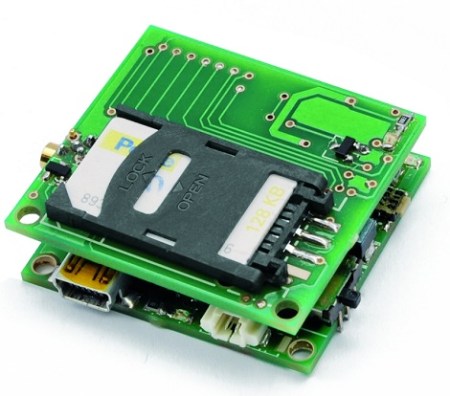
The board itself is a PIC18 microcontroller and a SIM900 GSM module. The firmware available at Open Electronics is pretty impressive – all communication to the board is handled through SMS and the phone can report it’s location to 8 other phones.

It’s pretty impressive to think the same technology that caught [Kevin Mitnick] is now available to the masses. We’re wondering what Hack a Day readers would use this for, so if you have an idea leave a comment.

Wifi Sniffing Digital Picture Frame

[AUTUIN] sent in a tip for his wifi sniffing digital picture frame.

A soon-to-be-trashed Pentium II laptop was rescued from Free Geek Vancouver. A lot of coffee shops around Vancouver feature local art and free wifi, so [AUTUIN] decided to combine the two. The project is designed to hang on the wall of a cafe and sniff images transmitted on the wireless network – an invasion of privacy, but as [AUTUIN] says, “that’s kind of the point.”

After gutting the laptop and putting it in a custom picture frame, Driftnet, a program that listens network traffic and picks out images from TCP streams, was installed. [AUTUIN] tested his build with an open wireless connection in his building. The results provided a wonderful narrative that started with pictures from news sites than slowly devolved to pictures from a hot-or-not style website, an online dating site and finally pictures from the inevitable conclusion of that browsing session.

[AUTUIN] is now looking for either a brave or foolish local coffee shop in Vancouver to feature his wifi sniffing picture frame. We think this would be very amusing if we weren’t using that network, not that we have something to hide or anything.