Launching Model Rockets Wirelessly

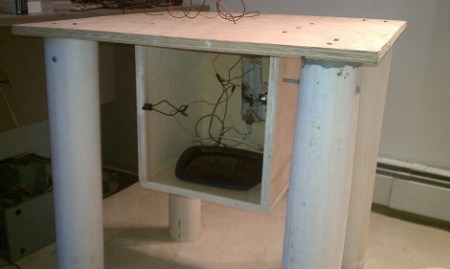
We love ballistic trajectories and the smell of black powder in the morning, so we’re really interested in the wireless rocket launch pad sent in by [Brent Strysko].

[Brent] used an ATmega with an enc28j60 ethernet shield and wireless router to launch the rocket without a physical connection with ‘the button.’ Everything on the launchpad is powered by a 12 Volt motorcycle battery, and there’s also a flashing LED for the countdown. All that’s needed to launch a rocket is to send a command from the laptop. We think this would be an awesome project when combined with the radio telemetry build we covered earlier – the computer is already there with the range safety officer.

Although amateur rocketry is extremely safe, with no high-power flight ever hitting a person (PDF warning), there’s still some risk of from black powder engines CATOing. We think [Brent] came up with a great way to make a safe hobby even safer, and managed an interesting project in the process. Check out the walkthrough of the launchpad after the break, or check out this video of the launchpad in action.
Continue reading “Launching Model Rockets Wirelessly”

Tiny Morse Code Trainer

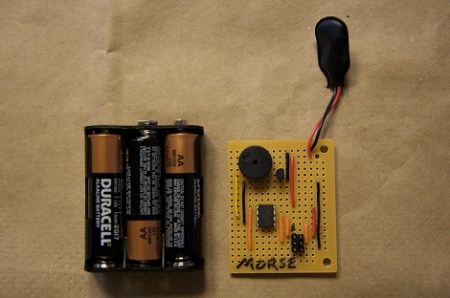
[Eric] wanted to teach his kids Morse code, so he built a tiny Morse code trainer.

[Eric] built the trainer around an ATtiny85, and the rest of the circuit follows this minimalist idea. After connecting a piezo beeper and 6-pin ISP header, the only thing left to do was write a little code and start teaching his kids Morse. The Morse trainer is programmed to repeat the message, “SOS the moon rover has broken down and I am stuck in the trash can in the garden shed,” [Eric] planted a Lego moon rover in his shed as a prize for learning Morse, making him one of the coolest dads ever.

Although learning Morse isn’t required for an amateur radio license anymore, it’s a requirement for continuous wave radio. We think this is a great way to learn Morse the right way – actually hearing the characters – instead of memorizing the Huffman tree of Morse characters.

Converting A Roomba Into A Mars Rover

When we first heard of [Dino]’s all-terrain Roomba, we hoped the ‘stair-climbing Roomba’ problem had finally been solved, but the final build turned out much cooler.

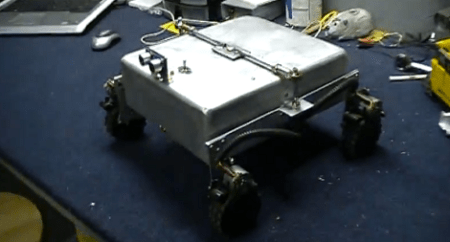
A year ago, [Dino] built a small robot based on a rocker-bogie suspension. This suspension system has been used on every Mars rover, including the huge Mars Science Labratory scheduled to land on Mars next year. [Dino] beefed up the suspension from the previous version and changed the wheels and center of gravity. Now, the little Roomba rover seems quite capable of climbing over objects as tall as itself.

The control of the rover is similar to other Roomba hacks we’ve seen – just tapping a few transistors. [Dino] is using a Seeduino and an ultrasonic sensor to avoid collisions. [Dino] says that he’s thinking about pivoting each wheel independently to get around the skid-steering, but maybe an omnidirectional wheel would be better suited.

Check out the video after the break for a demo of the Roomba rover traversing the treacherous boulder strewn terrain in [Dino]’s garage.

Continue reading “Converting A Roomba Into A Mars Rover”

Receipt Racer Wastes A Lot Of Paper

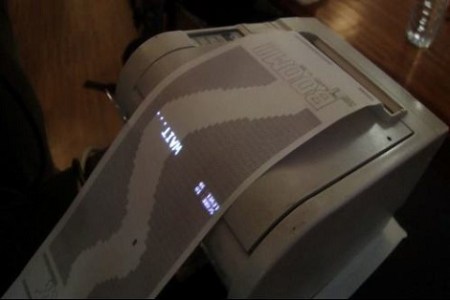
[Joshua Nobel] and the team at undef came up with a receipt printer game for the OFFF 2011 festival in Barcelona.

The game is a small openFrameworks app that prints a maze on a thermal printer. A ‘car’ is guided through the maze with input taken from a DualShock 3 controller. The game is limited to a maximum distance of 50 meters, the length of the roll of paper. We wondered about the waste of paper this would be until undef pointed out, “ecologically it’s pretty much a disaster, just like any real car.”

The undef team tried to use the printer for the entire visual representation of the game but that didn’t quite work out until [Joshua Noble] came up with a ‘beamer’ to project the car and score onto the paper. We’re not quite sure what the ‘beamer’ is, but everything syncs up and the resulting game is quite nice.

The game itself reminds us of a certain flash game, but that can’t be where the original idea came from. Check out the Receipt Racer gameplay video after the break.

Continue reading “Receipt Racer Wastes A Lot Of Paper”

Arduinos…. In…. Spaaaaaace…..

Since 2007, [Adam Kemp] has been leading a team of students from Thomas Jefferson High School, guiding them through the process of designing and building a small satellite that NASA selected for launch early next year.

The CubeSat, officially named TJ³Sat, uses commercial, off-the-shelf components for nearly all its systems. The team ran into a problem interfacing the FM430 Flight Module (PDF warning), so [Adam] designed an Arduino-based replacement. Based on an ATMEGA328, the entire board is a drop-in replacement for the FM430 Flight Module. On July 1st, the TJ³Sat will begin testing at Orbital Sciences Corp. to make sure the entire satellite is up to snuff.

The TJ³Sat’s payload will take data from the ground controllers and using a TextSpeak module convert serial data into spoken voice. This audio will then be transmitted over amateur radio frequencies and will be picked up by hams all over the world. We’d like to wish the students at Thomas Jefferson High a hearty congratulations for being the first High School to build a satellite and hope the testing and launch go as planned.

Modding A Car Charger To A Variable Power Supply

For an upcoming road trip, [Patrick] needed a small variable power supply. Instead of lugging around a bench supply, [Patrick] did the sensible thing and reverse engineered a cell phone charger to fit his requirements.

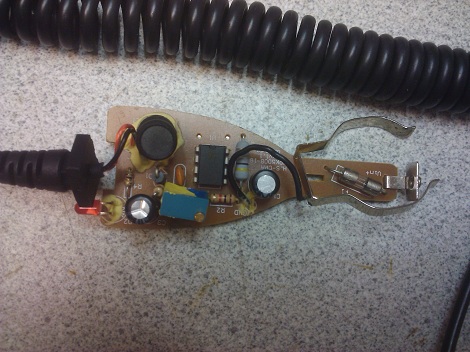
After cracking open an old Kyocera car charger, [Patrick] found a small PCB with completely labeled, all through-hole components – excellent reverse engineering potential. After finding an On Semi MC33063 IC, [Patrick] tore through the datasheets, generated a netlist, and developed a schematic that closely resembled the reference schematic given by the datasheets.

With all the grunt work done, [Patrick] set out to finish what he started – modifying the charger to output 3-10 Volts. After replacing a resistor with a 5k multiturn pot, [Patrick] was left with a power supply with a variable output from 2.8 to 8.8 Volts. Not exactly what was desired, but more than enough for the application at hand. While this hack isn’t a disco floor, it’s a great walkthough of the hacking process – building or modifying something to suit a need.

Homebrew TTL Logic Computer

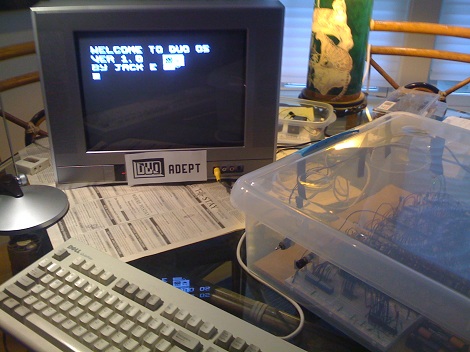
Although [Jack] just graduated High School and doesn’t have much experience with electronics, that didn’t stop him from building the DUO Adept, a homebrew computer built entirely out of TTL logic chips.

The DUO Adept has 64k of memory, 6K of which is dedicated to the video ram that outputs a 240×208 black and white image onto a TV. Bootstrapping the computer to it’s current state was quite a challenge, as an entire OS was put into th system one bit at a time though DIP switches. After the OS was written to the computer, [Jack] was able to connect a keyboard and started programming. [Jack] programmed a hex editor and a few games of his own design. If all that wasn’t impressive enough, [Jack] also programmed an assembly compiler and emulator for his homebrew system.

We’ve seen a a few homebrew computersbefore, but not many of them are laid out on 17 breadboards like the DUO Adept. With skills like these, we can’t wait to see what [Jack] comes up with next. Check out the video after the break for a walk-through of the build.

Continue reading “Homebrew TTL Logic Computer”