Rescuing Surplus Blinkenlights

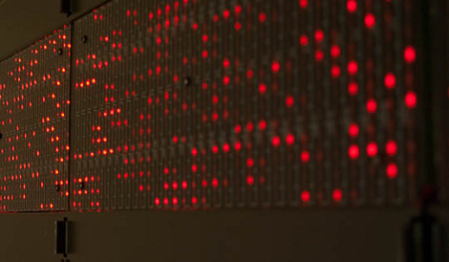
Because surplus LED panels from an early 1990s supercomputer is a completely reasonable thing to own, [William Dillon] set to work displaying them on his wall.

The LED panels came from a surplus CM-5 Connection Machine, best known from it’s role as the mainframe in Jurassic Park (only an empty case with LED panels were used in the movie). When not on Isla Nublar, the Connection Machine was a fabulous piece of engineering from the 1980s Artificial Intelligence revival. With some machines having 65,536 processors, it was used for AI research using Lisp (although we were never very good at Lisp.

[William] built a wooden frame out of 1×2 inch maple and installed an X10 module behind the panels as a remote switch. The panels themselves aren’t controlled by a computer, so the only thing left to do was to mount the power supplies. It’s impressive to see the massively over-engineered power supplies that were designed to source 5V @ 30A when the panels only draw 7 Amps. [William] says it was a design feature of the Connection Machine to spare no expense.

[William]’s next plan is to reverse engineer the panels to display custom messages, and we can’t wait to see what he comes up with. We can’t explain why, but we really want to build one of these panels. Check out the pictures of [William] decommissioning the CM-5.
A Suitcase For All Your Wardriving Needs

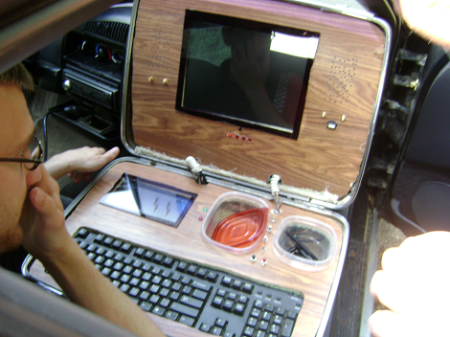
[Corrosion] sent in a tip about the Weaponised Auditing Response System he built inside a suitcase that, “has all the tools (and then some) for a wireless assault”.

The WARS is equipped with two WiFi adapters and two bluetooth adapters for all the wardriving and bluejacking anyone could ever want. [Corrosion] also included a 4 channel, 2.4GHz video scanner for warviewing. Everything runs off of a 12 inch netbook that will eventually run linux, and we’re really liking the 1970s suitcase aesthetic the WARS has – it looks like [Corrosion] is about to step into the set of a Beastie Boys video.

We were wondering about including a long range RFID sniffing antenna (PDF warning) behind the monitor of the suitcase’s monitor and asked [Corrosion] about it. He said it sounded doable, but is out of funds at the moment, so if you know how to build a cheap RFID antenna with a 50 foot range, drop [Corrosion] a line.

There’s a video demo with some stills of the build included after the break.

Continue reading “A Suitcase For All Your Wardriving Needs”

Satellite Tracking By Shining A Laser Into Space

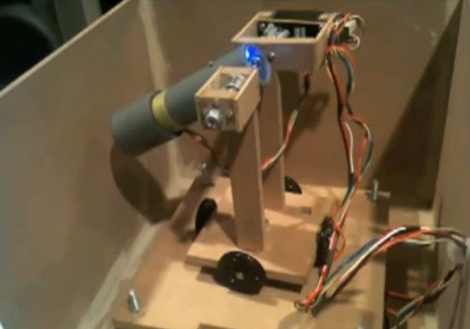
[Shingo Hisakawa] sent in a tip for a for a neat little box called the Levistone that tracks the Internation Space Station with a laser. His video log goes though all the steps for this great little project.

[Shingo] originally planned to pull orbital data down from NORAD and send that to an ArduinoBT board with ethernet, GPS and compass modules. In the original plan, the Arduino would do the orbit calculations and point the laser using a few servos. There wasn’t much success with making an Arduino do all the work, so the an Android phone stood in for the GPS, compass and connection to the web. The duty of calculating the location of the ISS using GPS and orbital elements was moved onto the Amazon EC2 cloud. The final product looks great, even if it’s impossible to record the beam for the video.

With the ability to calculate the azimuth and elevation of the ISS from any point in the world, [Shingo] came up with SightSpaceStation, a neat mashup of his data and Google Maps. There are also iOS and Android apps for a nice piece of work in augmented reality. It’s a great project that would really compliment the ISS desk lamp we covered a few days ago.

3D Printer Looks Factory Made

[Richard Sum] came up with a great looking 3D printer and put his project up as a campaign on IndieGoGo.

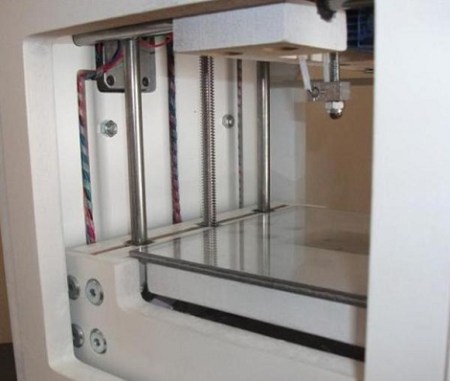
[Richard]’s ‘SUMPOD’ is based off the reprap like a lot of other 3D printers, but the SUMPOD has a look of professionalism to it; the printer looks like something that would come from a factory. We think a lot of thought went into the design and fabrication of this printer.

The specs of the machine aren’t too bad either. It’s build area is 150x150x100 mm, or nearly 2 inches than the Makerbot Thing-O-Matic. We asked [Richard] about the drive system of the machine, and he told us there is a linear bearing/belt setup for the x and y axes with a screw drive for the z axis. The electronics are standard NEMA 17 motors and reprap RAMPS fare, so everything electrical is tried and true.

[Richard] plans on adding a Dremel attachment for pcb and lithophane milling. We hope that some design files of the SUMPOD released, but in the mean time we’re really looking forward to seeing the progress of this project.

Displaying Graphics On An Oscilloscope

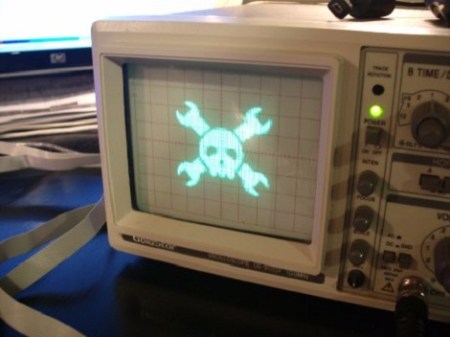
[Andrew Rossignol] was curious one day and decided that he wanted to display graphics on an oscilloscope after playing around with the X and Y inputs.

[Andrew] started out with a resistor ladder on the DAC of his AVR Butterfly. He was able to to draw a line on the oscilloscope’s screen but bandwidth limitations forced him to reconsider his approach. A friend wrote a Python script to generate C code so the ports of the Butterfly can be toggled. After getting the Butterfly to generate a voltage for every non-white pixel, [Andrew] was impressed with the results so the code was modified determine the brightness of each pixel. The setup managed 10 shades of gray and careful selection of what graphics to post on the build log assured the project a little bit of blog cred.

There are a few ways to display a picture on an oscilloscope, like plugging the Hsync and Vsync into the inputs of a scope. Except for a few music visualizations, we haven’t seen a scope display generated from a microcontroller. Great work [Andrew], but we’d like to mention there’s a grayscale Hack a Day logo from way back when.

Check out a video of [Andrew]’s oscilloscope after the break.

Continue reading “Displaying Graphics On An Oscilloscope”

Gigantic Ball-manipulating Binary Computer

The folks at Evil Mad Scientist Labs just put up a post on the giant mechanical binary computer they brought to last month’s Maker Faire.

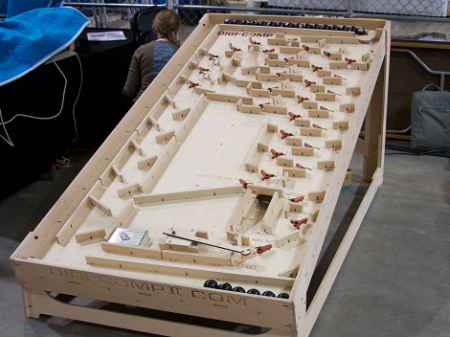
As a faithful reproduction of the Digi-Comp II from the 1960s, every operation is powered by balls falling onto levers. Unlike the original, the larger version is powered by billiard balls instead of half-inch marbles. The Digi-Comp II is able to count, add, subtract, multiply, divide, get the 1s or 2s complement and zero all of it’s bits. With a 7-bit accumulator, the Digi-Comp II is able to calculate anything where the result is less than 127, so we wouldn’t recommend doing your taxes on it. In the demo video, it took the Digi-Comp II about two minutes and twenty seconds to multiply 3 by 13. We’re not going to venture a guess on the equivalent seconds per cycle for an electronic calculator, but it’s an impressive build

The Digi-Comp II is a great way to show the process of binary arithmetic in a computer and we were wondering why there aren’t any educational toys like the Digi-Comp II out today. A site linked from the build page tells us there will be kits available this summer, we’re hoping the kit doesn’t fill the bed of a pickup truck.

Check out the video after the break for the multiplication demo.

Continue reading “Gigantic Ball-manipulating Binary Computer”

ISS Lamp Tells You When To Look Up

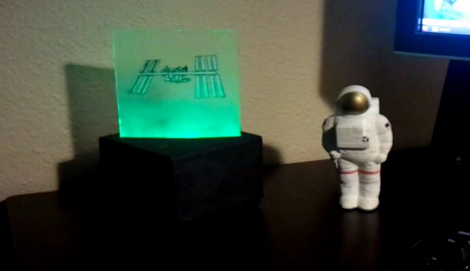
[Nathan Bergey] came up with a really neat desk lamp that provides a visualization of when the International Space Station is overhead.

The lamp uses a Teensy board to light a few LEDs on the edge of a piece of plexiglass. Because the orbit of the ISS decays over time, the time that overhead passes will occur is unpredictable after a few months. A stand-alone satellite tracking lamp will eventually lose it’s accuracy, so [Nathan] needed to parse tracking data the internet. Since he couldn’t find an API to track the ISS, [Nathan] wrote a Python script to parse the data he found on Heavens Above. Everything on the computer runs in the Gnome panel and is passed to the Teensy over the USB connection. [Nathan] posted all of the code is posted on github.

It’s a really great build that provides a reminder that there are people in space, and we think this would be a great way to provide some notification of upcoming Iridium flares, or when it’s most likely to pick up some APRS packets.

Check out [Nathan]’s demo of his ISS lamp after the break.

Continue reading “ISS Lamp Tells You When To Look Up”